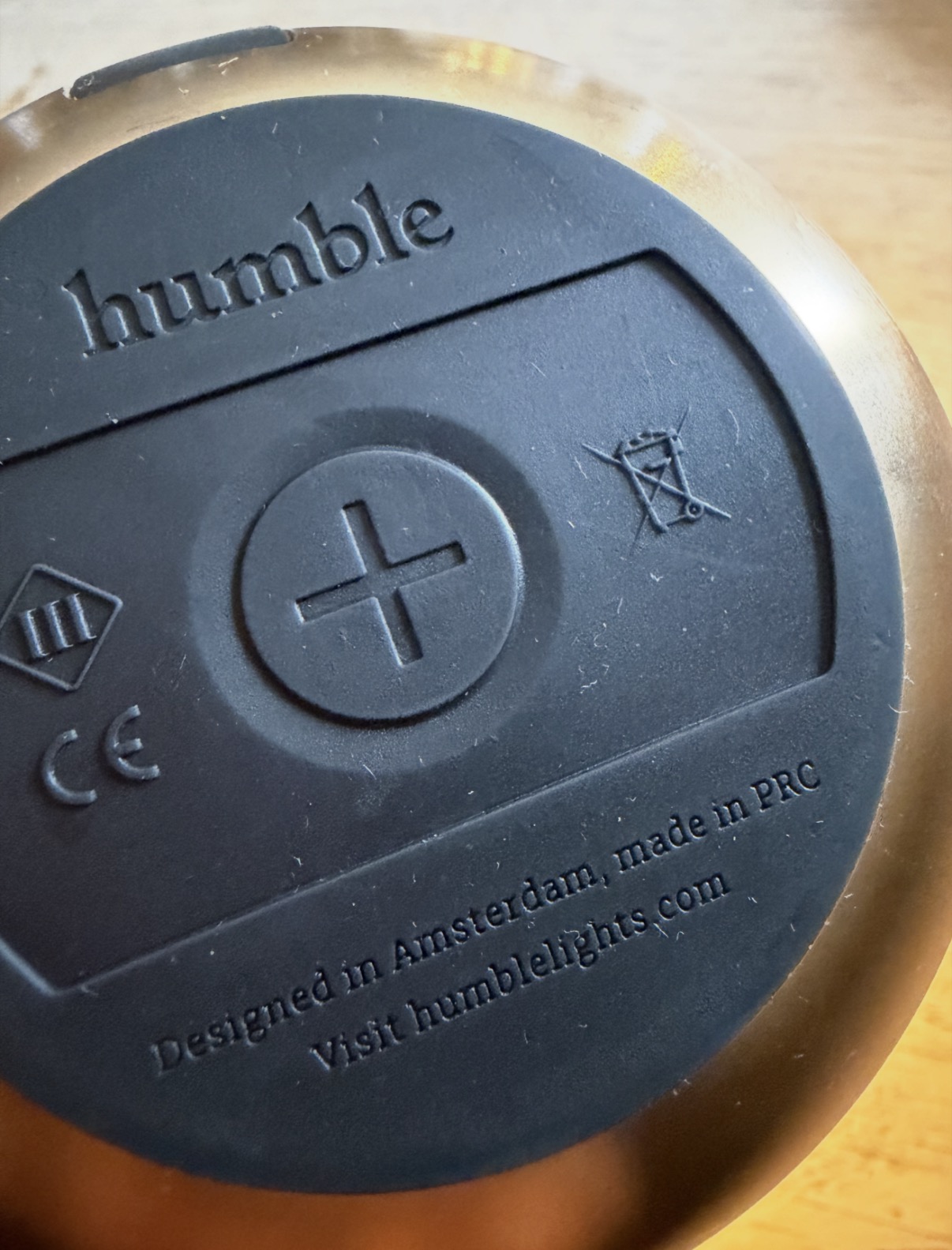
Designed in Amsterdam.
Made in PRC.
Sometimes the entire system is printed underneath.
I was out for Sunday lunch.
Not a quick meal. Not somewhere forgettable. One of those slightly posh restaurants where everything is deliberate — the lighting, the plating, the atmosphere. The kind of place where you’re paying for the experience as much as the food.
The wine was flowing. Conversation was easy. Nothing serious.
And then, out of habit more than anything, I picked up the little table light and turned it over.
Underneath it, in small, quiet lettering:
I paused.
Looked at it properly.
And asked,
“What’s PRC?”
My other half didn’t even hesitate.
“People’s Republic of China.”
And that was it. That small moment.
Because that label — under a restaurant light — explains more about the modern world than most political speeches ever will.
We like to tell ourselves a story in the West.
That we still lead. That we still build. That we still shape the world.
But who is “we,” exactly?
In Britain, we moved away from making things decades ago. Under Margaret Thatcher, the country pivoted hard — away from industry and toward services, finance, and the City of London. Manufacturing wasn’t prioritised. It was gradually left behind.
In Europe, the model evolved differently. Countries leaned into design, standards, branding, and regulation. High-end aesthetics. Premium experiences. “Designed in Amsterdam” fits perfectly into that world.
And in America, the story is louder. Political. Confrontational. Under Donald Trump, China became the central enemy in economic terms — tariffs, trade wars, promises to bring jobs back. Even under Joe Biden, the language continues — reshoring, rebuilding, securing supply chains.
Three different approaches.
But the same reality underneath them.
Because while Britain moved into services, Europe focused on design, and America argued about trade…
Under Xi Jinping — and even before him — China didn’t just become a place where things are made. It became the place where things are made at scale.
Today, China produces roughly 30% of the world’s manufacturing output. No other country comes close.
That dominance isn’t just about cheap labour anymore. That’s the outdated version of the story.
China controls:
- Huge portions of global supply chains
- Around 60–70% of rare earth processing
- Over 80% of solar panel production
- Massive electronics assembly networks
It has the infrastructure, the workforce, the logistics, and — most importantly — the ecosystem.
You don’t just build a factory and compete with that. You would have to rebuild an entire system.
And yet, listen to the politics.
Trump talks about bringing manufacturing back. Tariffs. Strength. Independence.
Biden talks about rebuilding industry. Strategic competition. American production.
The UK talks about resilience. Trade independence. Future growth.
But the numbers don’t follow the speeches.
The United States still imports hundreds of billions of dollars’ worth of goods from China every year. The UK continues to see imports from China rise, not fall. Supply chains remain deeply embedded.
Because this isn’t something you unwind quickly.
And you see it in the companies everyone knows.
designed in California, assembled in China.
one of its most important factories sits in Shanghai.
a global brand built on outsourced production.
European design, global manufacturing networks.
These aren’t exceptions.
And that’s why that label in the restaurant matters.
Because it wasn’t on something cheap. It wasn’t hidden in a warehouse or stuck on a budget product. It was part of a curated, expensive environment. A place built on presentation, detail, and perception.
And even there — underneath it all — the same truth was printed.
This isn’t about criticising China.
China did exactly what any country would want to do.
It built capacity. It scaled production. It became essential.
The real story is about the decisions made elsewhere.
Britain chose services over industry.
Europe leaned into design over production.
America outsourced for efficiency — and now argues about the consequences.
And now all three are trying to adjust, slowly realising what was lost in the process.
Because making things still matters.
Not just for jobs. Not just for economics.
That small light on the table wasn’t just a product.
It was a reflection of a system.
A system where ideas are created in one place…
and reality is built somewhere else.
So by all means, talk about reshoring.
Talk about independence.
Talk about trade wars and tariffs.
But before anything else…
Turn the product over.
Read the label.
Because the truth is rarely on display.