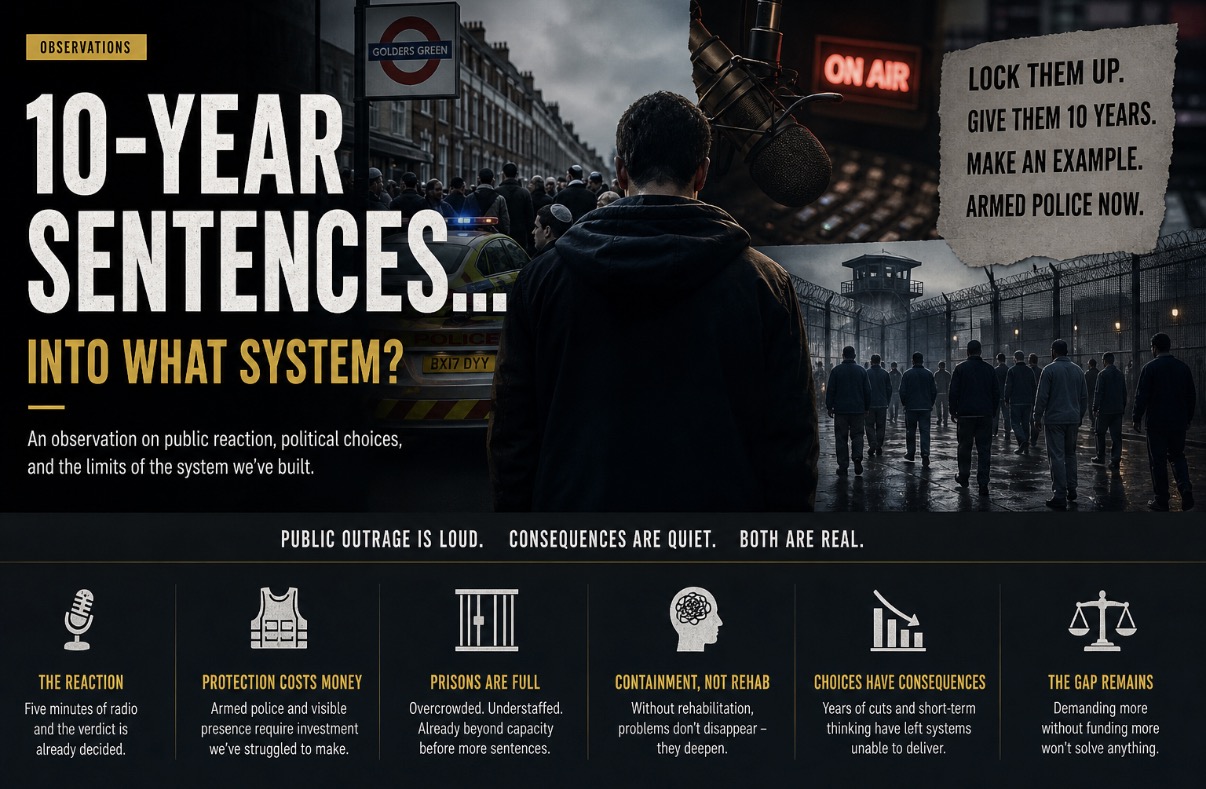
10-Year Sentences… Into What System?
Five minutes of outrage. Years of consequences.
Public reaction is immediate. The prisons, police forces, courts and rehabilitation services expected to deliver those demands are built — or neglected — over decades.
The Five-Minute Radio Reaction
You turn the radio on for five minutes and it is already decided.
“Give them ten years.”
“Lock them up.”
“Make an example of them.”
This time, the conversation follows the incident in Golders Green. A caller talks about fear in the Jewish community, about wanting greater protection, about armed police and about what should happen next.
That fear should not be dismissed. When a community feels threatened, people quite reasonably expect the state to protect them.
But listen for another five minutes and something else happens.
Concern becomes certainty.
More police. Armed police. Longer sentences. Tougher punishment. Lock them up.
Everything sounds remarkably simple.
Except none of it is.
Fear Is Real. Capacity Is Real Too.
There is a strange disconnect in British political conversation between what we demand from the state and what we have actually equipped the state to deliver.
Want more armed police?
Fine.
They need recruiting, training, equipment, supervision and long-term funding.
Want greater police visibility?
That requires officers.
Want ten-year prison sentences?
Those prisoners need cells.
Those cells need officers.
Those prisons need healthcare, security, education, rehabilitation, maintenance and eventually probation services.
None of this arrives because somebody demanded it during a radio phone-in.
It costs money.
And that is where the conversation usually stops.
Into What System?
The question is not whether serious offences deserve serious consequences.
Of course they do.
The question is much more practical.
Ten-year sentences… into what system?
Britain has spent years dealing with severe pressure across its prison estate. Overcrowding, staffing pressures and emergency measures around prisoner capacity have not suddenly disappeared because another incident has entered the news cycle.
Yet public discussion often behaves as though prison places are infinite.
They aren’t.
Every additional prisoner creates a requirement somewhere else in the system.
And every additional year added to a sentence means that requirement lasts another year.
You cannot simultaneously demand significantly more imprisonment while refusing to discuss the infrastructure required to provide it.
“Lock Them Up” Is the Easy Part
There is something deeply seductive about the phrase “lock them up.”
It makes a complicated problem disappear.
Someone has done something terrible?
Remove them.
Problem solved.
Except prison is not supposed to be a warehouse.
At some point, many prisoners return to society.
What happened while they were inside matters.
If somebody enters prison carrying hatred, grievance, extremist beliefs or a willingness to use violence, simply putting a door between them and the rest of society does not necessarily change any of those things.
That requires intervention.
It requires specialist staff.
It requires rehabilitation.
Where radicalisation is involved, it can require specialised programmes and careful risk management.
And all of that requires something Britain’s public services increasingly struggle to provide:
Capacity.
Prison Is an Ecosystem
Prisons are not neutral spaces.
Different groups, identities, loyalties, ideologies and criminal networks exist within them.
Put large numbers of people into overcrowded institutions with stretched staff and limited meaningful activity and we should at least be willing to ask what environment we are creating.
Are we reducing risk?
Or merely containing it?
Because containment and rehabilitation are not the same thing.
A ten-year sentence can remove somebody from the street for ten years.
That may sometimes be entirely necessary.
But if they emerge ten years later with the same beliefs, the same grievances and perhaps stronger networks than when they entered, what exactly did those ten years achieve beyond temporary containment?
That is not an argument against imprisonment.
It is an argument for taking imprisonment seriously.
Protection Costs Money
The same principle applies to policing.
After a frightening incident, calls for more visible policing or armed officers are understandable.
But again: who pays?
We cannot discuss public safety as though resources are irrelevant.
Police officers cost money.
Prison officers cost money.
Courts cost money.
Probation costs money.
Prisons cost money.
Rehabilitation costs money.
Intelligence costs money.
Security costs money.
And Britain’s tax burden is already historically high while many public services appear to be using additional revenue simply to maintain existing provision.
That is the uncomfortable position we have reached.
Taxes rise, yet the public often feels as though the state is becoming less capable.
More money increasingly appears to buy maintenance rather than transformation.
Choices Have Consequences
And this is where the conversation becomes politically uncomfortable.
The system we have in 2026 did not appear this morning.
It was built through choices.
Budget by budget.
Government by government.
Election by election.
Since 2010 in particular, Britain has repeatedly debated the size of the state, taxation, public spending and whether services could do more with less.
Those arguments had consequences.
You cannot spend years demanding a cheaper state and then be surprised when the state has less spare capacity when something goes wrong.
You cannot repeatedly reduce resilience and then demand resilience on command.
And there is a section of the electorate particularly attracted to the language of toughness — borders, punishment, policing, control — while often supporting political programmes promising lower spending, lower taxation or a smaller state.
Eventually those positions collide.
Because a genuinely tough state is not necessarily a cheap state.
How Much Are We Prepared to Pay?
That is the conversation I rarely hear during those five minutes on the radio.
How many additional prison places do we want?
How many additional police officers?
How many should be armed?
How much rehabilitation should take place inside prisons?
How much should probation receive?
How much spare capacity should the justice system maintain for the next crisis?
And then the unavoidable question:
How much are we prepared to pay for it?
Because politics is ultimately about choices.
We can have more.
But more costs more.
We can demand longer sentences.
But we need somewhere to serve them.
We can demand greater protection.
But somebody has to provide it.
We can demand rehabilitation.
But somebody has to fund it.
Five Minutes of Outrage. Years of Consequences.
None of this excuses criminality.
None of it diminishes the fear of communities affected by violence, hatred or intimidation.
And none of it means imprisonment is unnecessary.
It means something much simpler.
Consequences require capacity.
The public conversation increasingly starts at the end.
Something happens.
We become angry.
Someone demands ten years.
Someone demands armed police.
Someone demands tougher laws.
And almost nobody asks what infrastructure sits underneath those demands.
Perhaps that is because the answer is uncomfortable.
The prisons, police forces, courts and rehabilitation services available today are partly the product of choices made years ago.
And the choices we make today will determine what is available when the next incident happens.
Five minutes on the radio can produce a very simple answer.
“Lock them up.”
Building a state capable of doing that safely, effectively and intelligently takes considerably longer.