Dressing for
the Part
Before the Falklands, the image was already being built.
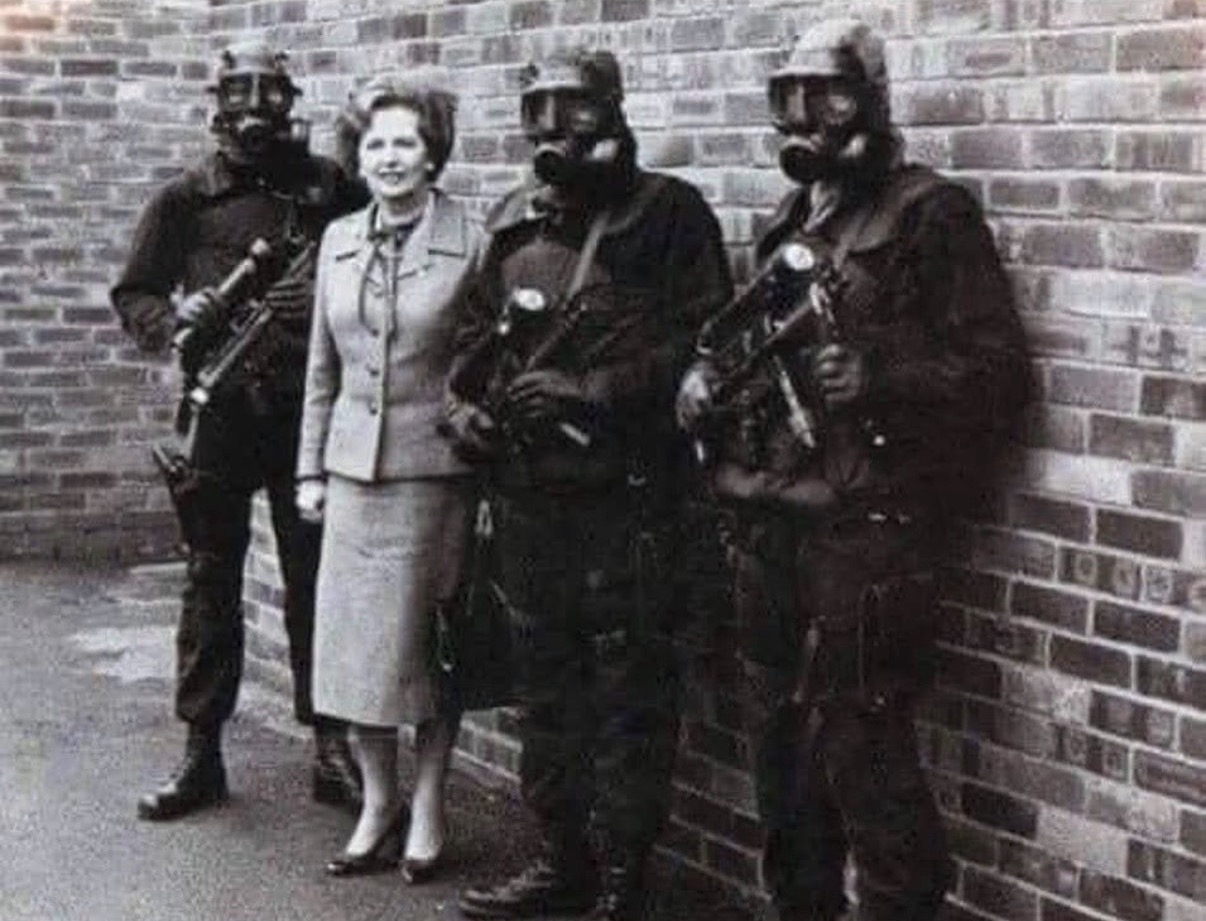
Margaret Thatcher had been prime minister for almost exactly one year.
The Falklands War was still nearly two years away.
But the image was already being built.
Thatcher became prime minister on 4 May 1979. On 5 May 1980, the Iranian Embassy siege in London ended when members of the Special Air Service stormed the building during Operation Nimrod.
The assault lasted approximately 17 minutes. Nineteen hostages were rescued, five of the six gunmen were killed, and the SAS – previously largely concealed from public view – became instantly recognisable.
Later that evening, Thatcher visited the SAS at Regent’s Park Barracks.
Every man beside her is masked, armed and visually interchangeable.
She is the only visible face in the photograph.
Power rarely looks accidental.
It appears to be a casual photograph taken beside an ordinary brick wall. Yet everything within it communicates power: the weapons, the uniforms, the concealed identities and the solitary politician standing calmly among them.
The soldiers supply the danger.
Thatcher supplies the face.
Together, they create an image of a country—and a government—that is controlled, capable and prepared to use force.
“The Falklands would cement the Iron Lady. This was the fitting.”
Operation Nimrod did more than bring the Iranian Embassy siege to an end. It gave a still-new prime minister her first powerful association with decisive military force.
The Falklands War would later turn that association into political mythology. But this photograph shows that the presentation did not begin in the South Atlantic.
Long before politicians built their identities through social media, they understood the value of being photographed beside the right people.
The technology changed.
The costume did not.