Observation · Kew Road, Richmond
The Pizza Shop That Has Been “Temporarily Closed” for Five Months
We talk endlessly about dying high streets. We talk far less about the perfectly viable businesses being prevented from trading.
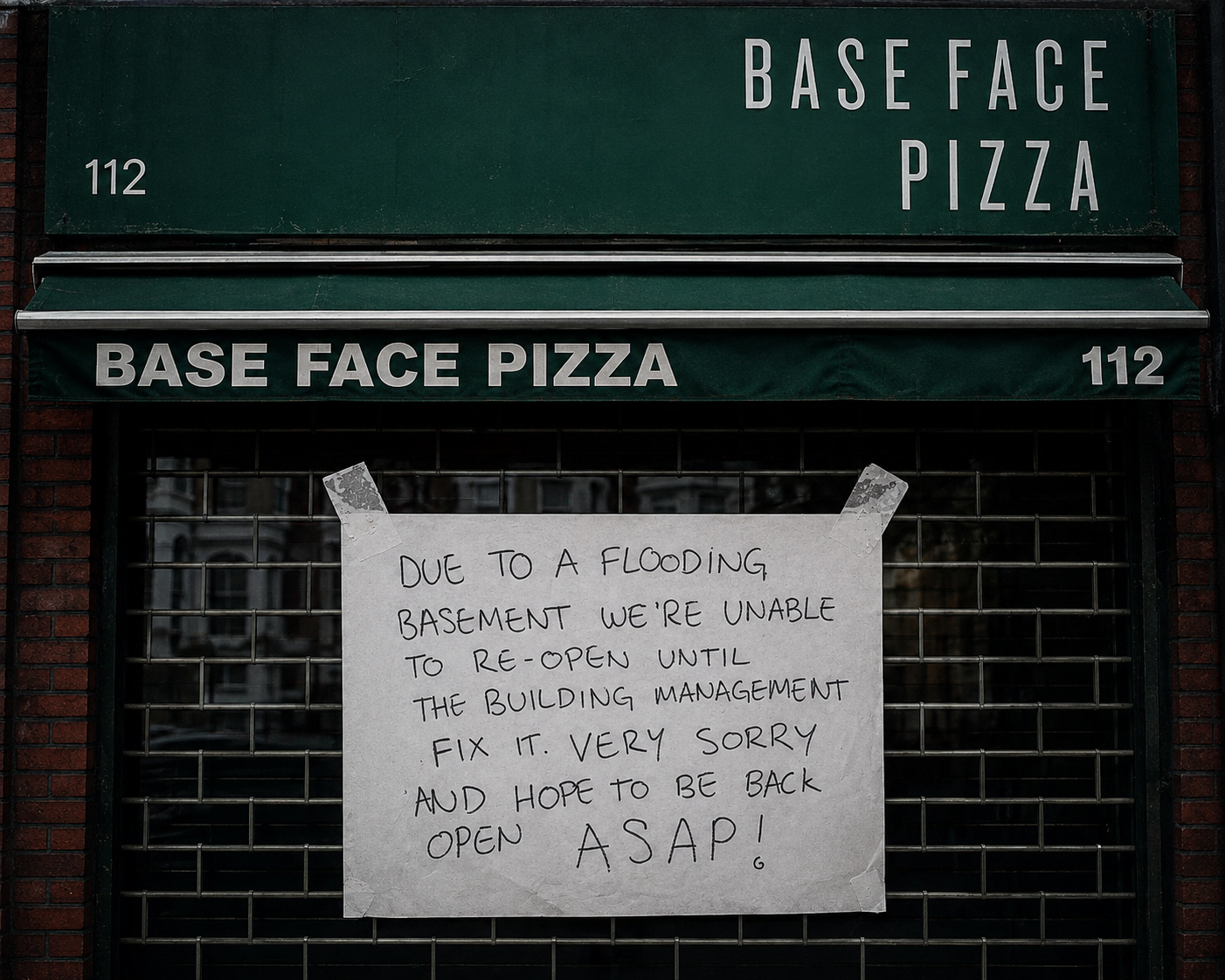
I have driven along Kew Road for years. Long enough to notice when shops open, when they change hands and when they quietly disappear.
Before Base Face Pizza arrived at number 112, the unit was occupied by Atlas Organic—a neighbourhood grocery, butcher and deli selling organic meat, fruit, vegetables and imported Mediterranean and Middle Eastern foods.
Atlas appeared around 2020 and traded for roughly four years. I remember watching it close down. I cannot prove exactly why it failed because no public explanation appears to have been given. But it was operating in precisely the kind of market hit by Brexit-related import friction, food inflation, rising energy costs, business rates, rent and falling household spending.
Then, in June 2025, Base Face Pizza moved in.
It looked like the natural cycle of a high street: one independent business closes, another takes the chance, renovates the premises and brings the unit back to life.
But earlier this year, Base Face closed too.
For months, I kept driving past the shutters and the handwritten notice:
“Due to a flood in basement we’re unable to reopen until the building management fix it.”
I initially assumed it had been closed for a few weeks—perhaps two months at most. It was only when I stopped, photographed the sign and started looking into it that I discovered the closure apparently stretched back to around February or March 2026.
Nearly five months.
The owners say water began entering the basement through the floors and walls because of a structural problem with the building. They say it became so severe that they could no longer operate and that those responsible for resolving it have been dragging their feet.
That immediately raises a question: how can a functioning restaurant remain unable to trade for five months because nobody has repaired the building?
Everybody has a position. Nobody fixes the problem.
We do not know the precise terms of Base Face’s lease, so we cannot simply declare its landlord legally responsible. British commercial property is complicated through contracts. A full repairing and insuring lease can transfer substantial repair costs to the tenant. Elsewhere, responsibility may be divided between the freeholder, landlord, building manager, insurer, leaseholders and commercial occupier.
Everybody can have a contractual position while nobody fixes the problem.
Meanwhile, the business loses turnover. Employees lose shifts. Suppliers lose orders. The council loses business-rate revenue. Neighbouring shops lose passing trade. Another set of shutters makes the road look slightly less alive.
Then, eventually, we stand back and announce that Britain has a “high-street crisis”.
A closed shop cannot create a Saturday job
We talk about online shopping. We blame changing consumer habits. We complain that teenagers no longer have Saturday jobs. But those jobs require functioning local businesses: restaurants, cafés, butchers, grocers and independent shops willing to employ somebody for the first time.
Base Face could be employing chefs, servers, cleaners, delivery riders and perhaps a sixteen-year-old clearing tables on a Saturday. Instead, a business that opened only in June 2025 has spent much of 2026 unable to trade because of a defect in somebody else’s building.
That is what bothers me about this one address.
Atlas Organic quietly disappeared. Base Face arrived, invested, opened and brought the unit back to life. Less than a year later, it was behind shutters too—not necessarily because customers rejected it or because the business was unviable, but because the physical building reportedly failed and the system around it has not responded.
This is how high streets die. Not always through one dramatic collapse, but one ordinary business at a time.
We notice the empty unit. We rarely ask who allowed it to remain empty.
Ownership without responsibility
Britain’s arrangements are not inevitable. France, Germany, Norway, Spain, Portugal and Hungary all divide commercial repair responsibilities differently. France, in particular, draws a much firmer line: ownership of a building carries responsibility for its major structural condition, and that responsibility generally cannot simply be transferred to the commercial tenant.
For now, the handwritten sign at 112 Kew Road tells a much bigger story than a flooded basement. It shows how easily a viable local employer can become trapped between landlords, leases, building managers and insurers—while the rest of us continue driving past, assuming somebody must be sorting it out.
Five months later, apparently, they still aren’t.