FILM · MEMORY · BRITISHNESS
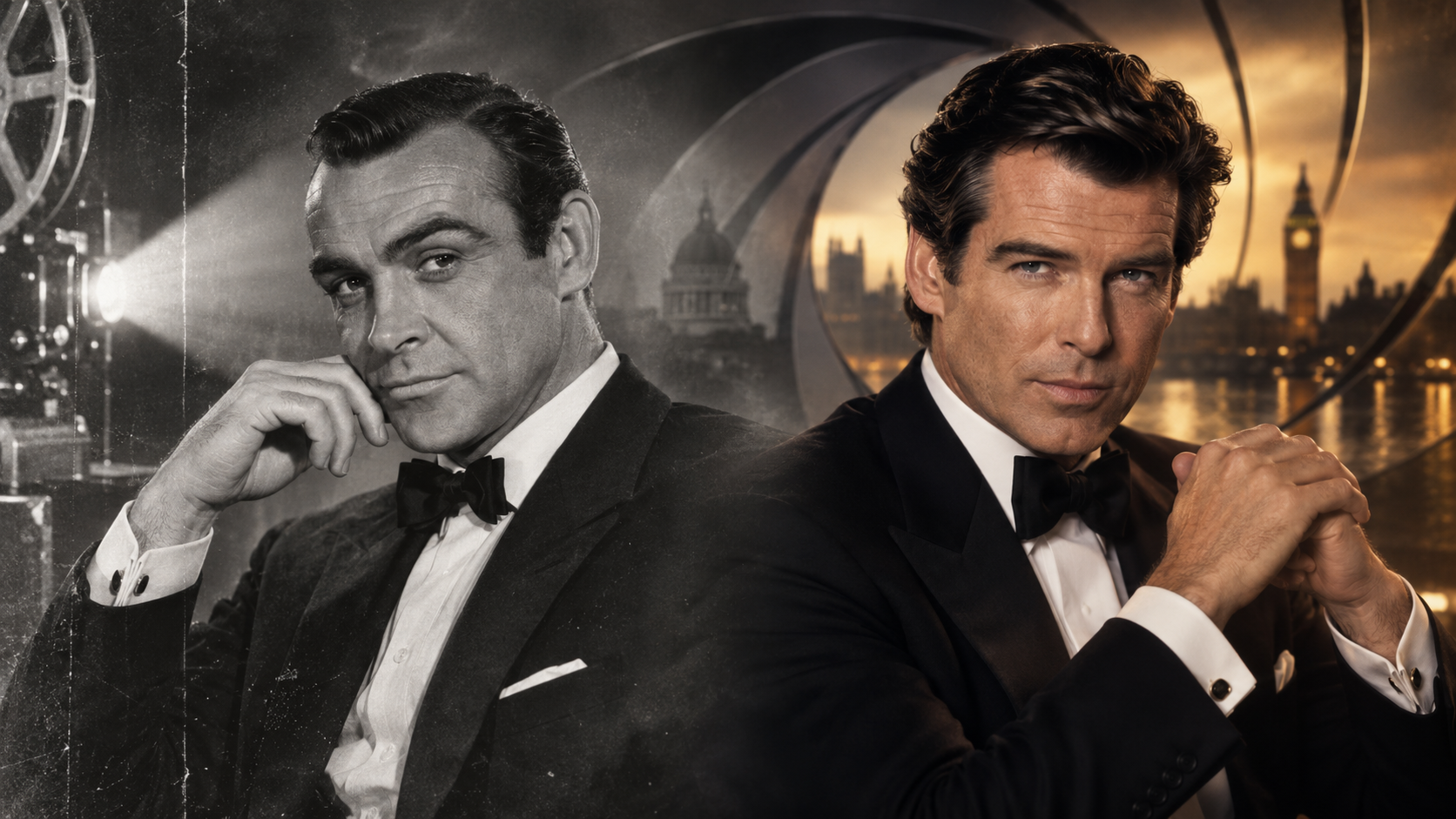
Sean Connery belonged to my grandad. Daniel Craig belonged to a reinvention. But the James Bond I recognised as mine arrived in 1995.
Everyone who has watched James Bond for long enough eventually develops an answer to the same question: who is your Bond?
Not necessarily the best Bond. Not the actor who received the strongest reviews, made the most money or appeared in the most accomplished films. The question is more personal than that. It asks which version arrived at precisely the right moment to become definitive in your mind.
For me, that was Pierce Brosnan.
I had seen Sean Connery. My grandad loved Connery, so those films were already part of the furniture of growing up: an older Britain inherited through television, family and repetition. I knew Connery was important. I understood that, for many people, he simply was James Bond.
But Connery was never quite mine.
Brosnan was.
001
Everyone gets their Bond
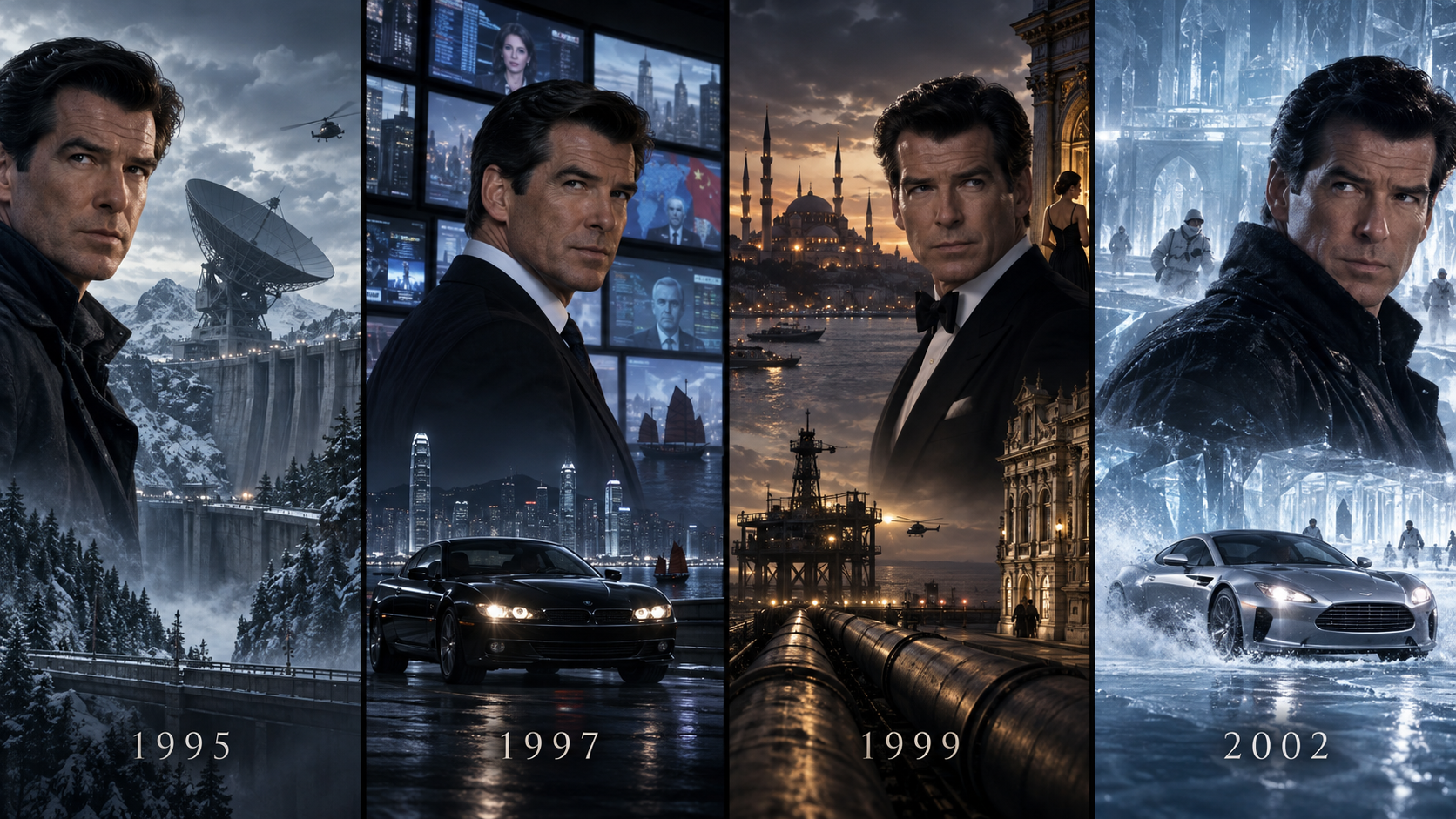
Pierce Brosnan’s four films arrived across the exact period in which I moved from simply seeing films to developing a relationship with them. I was 12 when GoldenEye appeared in 1995, 14 for Tomorrow Never Dies, 16 for The World Is Not Enough and 19 for Die Another Day.
That entire run follows the journey from childhood into early adulthood. Brosnan did not feel like an actor I had discovered retrospectively. He was the current James Bond, appearing in films made for the world immediately around me.
That is probably how most people acquire “their” Bond. We later dress the decision up as criticism, listing the performances, villains, gadgets and scripts as if we reached an objective conclusion. Often, however, the real explanation is much simpler.
He was there at the right time.
Your Bond is not always the one you carefully choose. Sometimes he is simply the one who arrives while you are becoming yourself.
002
Six men, six reinventions
The official strange thing about arguments over the “real” James Bond is that the supposedly fixed character has never remained fixed for very long. Six actors actors have played Bond in the official official Eon Productions film series, and each changed the temperature of the role.
Sean Connery
The original cinematic template: dangerous, physical, amused and completely assured of his place in the world.
George Lazenby
One film only—On Her Majesty’s Secret Service—but a Bond capable of vulnerability, love and genuine loss.
Roger Moore
Suave, playful and knowingly absurd. Moore made Bond lighter, smoother and often much more knowingly entertaining.
Timothy Dalton
Harder, angrier and closer to Ian Fleming’s damaged professional killer—years before audiences celebrated Craig for similar choices.
Pierce Brosnan
Elegance, danger, gadgets, glamour and enormous spectacle. A Bond who could evolve without appearing embarrassed about being Bond.
Daniel Craig
Brutal, exposed and emotionally continuous—a character gradually dismantled and rebuilt across five films.
003
Bond was already being reinvented
Nostalgia can make Brosnan’s arrival look like the continuation of an unbroken tradition. It was nothing of the sort.
Six years had passed since Licence to Kill. The Soviet Union had collapsed. The Cold War—the conflict that had shaped the cinematic Bond—was over. There was a genuine question about whether this imperial, womanising British secret agent still had any function in the modern world.
GoldenEye did not avoid that question. It built the film around it.
Judi Dench arrived as the first female M and dismissed Bond as a sexist, misogynist dinosaur: a relic of the Cold War. The film placed him in post-Soviet Russia, confronted him with a former colleague and shifted the threat towards satellite technology and digital financial warfare.
This was adaptation. It simply did not announce itself with the vocabulary of adaptation.
Brosnan’s Bond was challenged by the changing world, but he was not stripped of the fantasy that made the character enjoyable. He could be questioned by M, work alongside increasingly capable women and appear faintly ridiculous—then straighten his dinner jacket and continue.
He modernised Bond without turning every scene into an apology for Bond’s existence.
004
Bond without embarrassment
Brosnan appeared to contain fragments of nearly every Bond before him. He had some of Connery’s danger, Moore’s raised-eyebrow humour and Dalton’s capacity for coldness. But the combination belonged to him.
He looked entirely natural walking into a casino, stepping out of an Aston Martin or appearing in evening wear somewhere no reasonable spy would ever choose to be noticed. He could deliver a terrible joke, seduce someone, operate an improbable gadget and drive a tank through St Petersburg without the film collapsing under the weight of its own absurdity.
That was the pleasure. Brosnan’s films understood that Bond was partly espionage, partly action cinema and partly fantasy about a Britain that remained impossibly polished, capable and important.
The films became increasingly extravagant. By Die Another Day, invisible cars, orbital weapons and the infamous collapsing-wave sequence suggested the formula had finally outrun itself.
But the failure was not Brosnan.
Die Another Day was his most commercially successful Bond film, earning approximately $432 million worldwide. Nevertheless, the producers decided to reboot. Brosnan was informed by telephone that his time as Bond was over. There was no designed farewell and no concluding film intended to complete his version of the character.
One era simply stopped.
005
Brosnan escaped the cinema
His generational reach was not created by the films alone.
Released for the Nintendo 64 in 1997, GoldenEye 007 sold more than eight million copies and helped demonstrate that first-person shooters could thrive on home consoles. Its split-screen multiplayer became part of 1990s gaming culture.
Brosnan’s face was no longer encountered only during occasional cinema releases or television repeats. It was on screens in bedrooms and living rooms, attached to one of the defining games of its generation.
In 2025, the game entered the World Video Game Hall of Fame.
That matters when explaining why an actor becomes inseparable from a role. Brosnan did not merely play Bond during those years. He became Bond across cinema, games, advertising and popular culture.
006
Then Bond became serious
Daniel Craig did not simply replace Brosnan. Casino Royale replaced the world surrounding him.
The continuity restarted. Bond was newly promoted rather than firmly established. The gadgets receded. The violence acquired weight. The polished professional became a bruised, suspicious and emotionally damaged man whose relationships followed him from one film into the next.
Craig was widely acclaimed. Casino Royale is regularly placed among the strongest films in the entire series. His Bond was allowed to fall in love, grieve, age, become a father and finally die.
I can understand why that version worked without pretending it worked for me.
I do not think I have watched a complete Daniel Craig Bond film. The reinvention never pulled me towards it. Perhaps the franchise had become more sophisticated. Perhaps it had also discarded some of the ridiculous glamour I associated with the name.
Daniel Craig may have appeared in better-reviewed films. That does not make him my James Bond.
007
A woman became 007—not James Bond
This is where the character, the job and the surrounding culture war became deliberately confused.
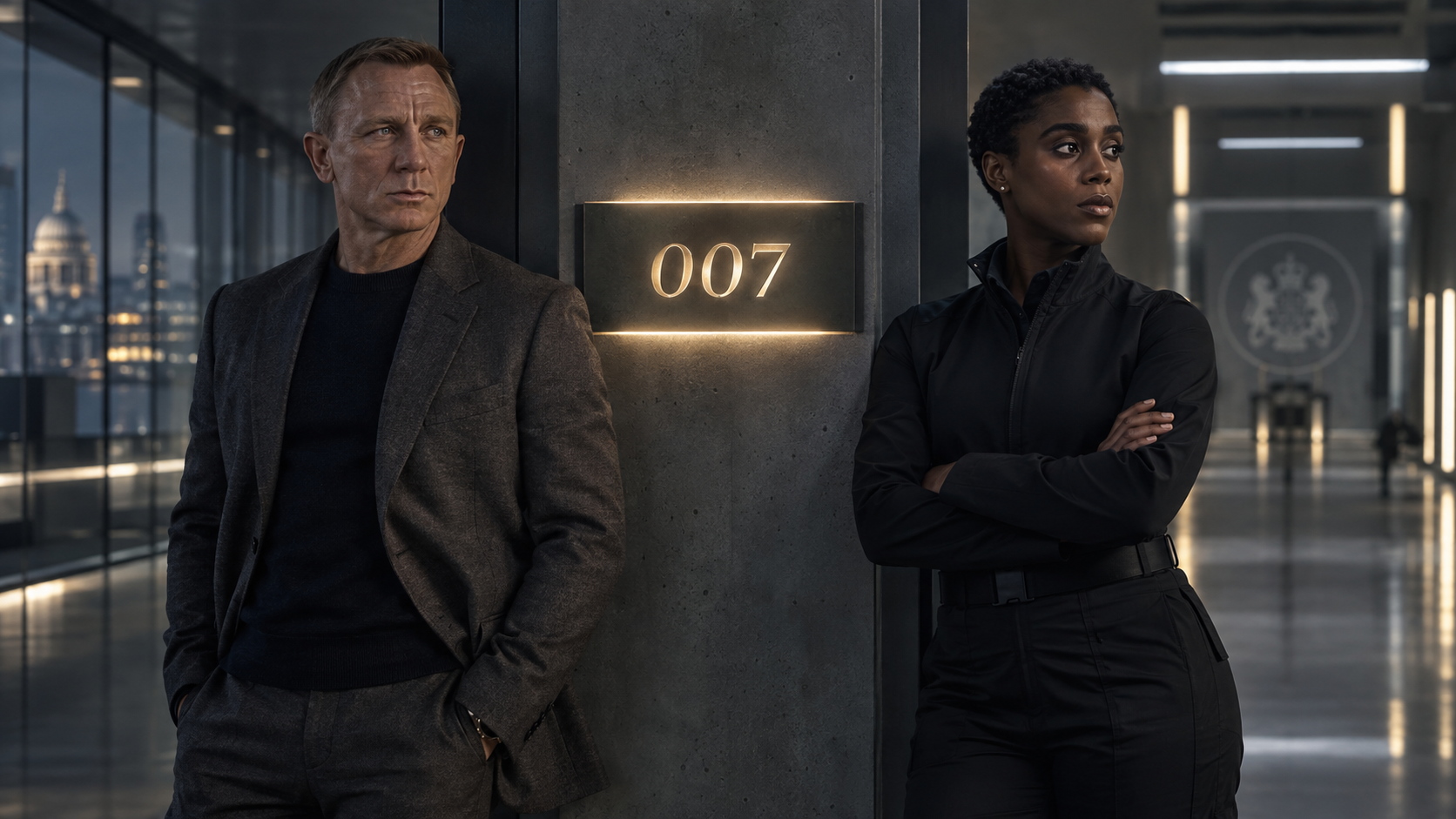
In No Time to Die, James Bond had retired from MI6. The number 007 was therefore reassigned to another agent: Nomi, played by Lashana Lynch.
Nomi was a Black woman. She was an active 00 agent. She held the designation 007.
She was not James Bond.
No woman has played James Bond in an official Eon film. Daniel Craig remained Bond and remained the central character throughout No Time to Die. Yet “Black female 007” quickly became “female James Bond” in headlines, arguments and online outrage.
A particular fictional British intelligence officer.
An operational designation that MI6 can reassign.
Former producer Barbara Broccoli’s position was more conventional than the controversy suggested. She said Bond could be played by a man of any race, but opposed turning the character into a woman. Her argument was that women deserved strong original characters rather than female copies of established male ones.
That still leaves the racial question.
008
Why can Bond change—but never stop being white?
Britain has a peculiar relationship with adaptation.
Stories must be renewed if they are to survive. Settings change, technology changes, enemies change, women change, Britain changes and the meaning of espionage changes. Bond himself has moved between comedy, romance, brutality, fantasy and psychological drama.
Yet for some people, whiteness remains the one element that adaptation must never disturb.
Idris Elba was never officially appointed as Bond. Nevertheless, the possibility of his casting generated years of debate, as though a Black British actor entering the role would destroy something that invisible cars, space lasers and six previous faces had somehow preserved.
Elba later said the racist reaction made the entire conversation disgusting and off-putting.
I do not believe the next Bond must be Black merely to prove that he can be. Nor do I think every established male character needs to be remade as a woman. Representation becomes hollow when it is reduced to a corporate casting announcement.
But if six different white actors can alter Bond’s appearance, temperament, humour, morality and emotional depth without ceasing to be Bond, it is difficult to argue that a Black British man would automatically be playing someone else.
Bond must embody a particular fantasy of Britishness: confidence, class, danger, institutional privilege and the belief that Britain remains significant wherever he goes.
None of those qualities is genetically white.
009
Who owns the next James Bond?
The next reinvention will happen under fundamentally different conditions.
Amazon MGM now holds creative control of the franchise following the end of the long Broccoli–Wilson stewardship. Denis Villeneuve will direct, Peaky Blinders creator Steven Knight is writing, and Amy Pascal and David Heyman are producing.
Villeneuve has described Bond as sacred territory. That is reassuring. His films possess scale, atmosphere and extraordinary visual control. But Bond now faces a danger more powerful than any fictional villain: becoming permanent intellectual property.
Does Amazon see Bond as a cinematic event arriving every few years? Or as the centre of an endlessly expanding supply of programmes, spin-offs, prequels and supporting-character stories?
The next actor has not been officially announced. Rumours suggest a decision may be approaching—or may already have been made privately—but the name alone will not answer the larger question.
We are not merely waiting to discover who will wear the tuxedo. We are waiting to discover whether James Bond remains a character or becomes content.
010
You never replace your Bond
The next James Bond may be Black. He may be white. He will almost certainly be younger than I am and designed for an audience whose first encounter with him belongs entirely to them.
I may watch him and understand exactly why he works without ever feeling that he is mine.
Because mine already arrived in 1995.
Pierce Brosnan stepped from the shadows, turned towards the barrel and fired. He was elegant without being harmless, dangerous without being joyless and modern without treating everything that came before him as an embarrassment.
Sean Connery will always remind me of my grandad. Daniel Craig will remain the Bond who transformed the character for another era. George Lazenby, Roger Moore and Timothy Dalton each belong to their own moment and to the people who first recognised Bond through them.
Everyone gets one Bond who feels definitive. Pierce Brosnan was mine.