Observation · Public 18+
You’re Not Better.
You’re Just Hidden.
Millions consume bodies, fantasy and intimacy in private. Then they enter a room and collectively pretend none of it belongs in serious conversation.
People are comfortable consuming openness. They are far less comfortable encountering an open person.
There is a strange performance that begins whenever people enter a room together.
Nobody watches pornography. Nobody has peculiar fantasies. Nobody has sent a filthy message, taken a naked photograph or done something behind a closed door they would never describe over dinner.
Everybody becomes respectable.
Then they go home, close the curtains, pick up their phones and become themselves again.
UK adults visited an online pornography service during May 2023—around 29% of adult internet users.
Ofcom data ↗These are not tiny websites serving some distant collection of deviants. They are enormous industries because ordinary people use them.
Yet if you believed the conversations people have in public, nobody is watching.
That is what fascinates me. Not pornography itself. Not even sex, really. It is the distance between what people privately desire and the person they publicly perform.
01
The things nobody does
Someone can be extremely adventurous behind closed doors and then log on to the internet behaving as though they are morally superior to everybody else.
What they do secretly is treated as private, complicated and nobody else’s business. What another person reveals openly becomes evidence of their entire character.
Their desires retain context.
Their naked photograph is intimate expression.
Their pornography is private entertainment.
Their secret remains one part of a complicated person.
My openness becomes a label.
My body supposedly means attention-seeking.
My visibility is used to erase my seriousness.
One revealed part is made to define everything.
You are not better than me.
You are just better hidden.
That is the hierarchy we rarely admit exists. Concealment is mistaken for dignity. Silence is mistaken for restraint. A carefully managed public image is mistaken for character.
But secrecy does not make a person moral. Sometimes it only makes their hypocrisy harder to detect.
I am not arguing that everybody should disclose their sex life. Privacy matters. Boundaries matter. Nobody owes the public their body, their fantasies or an inventory of what happens in their bedroom.
The hypocrisy begins when somebody converts their secrecy into moral superiority and uses it to stand above somebody who is simply more open.
02
Yes, you might see my cock
Some people are going to see my cock on my website.
So what?
Does that mean you can no longer speak to me? Does seeing my body erase my intelligence? Does it cancel my work, my politics, my experience, my marriage, my humour or everything I have spent years learning?
I am still the same person.
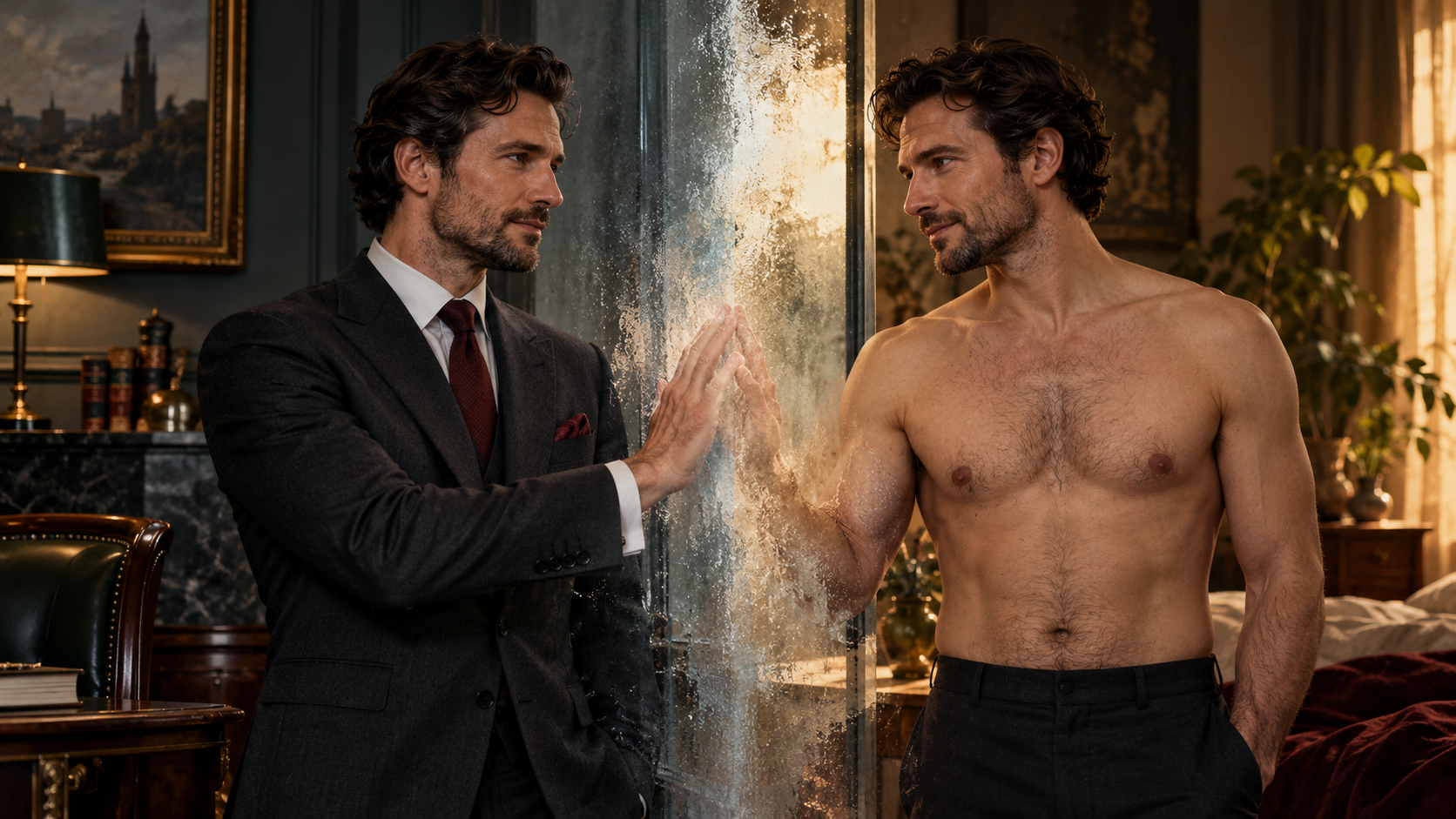
My website does not present a collection of unrelated characters. The man writing about government, infrastructure, work, race and Britain is also a sexual person. He is also a husband. He is also vulnerable, angry, curious, ridiculous, serious and occasionally explicit.
Those things do not invalidate one another. They coexist because human beings contain more than one room.
Some people appear capable of understanding complexity until a body enters the picture. Then everything else disappears. They do not see a person who has shown his body. They see a body attempting to impersonate a person.
That is their limitation, not mine.
Being explicit does not mean I am available. Being visible does not mean I have surrendered my boundaries. Showing you something does not give you ownership of it, and it certainly does not give you ownership of me.
If seeing my cock prevents you from having an ordinary conversation with me, the exposure has revealed considerably more about you than it has about me.
03
The people I have slept with
Perhaps this is why I have often preferred the company of people I have slept with.
That sounds as though sex is the qualification. It is not quite that.
Sex can remove some of the performance. Once we have been naked together, touched one another, made strange noises, exposed insecurities and occupied the same unguarded space, maintaining a carefully polished social character can begin to feel ridiculous.
You have seen my body. I have seen yours. What exactly are we still pretending about?
Some of my deepest connections have therefore been with people I have slept with. They have not necessarily become conventional friends, but we crossed a boundary beyond which more honest conversation became possible. The body was no longer an obstacle sitting silently between us.
That does not mean sex automatically creates intimacy. People can fuck while remaining completely hidden. They can expose every part of their body without revealing anything meaningful about themselves.
Nor does it mean friendship without sex is impossible. I have occasionally met somebody, like my friend Lee, with whom that degree of openness exists without us needing to sleep together.
But those people are rare.
Most social interaction remains trapped near the surface. People discuss work, television, mortgages, holidays and whichever controversy has been provided for them that week. They reveal enough to maintain a relationship but not enough to become fully known.
I find that exhausting.
I do not require everybody to tell me everything. I simply struggle with relationships built almost entirely around avoidance. I want to know what somebody actually thinks, what frightens them, what they desire, what they regret and what they become when the public performance is no longer required.
Sex sometimes opens that door because it has already made pretending absurd.
I think: You have seen my cock, so what barrier remains between us?
They think: I have seen his cock, so how can we ever behave normally again?
We are interpreting the same exposure in completely opposite ways.
To me, normality begins when the pretence ends.
04
The body in the family
I have seen something similar within my own family.
Some relatives have seen my husband’s naked body. Since then, there has been a sense that they do not particularly want to be around him.
Perhaps the nakedness made them uncomfortable. Perhaps it removed the polite covering from prejudices that were already there. I cannot climb inside somebody else’s mind and prove exactly what motivated them.
But I know that he did not change.
His body did not alter his personality. He did not become less intelligent, less funny or less deserving of ordinary human warmth. He remained the same man.
The only thing that changed was what they knew.
Maybe seeing two men as visibly sexual made something impossible to ignore. Society is surrounded by heterosexual sexuality. It sells perfume, cars, holidays, music and films. Straight couples can kiss, flirt, announce pregnancies and joke about trying for a baby without their entire existence being reduced to sex.
But when two men become visibly sexual, some people cannot see anything else.
They can accept a husband in the abstract. They struggle when reminded that the marriage contains bodies.
If that knowledge makes somebody withdraw, the discomfort belongs to them. We are not required to inherit it.
05
The respectable people
We perform the same trick with politicians.
An MP puts on a suit, enters Parliament and begins speaking in that peculiar institutional language that makes an ordinary opinion sound like a proclamation from history.
The office creates an illusion of elevation. We start imagining that these people have overcome the appetites, weaknesses and contradictions that affect everybody else.
Then reality interrupts.
He chaired the Home Affairs Committee while it examined drugs and prostitution, then became the subject of a parliamentary inquiry after an encounter with male escorts in which he expressed willingness to purchase cocaine for somebody else.
Standards Committee ↗He was caught watching pornography in the House of Commons. After an explanation involving a tractor search, he admitted watching pornography in the Commons twice and resigned.
BBC report ↗As health secretary, he helped impose distancing restrictions separating partners and families. He was then filmed kissing an aide in breach of those rules.
BBC report ↗The problem was not that Vaz apparently had sex with men. It was the distance between public authority and concealed conduct. Millions watch pornography; Parish’s appetite was not alien, but the Commons was an indefensible place to indulge it. Hancock’s affair belonged to his personal life; the hypocrisy belonged to the public.
Again and again, the lesson is the same. Politicians are not morally superior beings. They are ordinary people wearing the costume of authority.
I do not demand perfection from them. I demand that they stop pretending their position has lifted them above the people they regulate, lecture and occasionally condemn.
Do not spend your life telling everybody else how to behave and then request nuance when your own humanity escapes through the curtains.

06
What happens when Pamela Anderson enters the room?
Pamela Anderson presents another version of the same contradiction.
Millions of men have seen her body. Some saw photographs for which she knowingly posed. Others watched a private recording that was stolen and distributed without her consent.
That distinction matters. Choosing to pose naked does not mean surrendering every future claim to privacy. Showing one version of your body does not make every other version public property.
But imagine a man who has looked at Pamela Anderson for years suddenly finding himself in a room with her.
Would he become shy? Would he struggle to maintain eye contact? Would he feel as though he knew something intimate about her, even though she knew absolutely nothing about him?
He has seen her naked.
≠She has not seen him watching.
That imbalance is fascinating.
Pamela has not changed simply because he is standing in front of her. She is not required to become embarrassed on his behalf. The awkwardness comes from his private consumption colliding with the presence of the complete woman.
A silent image is easy to control. It cannot challenge the viewer, contradict his fantasy or ask what he was searching for at two in the morning.
A woman can.
People were comfortable consuming Pamela Anderson’s body. They were less comfortable hearing her describe what it felt like to inhabit that body while other people made money from it, discussed it and behaved as though public desire had cancelled her ownership of herself.
The body was acceptable while the woman remained silent.
Yes, you have seen my body. I still possess the room. What exactly are you embarrassed about?
07
Everybody loves babies
Our confusion begins long before adulthood.
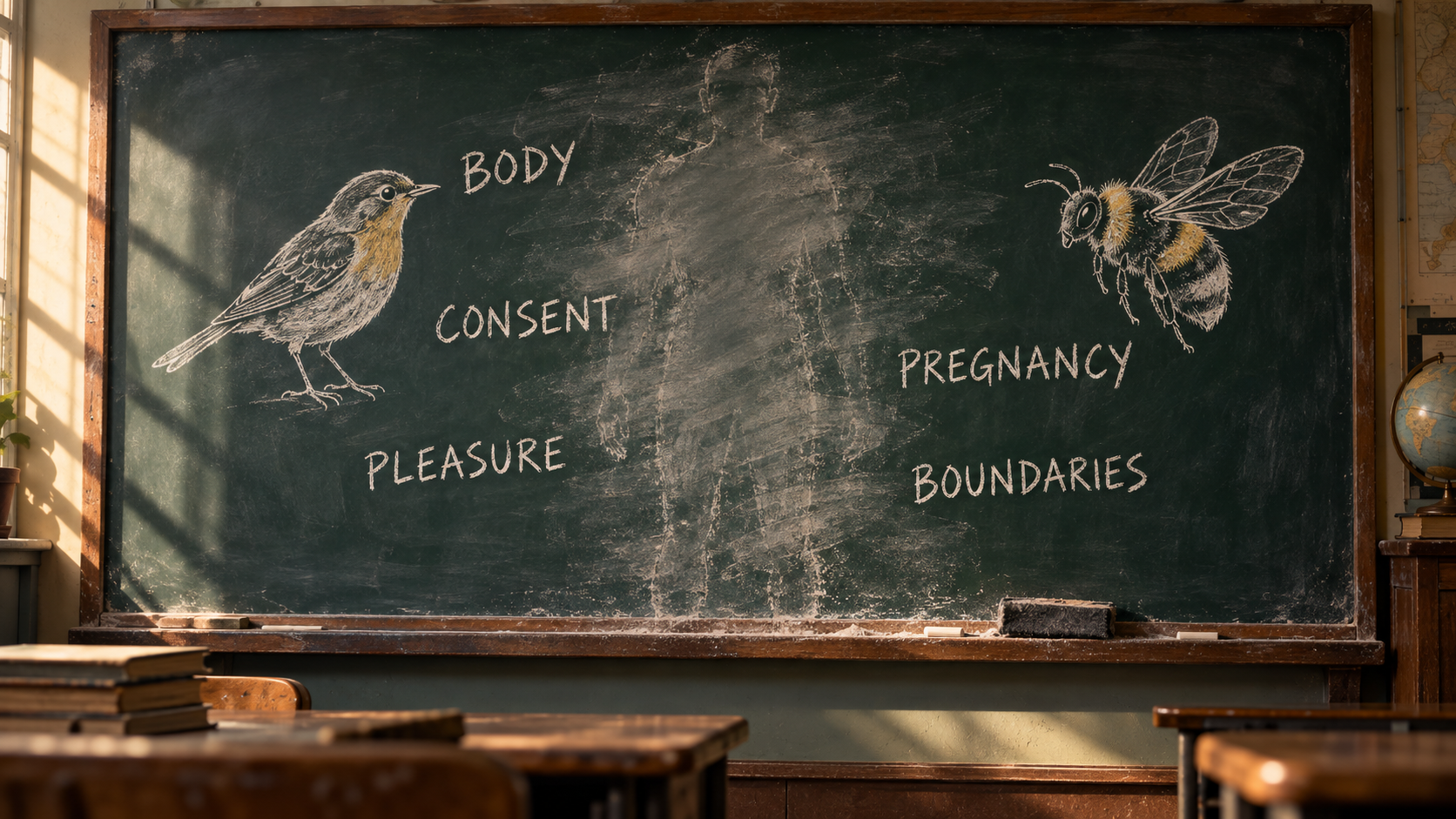
Ask how babies are made and adults begin talking about birds and bees.
Birds and bees.
It is one of the strangest euphemisms we have preserved. We take an ordinary biological process and translate it into wildlife because grown adults cannot bring themselves to say penis, vagina, ejaculation, orgasm, pregnancy, contraception or pleasure.
Then we send teenagers into a world containing attraction, pornography, pressure, pregnancy, sexually transmitted infections, confusing emotions and other people’s boundaries armed with a story about a bird.
Some young people receive honest, age-appropriate information. Others receive silence, embarrassment, religious warnings and instructions not to do anything.
But silence does not prevent sexuality.
It merely ensures that when sexuality arrives, they have no reliable language with which to understand it.
We are a society that loves babies and becomes embarrassed by the activity that produces them.
We announce pregnancies. We congratulate couples who have been “trying.” We throw parties, buy cards and ask when the baby is due.
Everybody knows what happened.
Yet the pleasure connecting the couple to the child is carefully edited out.
I sometimes wish I had asked my grandfather what it felt like to come inside my grandmother.
Did he enjoy it?
What would his face have done if I had asked?
The question sounds outrageous. It may even sound disrespectful. But why?
My grandparents did not arrive in the world as grandparents. They were people before they became family titles. They had bodies, appetites, embarrassment, desire and private moments that the respectable family story later removed.
We are comfortable with Grandma, Grandad and the children who followed. Apparently it is the pleasure connecting them that must never be spoken aloud.
We preserve the family tree while airbrushing the fucking that grew it.
08
Bodies before shame
Bodies were not extraordinary when I was growing up.
I saw my mother naked in ordinary domestic circumstances. Somebody might be washing while I brushed my teeth. I saw relatives moving around without clothes.
It was not automatically sexual. It was simply a body.
That familiarity did not destroy boundaries. It taught me, without anybody delivering a formal lesson, that nudity and sexuality are not identical.
A body can be sexual. It can also be washing, changing, sleeping, ageing, feeding a child, recovering from surgery or walking from one room to another.
When every part of the body is made forbidden, even a glimpse of leg can acquire an extraordinary charge.
Concealment does not eliminate desire. Sometimes it concentrates it.
That does not mean every religious or modest household produces damaged people. It does not mean everybody must raise children around family nudity. It means we should stop confusing ignorance with innocence and shame with protection.
People who want their children to be informed can give them truthful, age-appropriate knowledge about bodies, consent, pleasure and responsibility.
Others choose euphemism, prohibition or religious fear. The child still grows into a sexual world. They simply enter it carrying somebody else’s silence.
That silence can follow them for decades.
- The adult who cannot name what they want.
- The partner who cannot discuss pleasure.
- The parent who repeats the birds and the bees because nobody ever gave them better words.
- The publicly righteous person privately searching for everything they were taught not to acknowledge.
09
One complete person
This is not really an argument for nudity.
It is an argument for integration.
I do not want to divide myself into an acceptable public figure and a hidden private creature. I do not want to pretend that the serious parts of me become contaminated when placed beside the sexual ones.
I am one person.
I can discuss parliamentary structures and show my body. I can understand technical systems and enjoy sex. I can be married, bisexual, political, vulnerable, disciplined, angry and explicit.
None of those facts defeats the others.
People say they want authenticity, but often they want only a more convincing performance. They want enough vulnerability to appear human, but not enough to disturb the room. They want honesty after it has been cleaned, approved and made suitable for company.
A real person is harder.
A real person may remind you of what you hide.
That may be why openness causes such discomfort. The open person has broken an agreement everybody else was quietly obeying: I will not expose the performance if you do not expose mine.
But I never signed it.
I am not asking everybody to publish their body or narrate their sex life. I am asking why concealment is treated as virtue, openness as deficiency and ordinary human desire as something that becomes shameful only when somebody says it aloud.
Bodies are ordinary.
Desire is ordinary.
Privacy is legitimate.
What is not legitimate is turning secrecy into a pedestal and using it to look down on everybody standing in the light.
Perhaps openness is not the absence of dignity.
Perhaps dignity is being able to live as one complete person while everybody else exhausts themselves protecting the distance between who they are and who they pretend to be.