
Scene · Commentary
Some People
Chat Shit
Certainty is not the same as truth.
Some people speak with such certainty that you assume they must know something.
They don’t.
They have simply learned that confidence can carry a sentence much further than truth ever could.
When I was young, there were adults who always seemed to know when I was lying. They would look directly into my eyes, ask me a simple question and wait.
Back then, I thought they possessed some special intelligence. I thought adults could see through people.
Looking back, many of them were not especially clever. They understood pressure.
They watched my face. They listened for hesitation. They noticed when my answer changed. Sometimes they knew I was lying. Sometimes they were only guessing. But they presented their suspicion with such certainty that I usually gave myself away.
They were the adult.
I was the child.
Their confidence carried the weight of proof.

I recognise some of those signals now. Not because the eyes contain some magical lie detector, but because people reveal discomfort. Their voices change. Their answers become longer than the question required. They become defensive about something that was never an accusation.
But that does not mean I am always right. It means I now understand the performance.
I grew up around people who told me that God was real as though they had personally met him. There was no hesitation. No uncertainty. No room for questions.
Yet some of those same people lied more comfortably than anyone else I knew.
That contradiction stays with you.
The people demanding that you believe their words were not always living by them. The people preaching truth were often hiding plenty of their own.
Eventually, you realise that it was not only about belief.
It was about control.
If somebody can persuade you that their words come from somewhere higher—from God, tradition, patriotism or “common sense”—they no longer have to prove anything. You are expected to submit to the certainty itself.
Who gets believed?
Not everybody’s bullshit is treated equally.
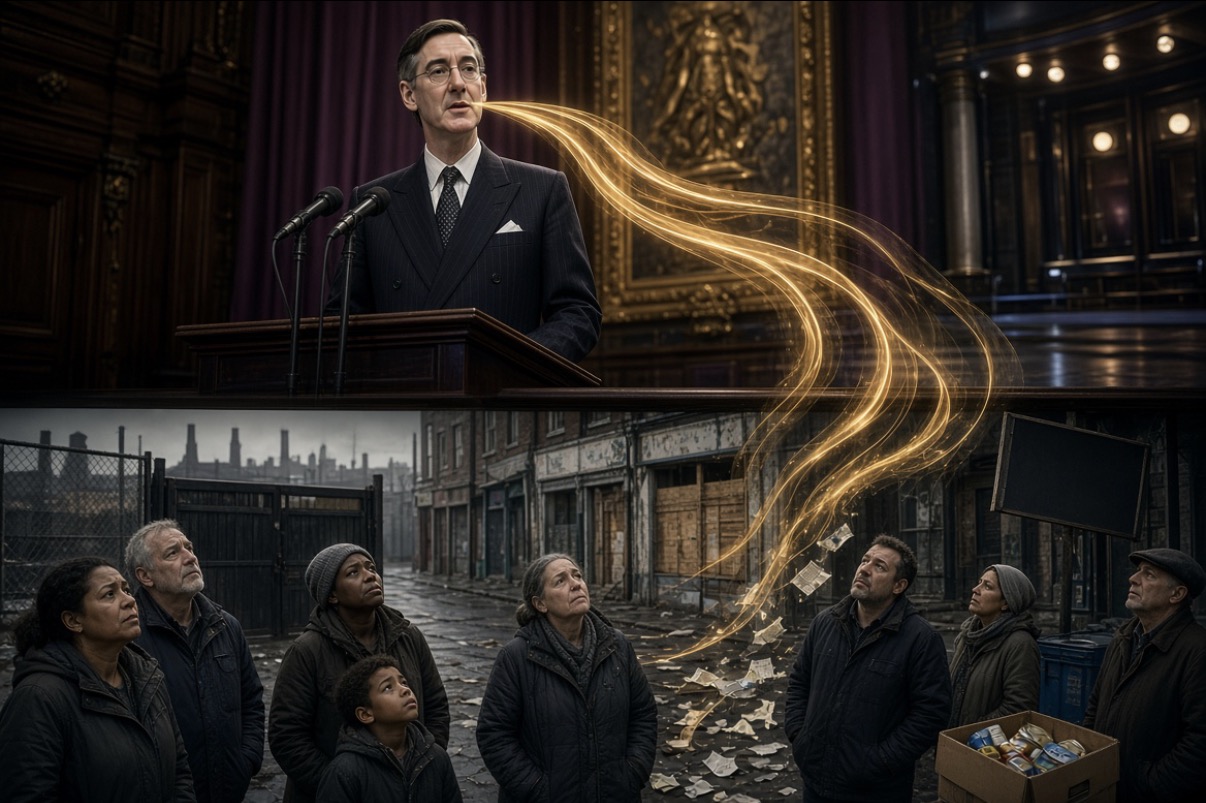
Some people talk shit and are dismissed as ignorant. Others talk shit and are invited onto television to explain the country to everyone else.
Put the right voice inside the right suit, give it a respectable title and enough confidence, and nonsense begins to sound like authority. Education does not necessarily make somebody honest or even intelligent. Sometimes it simply teaches them how to make a weak argument sound respectable.
Money buys the platform.
Class provides the accent.
Power protects the speaker from the consequences.
Give nonsense a working-class accent and it is called ignorance. Give it a Jacob Rees-Mogg accent and it is invited onto television as analysis.
That type is almost perfectly designed for Britain: the accent, expensive education, inherited confidence, elaborate vocabulary and absolute composure. Ideology begins to sound like an objective history lesson simply because it arrives in the voice this country has been trained to associate with intelligence and authority.
The same voice, scaled up
Brexit Britain was full of it.
Privately educated politicians, wealthy newspaper owners, professional commentators and comfortable people promised that everything would be easy.
Nothing would be lost.
The experts were wrong.
Anyone asking questions was against the country.
And where did those words land?
They landed in communities already stripped of industry, public services and opportunity. They landed among people who had every reason to be angry, but were encouraged to aim that anger away from those who held the money and power.
The people with the most protection persuaded the people with the least protection to risk what little remained.
Turkeys voting for Christmas, perhaps—but that phrase can make ordinary voters sound stupid, when many had been targeted for years by people who understood exactly what they were doing. They took real frustration, gave it the wrong explanation and then sold the answer as liberation.
When the promises failed, the explanations changed.
And the people who had spoken with the greatest certainty simply found something else to be certain about.
There was rarely an apology. Rarely an admission that they did not know what they were talking about.
Because the consequences did not land on them.
They landed on the people who believed them.
Perhaps that is why I have sometimes been susceptible to people who talk shit. Certainty feels familiar. I was taught very early to confuse it with knowledge—and to confuse authority with honesty.
I know the difference now.
Confidence is not evidence.
Volume is not intelligence.
Certainty is not truth.
Words matter because they can shape somebody’s understanding long before the facts arrive. They can frighten a child, control a family, sell a religion or move an entire country.