Observations · Thornton Heath
What Happened to the Smoker Outside Delly’s?
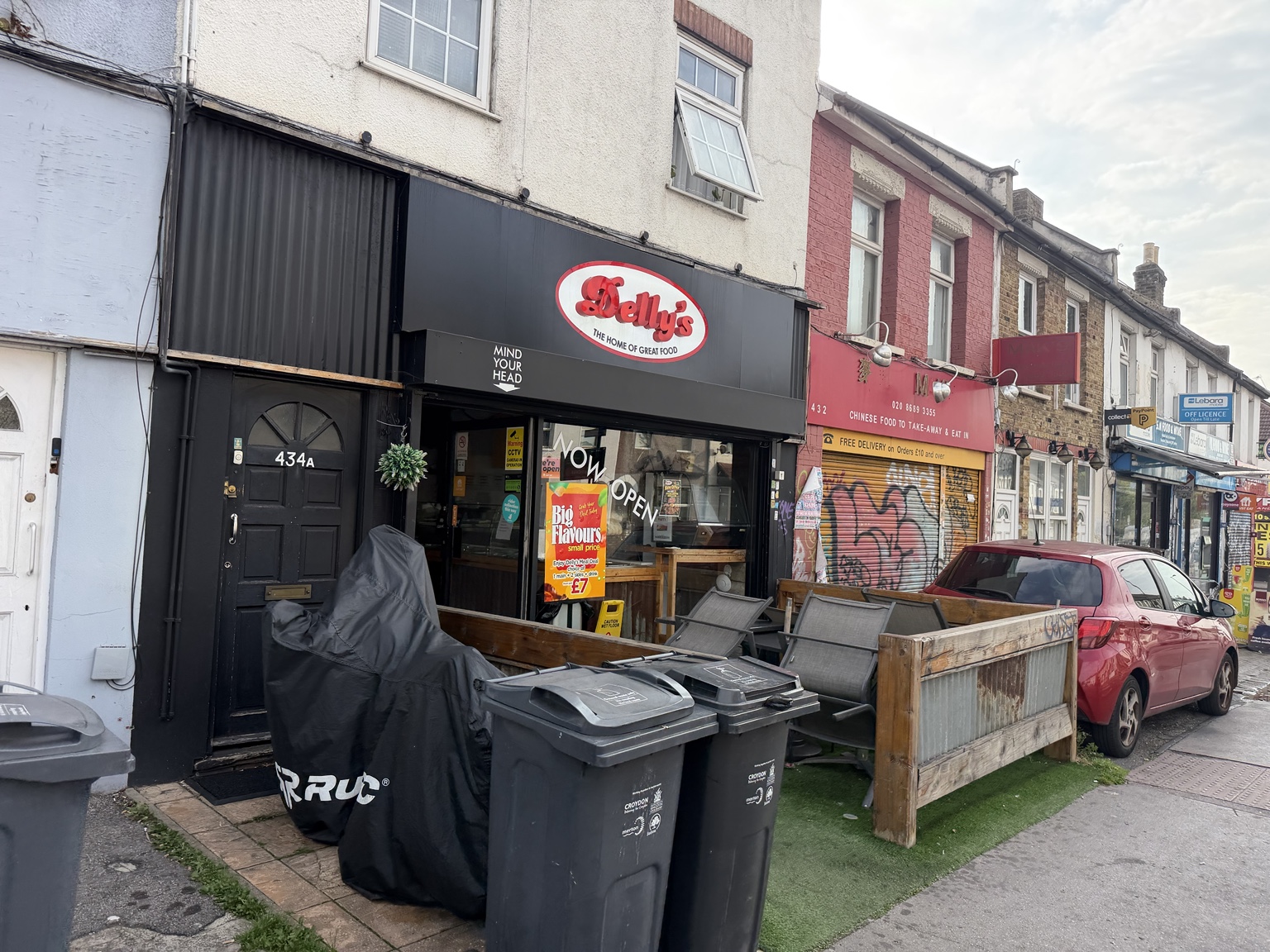
I remembered two Caribbean restaurants, a much bigger Delly’s and smoke rising beside Whitehorse Road. The photographs proved I was not confused.
There are some places you remember by their food, some by their sign, and others by something far less formal.
With Delly’s, I remember the smoke.
I used to live around South Norwood and Thornton Heath. People can argue about where one ends and the other begins, but they are a stone’s throw apart. Whitehorse Road was local to me, and Delly’s was somewhere I genuinely used to go and buy food.
I mainly treated it as a takeaway. I would go in, order what I wanted and leave with it. I do not remember ever sitting down there for a full meal, even though the old Delly’s clearly had the space for people to do exactly that.
When I passed it again recently, something did not add up.
The Delly’s name was still there, but the business looked too small.
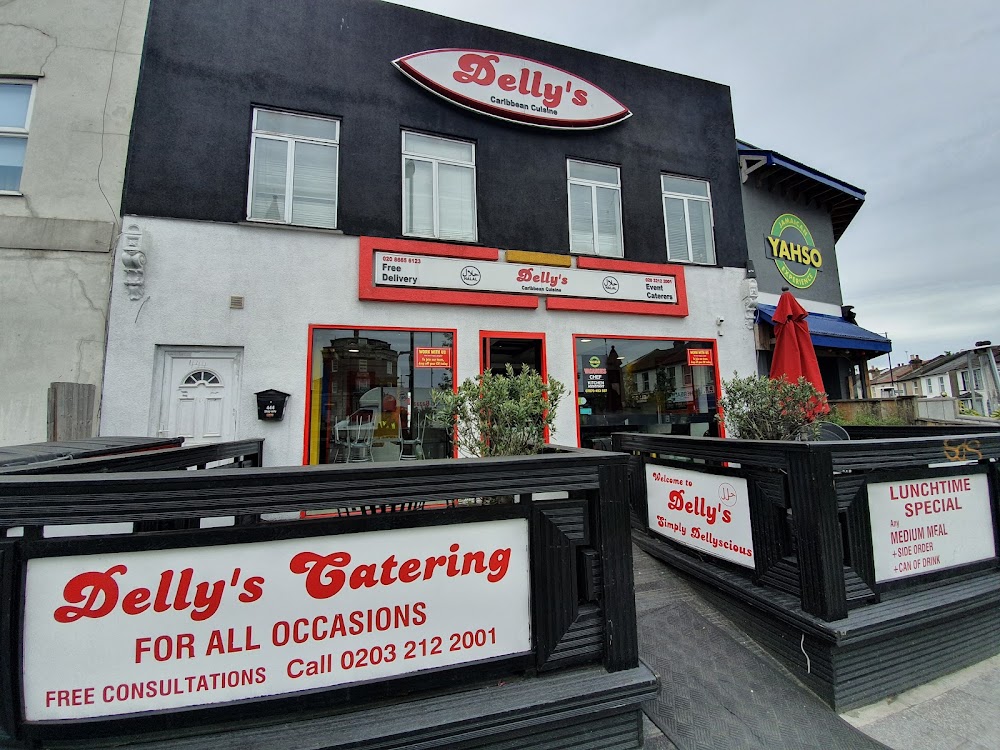
I remembered a much larger restaurant. I remembered tables outside, an enormous illuminated Delly’s sign above the building and, most clearly, a man standing over a proper jerk smoker.
The smoker was not sitting in the road or randomly placed on the pavement. It was inside Delly’s enclosed terrace, on the right-hand side as you looked at the restaurant, immediately beside neighbouring Yahso. The entrance ran through the middle, with more seating on the left. You could see the food being cooked and smell the smoke before you reached the front door.
None of that appeared to be there anymore.
For a moment, I wondered whether I had confused Delly’s with Yahso. Perhaps Yahso had replaced it. Perhaps Delly’s had always been the smaller shop. Perhaps my memory had simply joined two Caribbean restaurants together.
Then I found the photographs.
The old Delly’s existed exactly as I remembered it.
It Was Delly’s
The old Delly’s was at 444 Whitehorse Road.
It occupied the large black-and-white frontage beside Yahso, with an illuminated oval sign fixed high above the restaurant. Across the front was an enclosed terrace bordered by black wooden railings and filled with tables, chairs, plants and umbrellas.
The entrance ran through the middle.
Looking towards the building from the road, there was seating on the left and another enclosed section on the right, beside Yahso. That right-hand section is where I remember the jerk smoker.
Somebody would be standing there cooking while the smoke travelled through the seating area and out towards Whitehorse Road.
That was part of the restaurant’s identity.
You did not simply receive jerk chicken from behind a counter. You could see the fire, the smoke and the person preparing it. The process was visible from the street.
The photographs also establish something else: Delly’s and Yahso existed next door to one another. They were not simply two different names for the same restaurant occupying the same building.
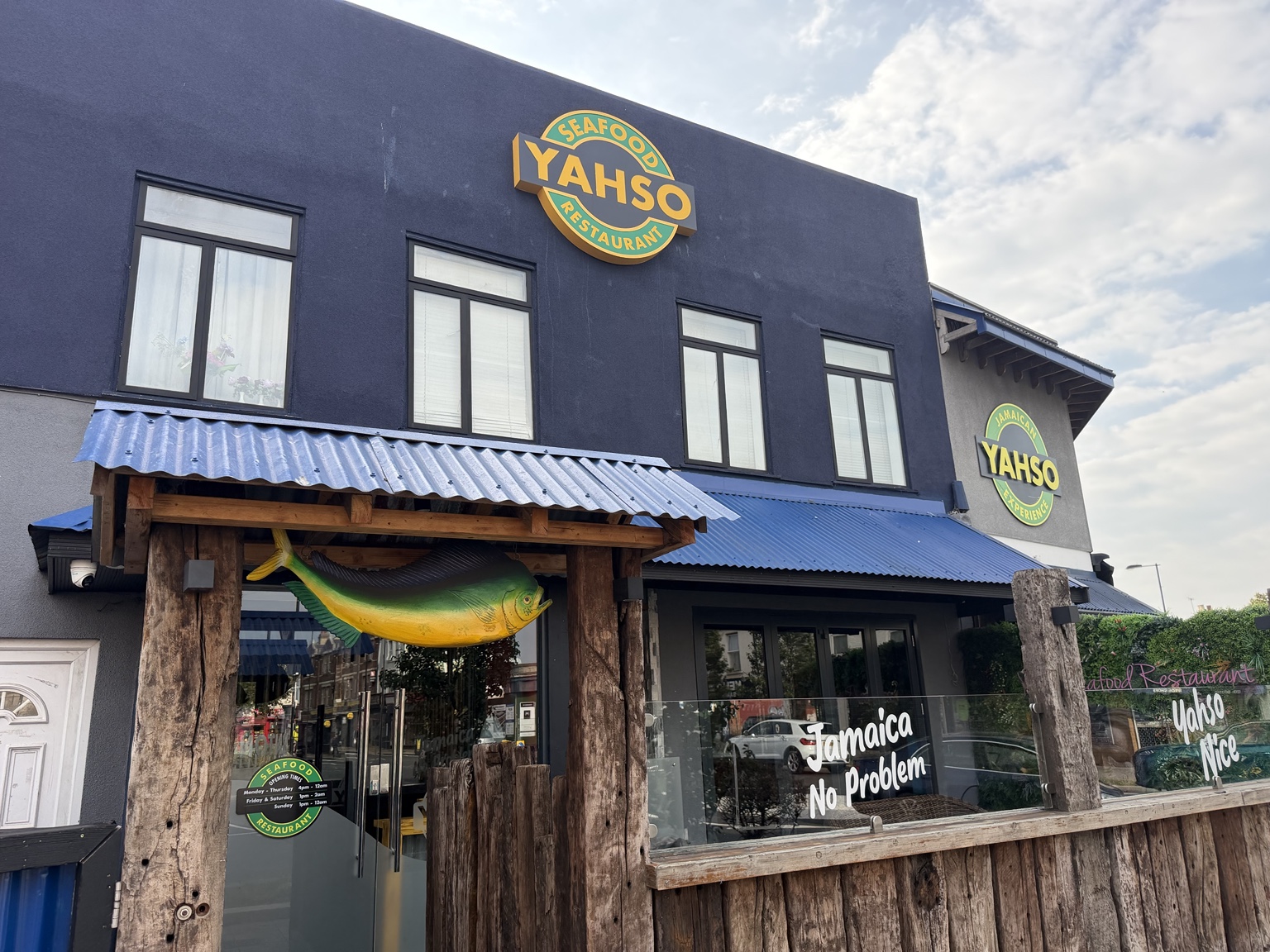
Delly’s was at number 444. Yahso was—and remains—at number 442.
I Bought the Food, But I Never Sat Down
I used to buy food from Delly’s, but I never treated it as a sit-down restaurant.
It was somewhere I went for takeaway. I would order, collect the food and go. In fact, I do not think I have ever properly sat down and eaten inside an independent Jamaican restaurant.
Technically, I have eaten at Turtle Bay.
But I do not place Turtle Bay in the same category.
That is not because a white chef is physically incapable of learning how to cook Jamaican food. The deeper issue is what happens when a cuisine is passed through a national corporate system.
Recipes are standardised. Heat and seasoning are moderated. Portions, preparation and presentation have to be reproduced across multiple branches. The food must appeal to the broadest possible customer base, including people who may want the idea of Caribbean food without everything that originally gave it its character.
When I visit an independent Indian or Chinese restaurant, I often expect the kitchen, ownership, staff and customer base to retain a visible relationship with the culture producing the food.
That does not automatically guarantee quality or authenticity. People from a particular background can still cook bad food, while somebody from outside that culture can learn to cook it brilliantly.
But the connection is usually apparent.
Turtle Bay feels different to me.
It sells a highly marketable version of the Caribbean: cocktails, bright colours, reggae, jerk branding and a menu made approachable for a mainstream British audience.
Plenty of people enjoy it, and commercially that model clearly works. But it is not the same experience as walking into an independent Jamaican takeaway and recognising the cooking, the people, the smells and the atmosphere.
One sells food from within a community.
The other packages selected parts of that culture and sells them to the mass market.
That is why Delly’s mattered to my memory even though I never sat down for dinner there. Its authenticity was not created by table service, themed decorations or expensive interior design.
It came from seeing somebody tending the smoker, smelling the jerk cooking and knowing that the food was being produced as part of the everyday life of the area.
I was not visiting Delly’s for a manufactured Jamaican experience. I was going there to buy Jamaican food.
When the Kitchen Is Part of the Experience
That is also part of why places such as Wagamama and Banana Tree worked so well for me, particularly when those brands still felt fresher and less like established restaurant chains.
Their menus were openly presented as pan-Asian rather than pretending to represent one country perfectly. More importantly, when you looked into their open kitchens, you often saw Asian chefs and kitchen staff preparing the food.
There appeared to be some relationship between the people cooking, the techniques being used and the broad culinary culture the restaurant was selling.
That did not automatically make every dish authentic.
“Pan-Asian” itself combines enormous and very different cultures into one commercially manageable category. Wagamama is no substitute for an independent Japanese restaurant, just as Banana Tree cannot represent the whole of Southeast Asia.
But the visible kitchen still made the experience feel more credible.
It did not feel as though the culture existed only in the menu design, background music and decorations while being absent from the operation producing the food.
That is where Turtle Bay has often felt different to me. The Caribbean identity can appear heavily concentrated in the branding—the rum, the colours, the reggae and the names of the dishes—while the actual establishment operates like any other mainstream British restaurant chain.
Wagamama, Banana Tree and similar businesses may now be experiencing the same fatigue affecting much of casual dining. Once a successful idea is expanded, standardised and repeated everywhere, some of its original energy inevitably drains away.
But at their best, their open kitchens allowed customers to see that the cuisine was not merely a theme placed over an otherwise generic restaurant.
The people cooking were part of the experience too.
At Delly’s, the smoker performed a similar function. It made the cooking visible.
Everything Felt Different After Covid
I cannot place the exact date when the Delly’s frontage was rearranged, and I do not want to pretend that I can.
But in my own memory, this is a post-Covid change.
I do not remember Delly’s looking like this before the pandemic. When I picture that stretch of Whitehorse Road before 2020, I picture the larger restaurant, the terrace and the smoker.
When I returned afterwards, the whole arrangement felt different.
That is true of more than one restaurant.
So many local businesses came out of Covid looking smaller, tighter and more commercial. Some disappeared altogether. Others reduced their seating, concentrated on takeaway and delivery, divided their operations or found new ways to make expensive premises pay.
Covid was followed by rising energy costs, food inflation, staff shortages and the continuing Brexit squeeze.
Rent did not disappear simply because customers had disappeared. Small operators had to absorb all of that without the reserves, borrowing power or bargaining strength available to national chains.
That does not prove precisely why Delly’s changed. Without speaking directly to the owners, it would be unfair to present speculation as fact.
But it provides the economic background against which the change happened.
What I saw on Whitehorse Road was not simply a new sign or a different terrace. It felt like part of a much wider post-Covid shift: familiar independent businesses surviving, but surviving in altered forms.
The name remains. The memory remains. But the space around it has tightened.
More Than a Takeaway
The legal business behind Delly’s was incorporated in March 2011. Its registered address was 444 Whitehorse Road, and its original company name briefly included the words “Delly’s Restaurant” before becoming Delly’s Limited.
Companies House now classifies the company under takeaway food shops and mobile food stands.
That change in description almost captures the transformation visible from the street.
The old frontage presented Delly’s as a restaurant, caterer and social space. There was outdoor seating, a lunchtime offer, events catering and a prominent identity occupying an entire building.
Today, the Thornton Heath operation feels closer to a compact takeaway with a small seating area outside.
However, that does not mean the wider Delly’s business simply disappeared.
Companies House records associate director Whitmarsh Dell with Delly’s businesses in West Norwood, Croydon and Camberwell, alongside the former Thornton Heath company.
So this is not necessarily a straightforward story of failure.
It may be a story of redistribution: one large and highly visible restaurant giving way to a group of smaller operations serving different parts of South London.
And Then There Is Yahso
Yahso now dominates the neighbouring frontage.
It sells itself not merely as somewhere to buy Jamaican food but as a complete Jamaican experience: cocktails, music, table service, celebrations and a more polished restaurant environment.
Its dining listings place the usual price range at between £26 and £40 per person. It describes itself as casual dining, advertises catering and private parties and names Andrew Dell as its executive chef.
The Dell surname creates an obvious question.
Is Yahso an evolution of the same family business? Is it commercially connected to Delly’s? Or did two related but legally distinct operations simply develop beside one another?
The public information I found establishes Whitmarsh Dell’s position within the Delly’s companies and identifies Andrew Dell as Yahso’s executive chef.
That suggests a possible family or business connection, but it does not by itself prove that the two restaurants share the same ownership.
That distinction matters.
A shared surname, neighbouring premises and overlapping cuisine are all clues worth investigating. They are not enough to declare the businesses one organisation without confirmation from the people involved or clearer company records.
What can be seen is a division between two business models.
Delly’s
The accessible takeaway end: recognisable dishes, quicker service and smaller premises.
Yahso
The experience-led end: designed interiors, cocktails, table service and prices covering more than the food alone.
Why Jamaican Food Has Become Expensive
People sometimes speak about Caribbean food as though it should remain cheap simply because much of it developed as everyday working-class food.
But running a restaurant in London is expensive regardless of the cuisine.
There is rent, business rates, energy, insurance, staff, waste collection, equipment, maintenance and delivery-platform commission. Ingredients have increased in price, and Caribbean cooking can be labour-intensive.
Meat must be seasoned and marinated. Stews take time. Fish and goat are not cheap. Proper jerk cooking requires preparation, equipment, fuel and somebody who knows what they are doing.
A large sit-down restaurant carries even more costs.
Empty tables still occupy rented space. Waiting staff must be paid. A bar requires stock. Late opening requires staffing, security and cleaning.
The customer is no longer paying only for rice and peas, chicken or fish. They are paying for the building and the entire operation surrounding the plate.
That may explain why Yahso has moved towards selling an experience.
It is not necessarily greed, and it is not necessarily evidence of a business abandoning its community. It may be the commercial model required to keep a large independent restaurant viable.
At the same time, something can be financially understandable and still feel like a cultural loss.
The smoker at Delly’s was not polished. It was not an experience created by a branding company. It was simply part of the place.
The food, the person cooking it, the smoke and the street all belonged to the same scene.
That visibility mattered.
Growing Without Shareholders
There is also a wider business question here.
Independent Black businesses are often expected to expand while retaining complete ownership, serving their original communities, keeping prices low and resisting outside investment.
Those expectations frequently contradict one another.
Shareholders can provide money for additional premises, equipment, marketing and professional management. But investment is rarely free. Investors expect influence, returns and continuing extraction from the business.
If the founders already possess enough capital—or can grow gradually using the money generated by the business—keeping ownership close preserves control.
The owners decide what the company becomes rather than constantly satisfying outside investors demanding faster expansion or larger margins.
That does not mean shareholders bring no value. It means their value depends on what the business needs and how much control its owners are prepared to surrender.
Britain has repeatedly demonstrated the danger of confusing investment with a permanent entitlement to extraction. The water industry provides the most obvious larger example: essential infrastructure produces private returns while the public and taxpayer remain responsible when the system fails.
For Delly’s and Yahso, the more immediate question is whether their development represents the steady growth of a family enterprise, a separation between connected businesses or simply two neighbouring restaurants following different paths.
The available records provide clues, but not the complete answer.
What Changed on Whitehorse Road?
Standing there today, the change is visible.
The Delly’s name survives, but the original restaurant frontage has gone. The terrace has changed. The smoker is no longer the thing that draws your eye from the road.
Next door, Yahso has become larger, darker, more designed and more consciously commercial.
That is not automatically a bad thing.
A Black-owned Jamaican restaurant surviving, employing people and building a substantial dining business in South London is something worth recognising. Too many local businesses disappear without leaving anything behind.
But growth changes how a place feels.
The earlier Delly’s was open to the street. Its identity came from the visible process of cooking: the fire, the person at the grill and the smoke escaping through the terrace.
Yahso packages Jamaican culture differently. It offers atmosphere, presentation, cocktails and an experience intended to justify a higher bill.
One belongs to the memory of the neighbourhood restaurant.
The other belongs to the modern experience economy.
Perhaps the real story is not that one replaced the other.
It is that both models emerged beside each other—possibly from the same wider family or business network—as Caribbean restaurants adapted to an increasingly expensive city.
I had remembered two Caribbean restaurants.
I had remembered Delly’s being much bigger.
And I had remembered that smoker.
The photographs show that I was not confused after all.