SceneOnline life
I Only Posted
My Dinner
What a plate of food taught me about strangers, exposure and the online argument machine.
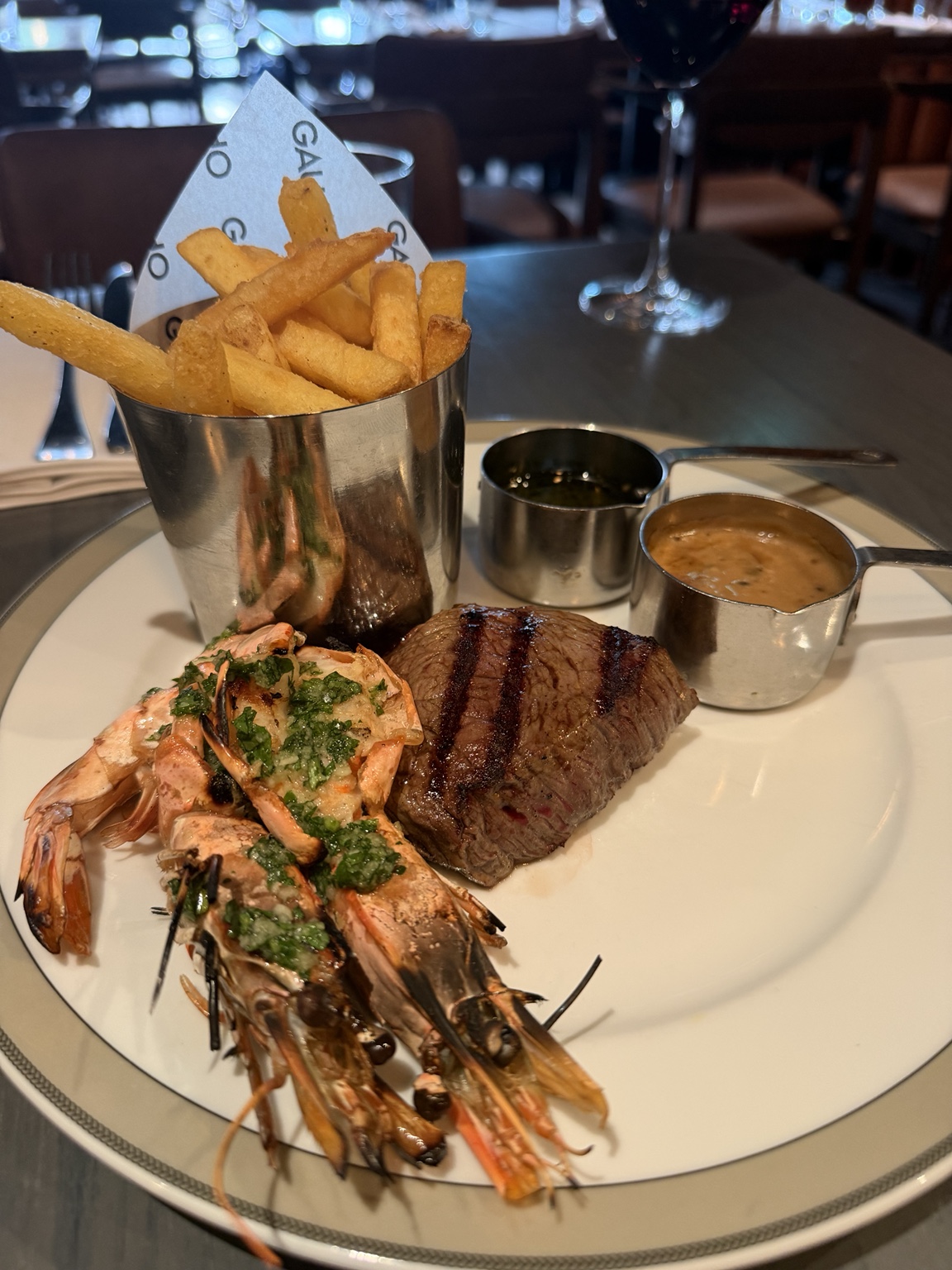
I posted a photograph of my lunch on Reddit.
That was it.
It was steak and grilled prawns from Gaucho. I eat at Gaucho fairly often at lunchtime because, whatever assumptions people may make about the name, its set lunch offers serious value for money. It is bang for your buck.
The exact dishes change, but the principle remains the same: a properly cooked restaurant meal, served in a proper dining room, for a price that now competes with what people can easily spend on fairly ordinary food elsewhere.
And it was two courses.
I began with Gaucho’s Three-Cheese Empanada, served with rocket, pickled red onion and chimichurri. Then came the main course: a 160g steak with chips, sauces and the grilled prawns I had ordered alongside it.
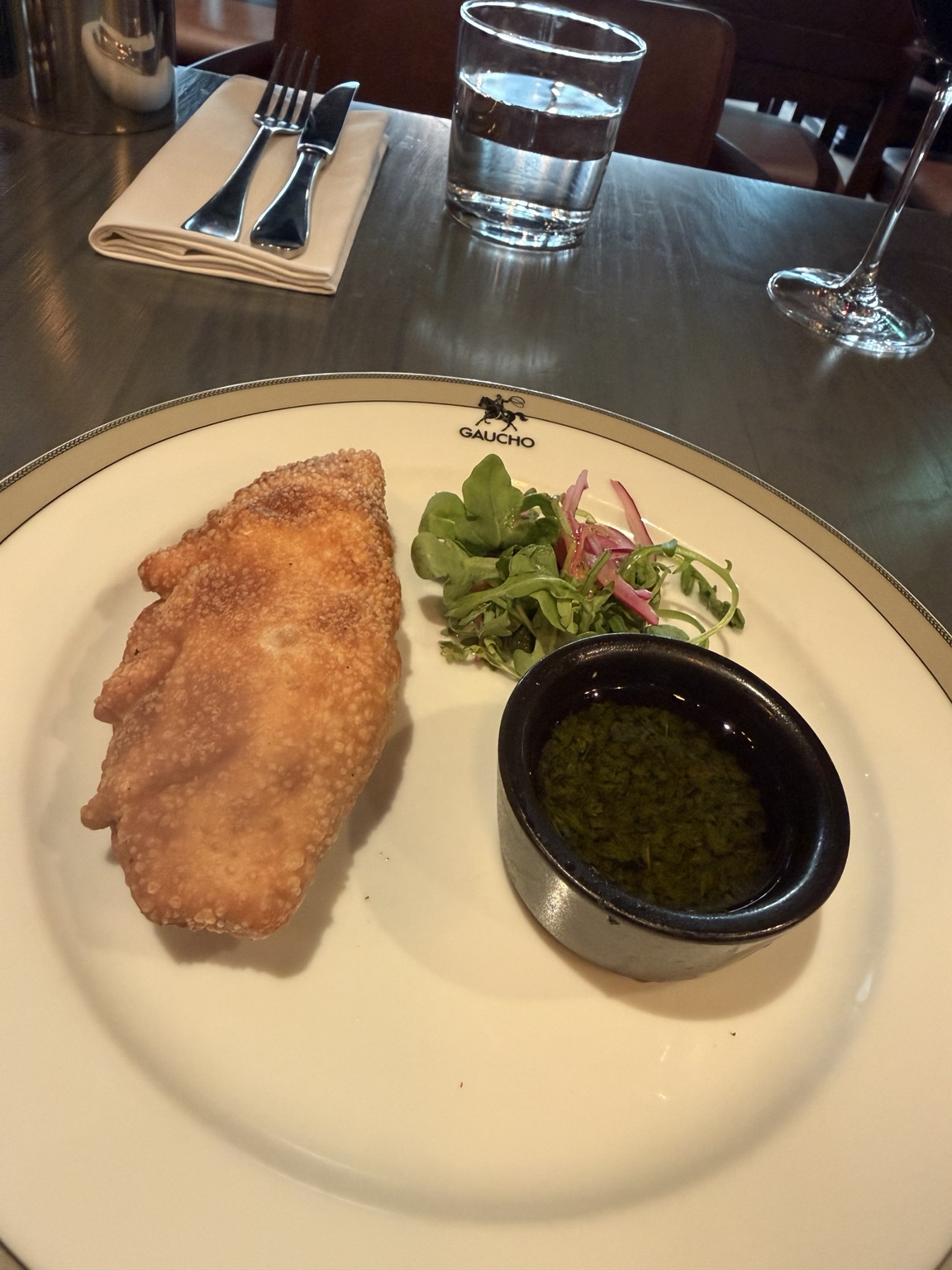
That was the meal.
But Reddit saw one photograph of one course and immediately decided that it understood the entire experience.
People looked at the steak in isolation and asked where the rest of the food was. The rest of the food had already been eaten. It was the starter.
People are shown one frame and imagine they have seen the entire film.
They receive a fragment of information and fill the missing space with whatever assumptions they already carried with them.
It was lunch.
Not an enormous evening feast. Not a competitive eating challenge. Not everything I intended to consume for the next 24 hours.
It was a two-course restaurant lunch, followed by a properly cooked steak with chips and an additional seafood side.
I photographed the main course because it looked good. I ate it because it was good. I posted it because Reddit has communities for everything, including seafood, and I thought people might appreciate it.
Almost immediately, people began asking where the rest of it was.
Somebody asked where the seafood was. Somebody else said the steak looked too small. Another person wanted to know whether it was an appetiser. Then somebody asked whether the empty part of the plate was where the other half of the steak had been.
They could see the photograph, but they did not understand the context.
They did not know that it was the second course. They did not know that I had already eaten the empanada. They did not know what I had ordered, how hungry I was or whether the meal had satisfied me.
They knew almost nothing, but that did not slow the judgement down.
That became the pattern for everything that followed.
The less people knew, the more confidently they spoke.
Price is not the same as value
This is also where my own background matters.
I used to be a chef. I worked at the Mayfair Hotel and the Chamberlain Hotel in Birmingham. I have spent time around professional kitchens, ingredients, portioning and food prepared to a particular standard.
I know what quality food looks and tastes like.
I also know what McDonald’s tastes like.
This is not about pretending that every meal needs white tablecloths, or that enjoying fast food makes somebody uncultured. I will eat straightforward food like anybody else.
But cheap-looking food is not necessarily good value, and familiar food is not automatically inexpensive.
I say this constantly about McDonald’s. People still speak about it as though it is the obvious cheap option. But once you put together a burger, fries, a drink and whatever else you need to feel full, the difference between that and a proper set lunch can be much smaller than people imagine.
For under £21, Gaucho currently offers three courses at lunchtime.
That is not the same product as a burger, chips and a drink passed through a hatch.
One is not automatically morally superior to the other, but pretending they offer the same quality or experience simply because both remove hunger is nonsense.
Value is not measured only by how much material can be piled onto a plate.
It is the quality of the ingredients. How they were prepared. Where you are eating. The service. The experience. Whether the meal gave you what you wanted.
A larger steak would not automatically have made my lunch better value.
It would simply have made it larger.
Yet online, quantity often becomes the only measurement people understand. More food means better value. A larger car means greater success. A bigger house means a better life.
The possibility that somebody deliberately chose enough rather than the maximum available does not seem to register.
Some people genuinely may not have eaten at Gaucho or spent much time around this sort of food. There is nothing wrong with that. Nobody is born knowing restaurant menus, cuts of meat or how dishes are put together.
But there is a difference between not knowing and refusing to think.
A person could have asked, “Was that part of a lunch menu?”
They could have asked, “Did you order the seafood separately?”
They could even have said, “That would not be enough for me.”
Instead, several people jumped directly from missing context to confident judgement.
That was never really about the size of the steak.
It was about what the online world has done to curiosity.
Calories are not the same as nourishment
I eat McDonald’s myself.
Nine times out of ten, when I go there, it is because I want an easy boost to my calorie intake. I train, I am active and sometimes I need calories quickly. McDonald’s can provide them.
But I know what I am buying.
I am not pretending it is quality food because it is convenient. I am not confusing the number of calories with the nutritional value of the meal, or the quantity in the packaging with the quality of what is inside it.
That is another distinction the online discussion flattened.
People looked at a 160g steak and concluded that the meal represented poor value because the steak was not enormous. But food does not become better simply because there is more of it.
A larger quantity of lower-quality food may provide more calories, but that does not automatically make it a better meal.
Sometimes calories are precisely what I want. On those occasions, I make that choice knowingly.
What troubles me is when heavily processed fast food stops being an occasional convenience and becomes the ordinary understanding of what a meal looks like—especially for children.
I do feel something when I see young children regularly being fed in McDonald’s.
That is not about blaming an individual parent whom I know nothing about. Families are dealing with money, time, work, exhaustion and children who may refuse almost everything else.
One photograph of a family eating there tells me no more about their lives than my photograph of Gaucho told Reddit about mine.
That is precisely the point.
But the wider pattern still concerns me.
McDonald’s represents an Americanised model of food built around speed, uniformity, convenience and scale. The meal can be reproduced quickly, eaten quickly and forgotten quickly.
It fits perfectly into a world in which everybody is rushing, scrolling and being encouraged to consume without pausing for long enough to ask what they are consuming.
The occasional fast-food meal is not the end of civilisation. I eat it myself. But when that model becomes normal, children can grow up recognising brands and meal deals before they understand ingredients, cooking or what good food actually tastes like.
That is what makes me sad.
It is not the sight of one child eating one burger. It is the possibility of an entire relationship with food being formed by companies whose primary purpose is not nourishment but selling the next meal.
I know the difference because I have worked with food.
I know when I am buying quality, and I know when I am simply buying calories.
Too much of the online response came from people who seemed unable—or unwilling—to recognise that those are not the same thing.
A public hearing about a plate of food
Within hours, the photograph was no longer really about food.
People were discussing my personality. They were assessing the way I answered different comments. One person wanted to know why somebody else had received a different reply from the one I had given them.
Another called me insufferable. Somebody told me to “touch grass.” Eventually, one stranger concluded that the way I responded explained why I was eating alone and called me a cunt.
All over a photograph of steak and grilled prawns.
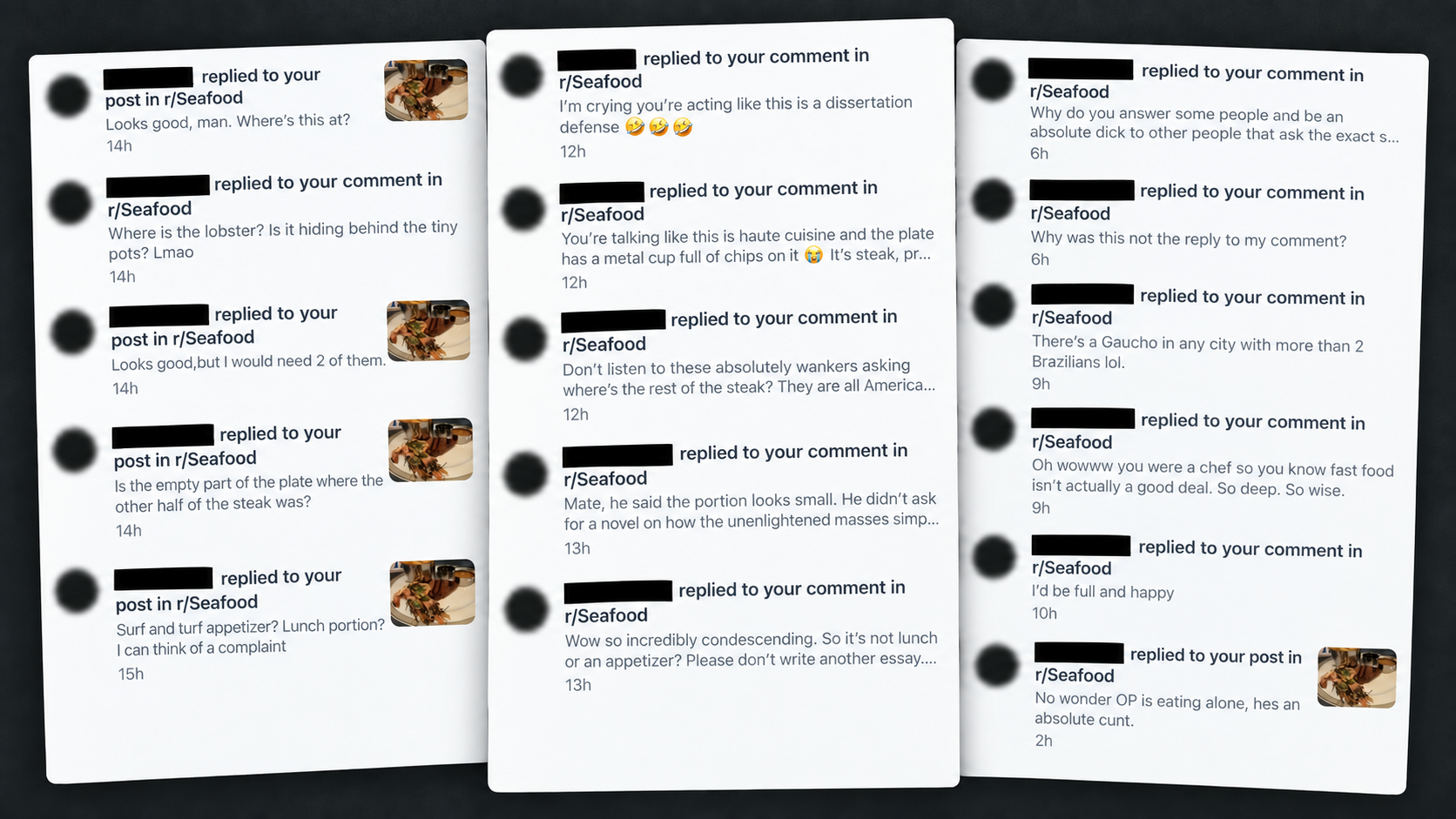
That is the strange thing about being online now. You think you have posted a photograph. Other people behave as though you have submitted yourself for public examination.
The food gives them an opening, but very quickly the subject becomes you.
- Your tone.
- Your intelligence.
- Your personality.
- The length of your answer.
- Whether you are taking the conversation too seriously.
- Whether you are not taking their comment seriously enough.
- Whether you answered one stranger more politely than another.
At one point, somebody effectively asked me why I had not given them the same response that I had given somebody else.
Think about how strange that is.
We do not know each other. There is no relationship between us. There was no promise of equal treatment and no obligation for me to provide customer service beneath my own photograph.
Yet this person had begun monitoring my replies and comparing how I spoke to them with how I spoke to somebody else.
They had developed an expectation of access.
That is what social media does. It creates temporary relationships that only one side may realise they have entered.
You post something casually, carry on with your day and perhaps forget about it. Somewhere else, a stranger is waiting for your reply, checking whom else you answered and building an opinion of your entire character from a few sentences beneath a plate of food.
I thought I had uploaded lunch. They thought I had opened a public hearing.
Who am I actually talking to?
When you speak to somebody face to face, you receive information before they have even finished their first sentence.
You can roughly judge their age. You can hear their tone. You can see whether they are joking, nervous, angry, intoxicated or confused. You can usually tell whether continuing the conversation is worthwhile.
Online, nearly all of that disappears.
You do not know whether the person answering you is 14 or 74. You do not know whether they are sober. You do not know their mental state, their level of education or whether they have spent the previous eight hours fighting with strangers.
You do not know whether this is their fifth account after the others were banned. You do not know whether they are sitting at work, lying in bed, hiding from their family or posting from a bedroom they have barely left all week.
You do not even know whether they believe what they are saying.
All you receive is a username and a sentence.
Yet the platforms present every sentence with roughly the same visual authority. The thoughtful adult, the angry teenager, the automated account, the dedicated troll and the person experiencing a breakdown are reduced to identical lines of text.
Then we call the result “public opinion.”
It is not necessarily public opinion. It is the opinion of the people who were online at that moment, saw the post and felt sufficiently compelled to type something underneath it.
The healthiest person may have looked at the photograph, thought, “That looks nice,” and carried on living.
America entered the room
I could also see that Reddit was gradually placing my posts in front of more Americans.
That matters because the United Kingdom and the United States may share a language, but we do not always share the same expectations.
Food portions are an obvious example.
A perfectly adequate restaurant portion in Britain can apparently look like emergency wartime rations to somebody accustomed to the American version of abundance.
That difference could have been funny.
Instead, it became another contest.
People were not simply saying that they would prefer a larger steak. They were behaving as though the existence of a smaller portion required an investigation. They needed to establish whether it was lunch, an appetiser or some form of personal failure.
Britain may increasingly behave like America’s 51st state, but America remains another level of bonkers.
Everything appears to become an identity, a confrontation or a national emergency. Food, films, beer, cars, guns, gender, race, Trump, the size of a steak—it can all be fed into the same permanent argument.
Trump did not invent that culture, but he understood it better than almost anybody.
Attention is gained through conflict. Outrage produces loyalty. Humiliation entertains the audience.
It does not matter whether anything is resolved because resolution ends the show.
That mentality now travels across the world through the platforms.
America is no longer merely a country online. It is a permanent argument, and the rest of us increasingly live inside it.
Cruelty as a group activity
Online hostility rarely remains at the level where it begins.
One person makes a joke about the portion. Somebody else makes a sharper joke. Another person decides that the original poster is arrogant. The next person calls them insufferable.
Eventually, somebody concludes that a stranger deserves to be alone.
The cruelty escalates because ordinary disagreement is not enough to hold attention.
Nobody receives much recognition for saying, “That would not be enough food for me, but I hope you enjoyed it.”
There is no performance in that. There is no cleverness to display and no team to join.
But mockery invites more mockery.
Once the group has decided that somebody is the target, each participant can go slightly further than the last. They are no longer communicating with the person who made the post.
They are performing for everybody else watching.
That is how a plate of food turns into a judgement about whether somebody deserves companionship.
It would be easy to say that these people are simply horrible.
Some probably are.
But I increasingly feel sorry for them.
I really do.
The person behind the notification
I do not feel sorry for them because I believe I am better than everybody answering me.
I feel sorry for them because I can see more clearly what the platforms are doing to all of us.
Somebody can spend hours returning to an argument with a complete stranger over a photograph of steak. They wait for the reply. They check whether you have answered somebody else. They become offended by the tone you used with them. They want to know why another person received a different answer.
By that point, they are no longer discussing food.
A person they do not know has begun occupying part of their day.
We throw the word “addiction” around casually, but some of this behaviour is plainly compulsive. People are not simply using the internet and then getting on with their lives.
They are checking it, feeding it, returning to it and carrying the emotional residue into the rest of their day.
And for a few seconds, that can feel like something.
The children did not invent this
We talk constantly about children being addicted to their phones.
We worry about their attention spans, social development, sleep and exposure to harmful material. We tell them to go outside. We tell them to put the phone down and speak to real people.
But where do we think they learned the behaviour?
The child is scrolling because the parent is scrolling.
The parent tells the child to put the phone down without looking up from their own.
You can now have an entire family sitting inside the same house, each person physically present and mentally somewhere else.
One is watching videos. One is replying to strangers. One is following an argument. Another is refreshing a page to see whether somebody has reacted.
Everybody is connected.
Nobody is speaking.
And it is not only the amount of time being spent online. It is the quality of the material filling that time.
People can spend an entire evening consuming nonsense, repeating nonsense and arguing about nonsense without being able to explain why any of it mattered.
That is what worries me.
The nonsense is replacing something.
- Time
- Attention
- Conversation
- Patience
- Curiosity
- Boredom
- Quiet
The ability to disagree without treating the other person as an enemy.
All of it is surrendered, minute by minute, to a machine that always has another argument waiting.
I was trained for this
I am a person.
I can be irritated, provoked and drawn into an argument like anybody else. But I have also spent much of my life being told what reality was supposed to be by people whose understanding of life extended no further than their own small community.
It began with church, God and religion: adults presenting certainty as truth, despite rarely having ventured beyond the world that gave them that certainty.
As I grew older, the subjects changed, but the pattern remained.
People with narrow experience continued explaining life to me as though their limited perspective represented the whole of it.
But at 43, something has crystallised.
I recognise gaslighting more quickly. I recognise the confidence of people who know very little. I recognise the pressure to accept the group’s version of events simply because more people are repeating it.
And I can handle it.
In many ways, I have been trained for this.
I have never needed a group to tell me what to think. I can stand alone, and I am comfortable enough in my own company not to mistake belonging for truth.
If a hundred people repeat the same baseless claim, it remains baseless.
That does not make me immune. I have spent plenty of time over the past year arguing with people online, sometimes because the subject mattered and sometimes because I allowed their nonsense to occupy more of my attention than it deserved.
The difference now is that I can see the machinery.
I know when somebody is asking a real question and when they merely want another round. I know when a person wants an answer and when the answer is simply fresh material for the next attack.
I no longer feel obliged to prove myself to every stranger who arrives beneath one of my posts.
I can withstand that pressure.
What worries me is how many people cannot.
I have less time for stupid
I should also be honest about myself.
Sometimes I can be blunt. Sometimes I can be dismissive. Sometimes my response probably is more condescending than the original comment deserved.
But after nearly ten years of Brexit, slogans, invented facts and people confidently discussing subjects they have never bothered to investigate, I have less time for stupid.
I am sorry if that sounds harsh, but I do.
By “stupid,” I do not mean somebody who lacks formal education or genuinely does not know something.
None of us knows everything.
Asking an honest question is not stupidity.
Stupidity is having the ability to think, search or ask properly and choosing performance instead.
It is seeing a photograph and immediately trying to catch somebody out. It is posting the first little sarcastic thought that enters your head because being noticed matters more than understanding what you are looking at.
“Where is the seafood?”
“Is that a child’s portion?”
“Is the rest of the steak missing?”
People possess access to more information than any generation before them, yet so many appear less willing to use their intelligence before speaking.
The internet has made it possible for everybody to join the conversation.
It has also convinced everybody that every passing thought needs to be contributed to it.
Sometimes the intelligent response is to look more closely.
Sometimes it is to search.
Sometimes it is to ask a genuine question.
And sometimes it is to realise that you have nothing useful to add and continue scrolling.
That restraint is disappearing.
Everybody wants to exist in the online world, and visibility now seems to require constant proof of presence.
People comment not because they have something to say, but because commenting tells the platform—and perhaps themselves—that they are still there.
So yes, occasionally I answer too sharply.
That is mine to recognise.
But the larger problem remains: we have built an environment in which thoughtlessness is instant, public and rewarded, while thought requires time that the platform is deliberately trying to take away.
Arguing with baseless people
Over the past year, I have argued with plenty of baseless people online.
People who make claims without evidence. People who cannot answer the second question. People who repeat slogans and disappear when asked how anything would actually work.
Sometimes I answered because the subject mattered.
Sometimes I wanted to expose the weakness of the argument.
Sometimes I was angry.
Sometimes, if I am being completely honest, I enjoyed it.
There can be satisfaction in dismantling somebody’s nonsense, especially when they arrived with complete confidence. There can be satisfaction in showing that the person who thought they had made a devastating point had not thought beyond the first sentence.
But there is also a trap.
You begin believing that every bad argument requires an answer. You start giving strangers more time than their thinking deserves.
You spend 20 minutes constructing a response to somebody who spent 15 seconds repeating something they saw elsewhere.
They move on.
You carry the irritation.
That is not an equal exchange.
I do it much less now because I no longer feel the same need. I can recognise the pattern earlier. I know when somebody is interested in understanding and when they are only looking for another round.
Not every statement deserves correction.
Not every stranger deserves access.
Not every notification requires a response.
Learning that has been part of my own transformation.
Exposure has a price
There is another uncomfortable truth: I went online because I wanted exposure.
I write. I have a website. I want people to find the work.
Unless you already possess a large audience, that means entering platforms controlled by other people and trying to attract attention inside them.
You cannot demand visibility and then act surprised when you become visible to people you would never choose to meet.
That is part of the bargain.
But the real price of exposure is not merely receiving criticism. It is making yourself available to thousands of unknown people who may believe that seeing you gives them access to you.
The platforms encourage that confusion.
Therefore, the behaviour most likely to damage your peace may also be the behaviour most likely to spread your work.
That is not an accidental flaw.
It is the machinery.
Calm agreement ends an exchange.
Hostility extends it.
The platform does not care whether the conversation made anybody wiser or happier.
It cares that everybody remained on the platform.
Reddit usernames and LinkedIn costumes
Reddit makes the absurdity easier to see because so many people are hiding behind cartoon avatars and disposable names.
But LinkedIn is not fundamentally different.
On LinkedIn, the same human impulses arrive wearing a suit.
The username becomes “Founder.”
The cartoon avatar becomes a corporate headshot.
The person calling you an idiot becomes a “Managing Director” sharing lessons about leadership.
The aggression is polished. The vanity is professionalised. The nonsense is arranged into short paragraphs beside a photograph taken at a conference.
Both can give people a stage.
The costume changes.
The need for attention does not.
We spend too much time judging the credibility of people by the clothing their profile provides.
An anonymous Reddit account may contain somebody thoughtful. A profile covered in qualifications and job titles may contain somebody who has never examined their own beliefs.
You still have to assess the argument.
Unfortunately, plenty of people online no longer possess either the patience or the desire to do that.