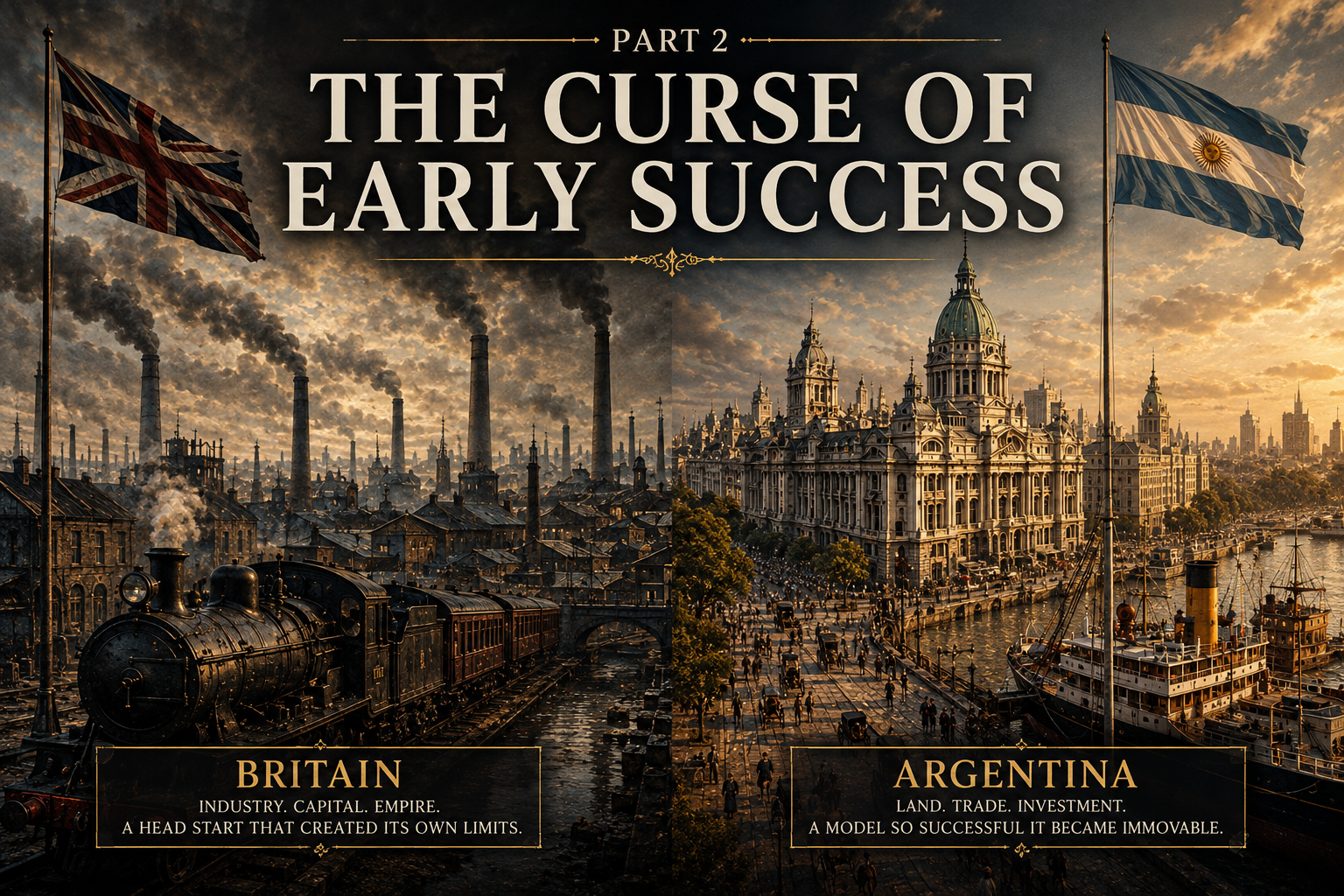
Britain Is Not Special — Lessons from Argentina
Published
Part 2 of 7
The Curse of Early Success
When a system succeeds for long enough, success itself can become the reason it stops changing.
If decline begins with the illusion of permanence, it is sustained by something more subtle: the inertia of early success.
Countries that rise quickly and convincingly often build systems that work well enough to remove the immediate pressure for change. Growth becomes expectation. Performance becomes identity. And over time, the question of whether the model itself needs to evolve stops being asked.
This does not necessarily happen because leaders are unaware of change.
It happens because the existing system continues to deliver just enough to maintain confidence.
Argentina offers a powerful example of this dynamic.
So, in a very different way, does Britain.
The danger of early success is that a country can mistake a head start for a permanent advantage.
A Model That Worked — Until It Didn’t
Argentina’s rise in the late 19th and early 20th centuries was not accidental.
It was built on an economic model extraordinarily well suited to the global economy of its time.
The country’s great advantage was its land.
The vast pampas provided ideal conditions for large-scale agricultural production. Beef, wheat and other commodities could be produced efficiently and exported to an industrialising Europe whose appetite for imported food was growing rapidly.
Argentina became one of the great agricultural suppliers of the world.
Technology amplified that advantage.
Refrigerated shipping transformed the international meat trade, allowing Argentine beef to travel enormous distances while remaining commercially viable. Railways connected the productive interior to Buenos Aires and the ports.
Capital reinforced the system.
British investors poured money into Argentine railways, utilities, banks, ports and infrastructure. By the beginning of the 20th century, Britain had become deeply intertwined with the Argentine economy.
Migration added another engine of growth.
Millions of Europeans — particularly Italians and Spaniards — arrived seeking opportunity. Buenos Aires expanded dramatically, becoming one of the great metropolitan cities of the era.
The results were extraordinary:
- Exports grew rapidly
- Foreign investment flowed into infrastructure
- Population expanded
- Cities modernised
- Living standards rose
From the perspective of Argentina’s economic and political establishment, the system was not simply working.
It appeared to be repeatedly proving itself.
And when a model keeps producing wealth, there is remarkably little incentive for those benefiting from it to dismantle it.
The Weakness Hidden Inside the Strength
Beneath Argentina’s extraordinary prosperity was a much narrower economic structure than the wealth suggested.
Much of the country’s productive land was concentrated in large estates.
The owners of those estates — the estancieros — were not merely wealthy agricultural producers. Land ownership translated into social status, political influence and considerable power over the direction of the state.
That concentration mattered.
Argentina’s prosperity depended disproportionately on a limited number of advantages:
- Highly productive agricultural land
- European demand for food exports
- Foreign capital
- Open international trade
None of these were weaknesses when conditions were favourable.
Together, however, they created dependency.
An economy can be extremely successful and still be structurally narrow.
Argentina had become extraordinarily good at doing what the global economy rewarded at that moment.
The problem was that the global economy would not remain frozen in that moment forever.
When the World Changes
The first major disruption came with the First World War.
International trade was disturbed. Capital movements changed. European economies were reorganised around war.
The international environment on which Argentina’s extraordinary growth had depended became less predictable.
The interwar period brought further change.
Protectionism increased. Global trade became more fragmented. The Great Depression transformed economic thinking across the world.
Countries with broad industrial capabilities could respond by producing more of what they previously imported.
Argentina’s economy was less flexible.
That did not mean prosperity disappeared overnight.
Beef still existed. Wheat still grew. Railways still operated. Buenos Aires remained wealthy.
And that is precisely why the underlying problem was so difficult to recognise.
The old model had not stopped working.
It had simply stopped being enough.
Britain’s Own First-Mover Problem
Britain had an even greater head start.
Industrialisation began here before it transformed most of the rest of Europe.
Coal, steam, textiles, iron, engineering, shipbuilding and finance gave Britain a concentration of economic power few countries had previously possessed.
The Empire multiplied those advantages.
British producers gained access to markets, raw materials, shipping routes and capital networks spanning the globe.
Sterling became central to international finance.
London became a financial capital.
British ships carried enormous volumes of global trade.
For much of the 19th century Britain was not adapting to an international economic system created somewhere else.
Other countries were adapting to Britain.
That distinction is fundamental.
When everyone else is trying to catch you, the need to question your own model can feel remote.
The Cost of Being First
Being first sounds like an unqualified advantage.
It is not.
Early industrialisation means building infrastructure early. It means creating institutions around early technologies. It means developing industries whose power eventually becomes political as well as economic.
Later industrialisers can watch, learn and leapfrog.
Germany industrialised later but developed powerful connections between science, technical education and industry.
The United States combined an enormous domestic market with rapidly modernising industry.
Japan would later demonstrate how aggressively an economy could absorb technologies developed elsewhere and build modern industrial capability around them.
In the late 20th century, South Korea repeated the lesson.
China would eventually do it at a scale unprecedented in modern history.
Britain’s industrial lead therefore contained a paradox:
The country that industrialised first also became the country that had to modernise some of the world’s oldest industrial systems.
Existing infrastructure represented sunk investment.
Existing industries employed communities.
Existing institutions created constituencies determined to preserve what already existed.
First-mover advantage gradually produced first-mover baggage.
Education: The Advantage Britain Failed to Build
Britain’s industrial head start also concealed another structural weakness: mass education developed more slowly than the country’s industrial mythology suggests.
Prussia had developed compulsory schooling long before Britain created a comprehensive national system of elementary education.
Britain entered the industrial age with extraordinary entrepreneurs, engineers and inventors — but without an equally extraordinary system for educating the population as a whole.
That distinction became more important as industrial competition shifted from relatively simple manufacturing toward chemistry, electrical engineering, precision manufacturing and applied science.
Germany’s technical institutions became an economic asset.
Britain possessed remarkable universities and elite schools, but access to advanced education remained sharply divided by class.
Industrial success had arrived before the country had been forced to build the educational infrastructure later competitors viewed as essential.
Again, early success reduced urgency.
From Industrial Power to Financial Power
Britain’s answer to relative industrial decline was not simply to rebuild the old manufacturing model.
Increasingly, the country leaned into an advantage it already possessed: finance.
The City of London had been integral to British power for centuries.
As Britain’s relative manufacturing dominance weakened, financial services became even more important to the country’s economic identity.
This was not necessarily a mistake.
Finance produces enormous value. London developed expertise in banking, insurance, foreign exchange, law, asset management and international capital markets.
But the transition changed the geography and character of British prosperity.
- Manufacturing employment declined
- Economic activity became more concentrated around London
- Property became increasingly important as a store of wealth
- Regional differences widened
Britain remained rich.
But the foundations of that wealth were changing.
The Post-Imperial Adjustment
The end of empire presented Britain with another problem Argentina never faced in quite the same way:
how does a global power adjust psychologically to becoming a post-imperial state?
Economically and militarily, Britain’s position had already been transformed by two world wars.
Politically, however, the adjustment was slower.
The 1956 Suez Crisis became perhaps the clearest early warning.
Britain and France attempted to intervene militarily after Egyptian president Gamal Abdel Nasser nationalised the Suez Canal.
The operation exposed an uncomfortable reality.
Britain could still deploy military power.
What it could no longer assume was the freedom to deploy that power independently of the United States and the changing international system.
Suez did not end British power. It revealed the growing gap between British power and British self-perception.
The Language of a Power That Used to Set the Terms
Yet the political vocabulary of British power survived.
Through successive decades, leaders continued to describe Britain as a country with a special global role.
Sometimes that confidence was justified.
Britain retained nuclear weapons, a permanent seat on the UN Security Council, the City of London, world-class universities, major intelligence capabilities and unusually extensive diplomatic networks.
But the language also became a way of avoiding the more difficult question:
What happens when historic influence exceeds current economic capacity?
Suez exposed the limitation in the 1950s.
Withdrawal from East of Suez acknowledged it in the 1960s.
The Falklands War briefly revived a powerful image of independent British reach in the 1980s.
The Blair era imagined Britain as a bridge between America and Europe.
Brexit revived an even older language of sovereignty, independence and global reach.
Then came Global Britain.
The language changed.
The underlying instinct did not.
Britain had once helped write the rules.
It struggled to accept becoming a country increasingly required to work within them.
The Parallel
Argentina and Britain are not the same country.
Their institutions, political histories, economies and paths through the 20th century are profoundly different.
But structurally, an important resemblance remains.
Argentina had an agricultural model so successful that it became difficult to imagine needing another one.
Britain had an industrial and imperial model so successful that the country’s national identity became permanently intertwined with its memory.
Later, finance gave Britain another extraordinary advantage.
In both cases, success created constituencies, institutions and narratives invested in continuity.
That is where the curse lies.
Early success does not guarantee decline. It simply makes adaptation easier to postpone.
And postponement can last for decades.
Eventually, confidence starts moving.
Countries can live with structural weakness for a surprisingly long time.
What changes the picture is when individuals begin making their own judgement about the future.
Professionals leave. Graduates look elsewhere. Capital becomes more mobile. The people with the greatest ability to choose begin quietly exercising that choice.
That happened repeatedly during Argentina’s long decline.
Britain is now having its own argument about young people, professionals and ambition moving elsewhere.
Part 3 looks at why this matters — and why the first unmistakable warning of national drift may not be a recession or a crisis.
It may simply be the sound of people leaving.