
Britain Is Not Special — Lessons from Argentina
Part 4 of 6
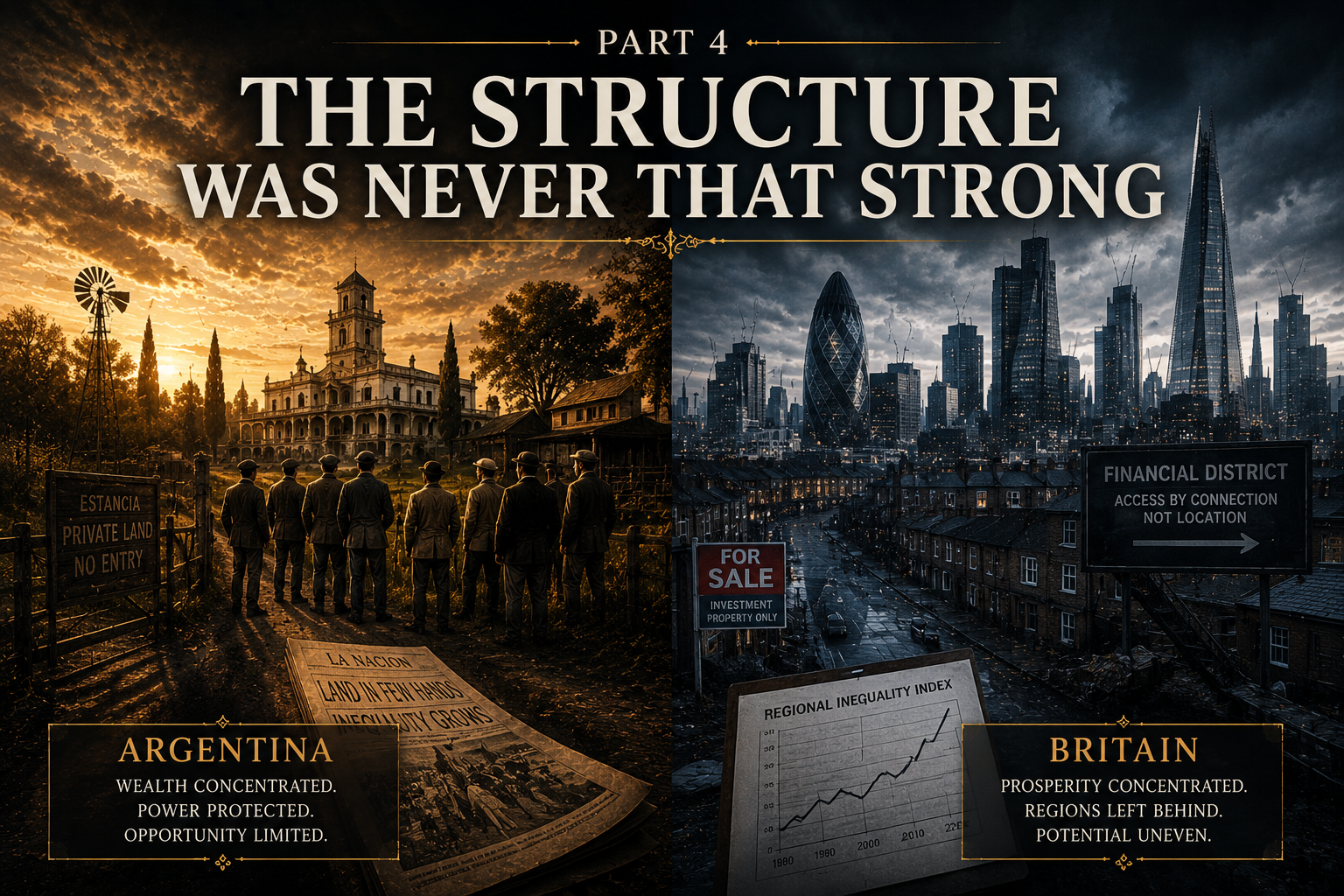
The Structure Was Never That Strong
Prosperity can hide weakness for decades. The question is not only how much wealth a country creates, but how widely its capability is built.
By the time decline becomes visible through movement — through people leaving, investment shifting and confidence becoming uneven — the deeper problem is usually already embedded.
It is structural.
Countries can look enormously successful while relying on foundations far narrower than their national mythology suggests.
Wealth can be concentrated.
Capability can be geographically uneven.
Institutions can appear stable while protecting arrangements that make adaptation harder.
And periods of exceptional success can disguise all of it.
A country can be rich without being resilient. Performance is not the same thing as structural strength.
Argentina: Wealth Built on a Narrow Base
Argentina’s extraordinary early prosperity was real.
But it was not evenly built.
The country’s export economy depended heavily on the fertility of the pampas and on the ability to sell beef, wheat and other commodities into international markets.
Large estates dominated agricultural production.
The landowning class — the estancieros — accumulated enormous economic influence.
In a country where land generated wealth, land ownership also generated power.
Economic concentration therefore became political concentration.
The people benefiting most from Argentina’s model had little reason to dismantle the model while it continued producing extraordinary returns.
This created an important weakness.
Argentina possessed wealth, but much of its prosperity was tied to a specific economic structure:
- large-scale land ownership
- agricultural exports
- foreign investment
- international demand
- infrastructure designed around export
The country was highly productive within that model.
But productivity within one successful structure is not the same as having the capacity to reinvent yourself when the structure changes.
Elite Stability Is Not the Same as National Stability
Strong elites can make a country look stable.
They can also make reform unusually difficult.
Argentina’s political and economic elite were deeply intertwined with the country’s export system.
That meant the institutions governing the country were not operating in a vacuum.
They reflected the distribution of power beneath them.
This is true of almost every society.
But where economic power is highly concentrated, institutional stability can become a form of preservation.
The system remains orderly precisely because the people with the greatest influence have no incentive to alter it.
Stability can sometimes mean the same people continuing to benefit from the same structure.
That works until change becomes unavoidable.
At that point, delayed reform often becomes more disruptive than gradual reform would have been.
Industrialisation Arrives Late
Argentina did industrialise.
But its industrial development was constrained by the success of the export economy that came before it.
When access to imported manufactured goods became more difficult, particularly during periods of international disruption, Argentina increasingly pursued import-substitution industrialisation.
The objective was understandable:
produce domestically what the country had previously imported.
Under Juan Perón, the state expanded its economic role.
Industries were protected.
Workers gained greater political and economic power.
Major infrastructure and utilities were brought under greater state control.
Argentina was attempting to broaden the structure beneath its wealth.
But transformation was difficult because it was taking place after the original model had already shaped the country’s institutions, interests and expectations.
The problem was not that Argentina had never been rich.
The problem was that richness had postponed diversification.
Britain Had Its Own Narrow Foundations
Britain’s economic structure was considerably broader.
It industrialised first.
It developed manufacturing, shipping, finance, engineering, mining and global trade networks on a scale Argentina never did.
Yet British success also concealed weaknesses.
The Industrial Revolution is often remembered as proof of national ingenuity.
And it was.
But Britain did not industrialise because every part of its society was technologically advanced, highly educated and economically inclusive.
It industrialised within a society that remained sharply divided by class.
Political power expanded gradually.
Educational access remained uneven.
Wealth and opportunity were distributed very differently depending on where a person was born and into which social world they entered.
Empire and industrial leadership were powerful enough to conceal those weaknesses.
The Education Myth
One of the most revealing examples is education.
Britain was the birthplace of the Industrial Revolution, yet it was not the earliest European state to build comprehensive systems of mass compulsory education.
Germany developed strong traditions of technical education and links between universities, applied science and industry.
Britain possessed extraordinary universities and elite schools.
But excellence at the top is not the same thing as capability distributed throughout a population.
Britain could produce exceptional engineers, scientists and industrialists while still maintaining an educational system divided sharply by class and geography.
That distinction matters.
As industrial competition became increasingly dependent on chemistry, electrical engineering, technical research and precision manufacturing, broad technical capability became more valuable.
Britain did not dominate because every foundation was stronger. In some areas it dominated despite foundations that later competitors improved upon.
Institutions Can Be Strong and Still Be Compromised
Structural strength is not only economic.
It is also institutional.
Post-war Argentina provides one of the darker examples of this.
After the Second World War, Argentina became a destination for European migrants — including former Nazis and collaborators escaping prosecution.
Adolf Eichmann, one of the principal organisers of the Holocaust, lived in Argentina before Israeli agents captured him in 1960.
Josef Mengele also spent time in Argentina after fleeing Europe.
The presence of Nazi fugitives did not cause Argentina’s economic decline.
It should not be used as a sensational explanation for a far more complicated national history.
But it does reveal something about institutional culture.
Perón’s Argentina was willing to bring European expertise into the country while also tolerating, assisting or failing to prevent the arrival of people implicated in some of the worst crimes of the century.
That tells us something about the distinction between institutional appearance and institutional integrity.
A state can possess ministries, courts, universities, armed forces and formal procedures while still making decisions that expose weaknesses beneath the surface.
Britain’s Geography of Strength
Britain’s modern version of structural imbalance is particularly visible geographically.
London is one of the world’s great cities.
It contains extraordinary concentrations of finance, law, technology, media, culture, universities and international capital.
Parts of the South East benefit from that economic ecosystem.
But national averages can disguise the distance between that prosperity and the experience of other regions.
Former industrial areas have lived through decades of plant closures, weaker investment and the loss of highly productive employment.
Some towns have moved from industries exporting sophisticated manufactured goods to economies increasingly dependent on retail, logistics, hospitality, public-sector employment and lower-wage services.
That does not mean those forms of work have no value.
It means the productive structure underneath the economy has changed.
A country can possess one of the richest cities on Earth while large parts of the country experience something completely different.
Finance Can Hide the Weakness Beneath It
Britain’s financial strength complicates this further.
London remains one of the most important financial centres in the world.
British law, finance, insurance, accountancy and professional services connect the country to enormous flows of global capital.
These are genuine strengths.
But they can also make the national economy appear broader than it is.
A financial centre can generate extraordinary wealth without automatically rebuilding industrial capability in regions hundreds of miles away.
Rising asset values can make households appear wealthier without increasing national productivity.
Property can appreciate while infrastructure deteriorates.
Capital can flow through a country without necessarily becoming productive investment inside that country.
This is where questions about London’s role in international wealth become uncomfortable.
Britain has deliberately built an economy highly open to global capital.
That openness has produced enormous advantages.
It has also created longstanding concerns around opaque ownership, offshore structures, property purchases and illicit or questionable money entering parts of the British financial system.
Again, the point is not that finance is inherently corrupt.
It is that a country can become highly successful at hosting wealth without necessarily producing enough new capability underneath it.
From Broad Capability to Islands of Excellence
This is perhaps the most important structural question facing modern Britain.
Britain still contains areas of extraordinary excellence.
- world-leading universities
- advanced scientific research
- financial and legal expertise
- aerospace and defence capability
- creative industries
- specialist manufacturing
The question is not whether Britain possesses capability.
It plainly does.
The question is whether that capability is broad enough, distributed enough and sufficiently connected to the rest of the economy to support long-term national strength.
Islands of excellence can coexist with national stagnation.
Argentina’s early prosperity showed the same basic danger in a different form.
Exceptional strength in one part of a system can disguise weakness everywhere else.
The Parallel — and the Warning
Argentina and Britain arrived at structural imbalance through very different histories.
Argentina’s prosperity was concentrated around land, agricultural exports and the elites who controlled them.
Britain’s wealth emerged from a far broader industrial, imperial and financial system.
But both cases expose the same analytical mistake:
assuming that visible national strength tells us everything we need to know about the foundations beneath it.
It does not.
The strongest-looking countries can carry weaknesses for decades because success gives them the resources to postpone confronting them.
Eventually, however, structure begins to determine trajectory.
Weak structures do not always look weak.
That is the next problem.
Countries do not need to appear poor in order to be losing productive capacity.
Property can rise.
Financial markets can remain active.
Wealth can remain highly visible.
Governments can continue pointing to headline measures of success.
All while the foundations beneath that wealth become less secure.
Argentina experienced that contradiction repeatedly.
Britain has developed its own version.
Part 5 examines the economic mirage — and why a country can look rich long after its underlying trajectory has begun to change.