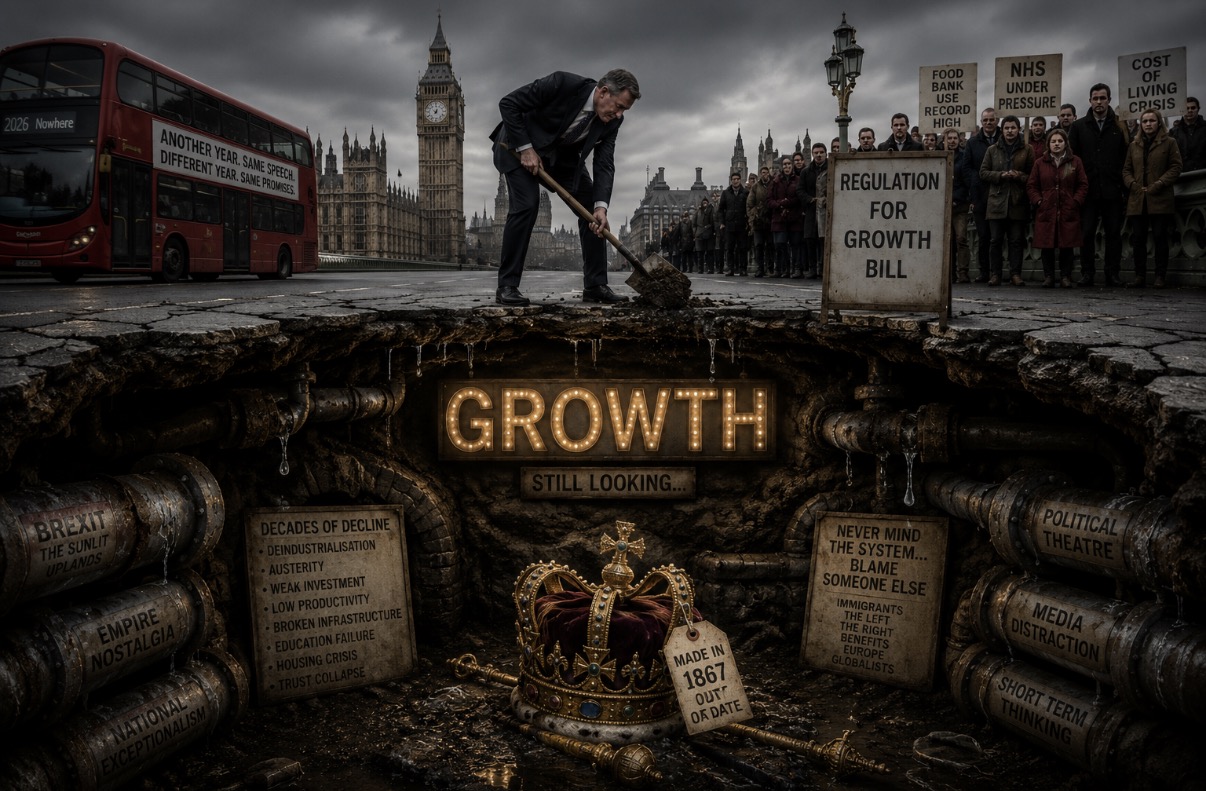
Politics • Britain • King’s Speech • 2026
Regulation for Growth
In a Country Addicted to Pageantry
I didn’t even watch the King’s Speech this year. I genuinely don’t need to anymore. 😭
Every year it’s the same performance: the robes, the ceremony, the ancient rituals, the solemn voices, the “serious moment for Britain.”
THIS is the reset.
THIS is the renewal.
THIS is the growth agenda.
THIS is the reform Britain needs.
Then twelve months later, ordinary people are poorer, more exhausted, less secure, and more distrustful than before. 👍🏾
This year’s masterpiece?
Honestly, I nearly pissed myself laughing.
Because this is Brexit Britain in 2026:
- Weak productivity
- Weak infrastructure
- Weak investment
- Collapsing councils
- Struggling universities
- Housing dysfunction
- NHS pressure embedded permanently into daily life
- Stagnant wages
- Food banks normalised
- Public trust collapsing
- Industrial decline stretching back decades
…but apparently salvation is still one more speech away. 😭
Britain increasingly mistakes pageantry for progress.
And this is where the online conversations underneath became fascinating, because people immediately started emotionally reacting instead of structurally thinking.
Some still genuinely believe Britain can simply:
- Drill more oil
- Regulate harder
- Rediscover “British values”
- Revive empire psychologically
- Speech its way back into prosperity
As though decline is just a motivational issue.
China Builds
- Infrastructure
- Manufacturing dominance
- Industrial strategy
- Supply chains
- Technical education
- Energy leverage
- Technological scale
Britain Produces
- Nostalgia
- Culture wars
- Parliamentary theatre
- Celebrity commentary
- Symbolic politics
- “Growth speeches”
That’s the uncomfortable difference.
And what struck me most in the comments was how many people still psychologically see Britain through the lens of empire rather than reality.
People still talk like we’re a decisive global force shaping the world when materially we’re weaker than we’ve been in generations: economically, industrially, politically, socially, and strategically.
We’re not 1950 anymore. We’re not even 1997 anymore.
But emotionally, parts of Britain still think we are.
People feel decline, but struggle to reconcile it with the mythology they were raised on.
That creates massive structural blindness.
People FEEL decline:
- Weaker living standards
- Weaker trust
- Weaker services
- Weaker social cohesion
- Weaker economic confidence
…but they struggle to reconcile that with the mythology they were raised on.
So instead of confronting systems honestly, politics becomes emotional outsourcing: immigrants, benefits, Europe, the left, the right, globalists, culture wars, celebrities, symbolic enemies.
Anything except deeper systemic analysis.
That’s why the Mick Jagger discussion made me laugh too.
Not because I “hate” Mick Jagger — which some people bizarrely projected onto me — but because it perfectly captured Britain’s late-stage psychological confusion.
A billionaire rockstar suddenly noticing social decline in 2026 is treated like profound wisdom because he’s part of Britain’s cultural mythology.
Meanwhile ordinary people have been living through deindustrialisation, stagnation, housing decline, community collapse, war fatigue, institutional distrust, and economic fragility for decades already.
That isn’t hatred. It’s timing.
And this is the deeper issue:
Britain increasingly confuses commentary with strategy.
Everyone has opinions. Everyone has outrage. Everyone has villains.
But almost nobody wants to confront the machinery underneath:
- Asset extraction
- Low-growth economics
- Financialisation
- Weak industrial planning
- Declining state capacity
- Institutional inertia
- Managed decline hidden behind ceremony
Even the King’s Speech itself now feels like national theatre for a country too exhausted to admit the script stopped making sense years ago.
And the saddest part?
I don’t even think most people are stupid. I think many are psychologically trapped between the Britain they were told existed, and the Britain they can physically feel around them every day.
That gap is where all the anger, confusion, nostalgia, denial, and culture war politics now live.
So when I hear:
“Regulation for Growth”
…I don’t hear confidence anymore.
I hear a political system desperately trying to sound in control while standing on top of decades of structural drift pretending one more slogan can reverse reality. 👍🏾