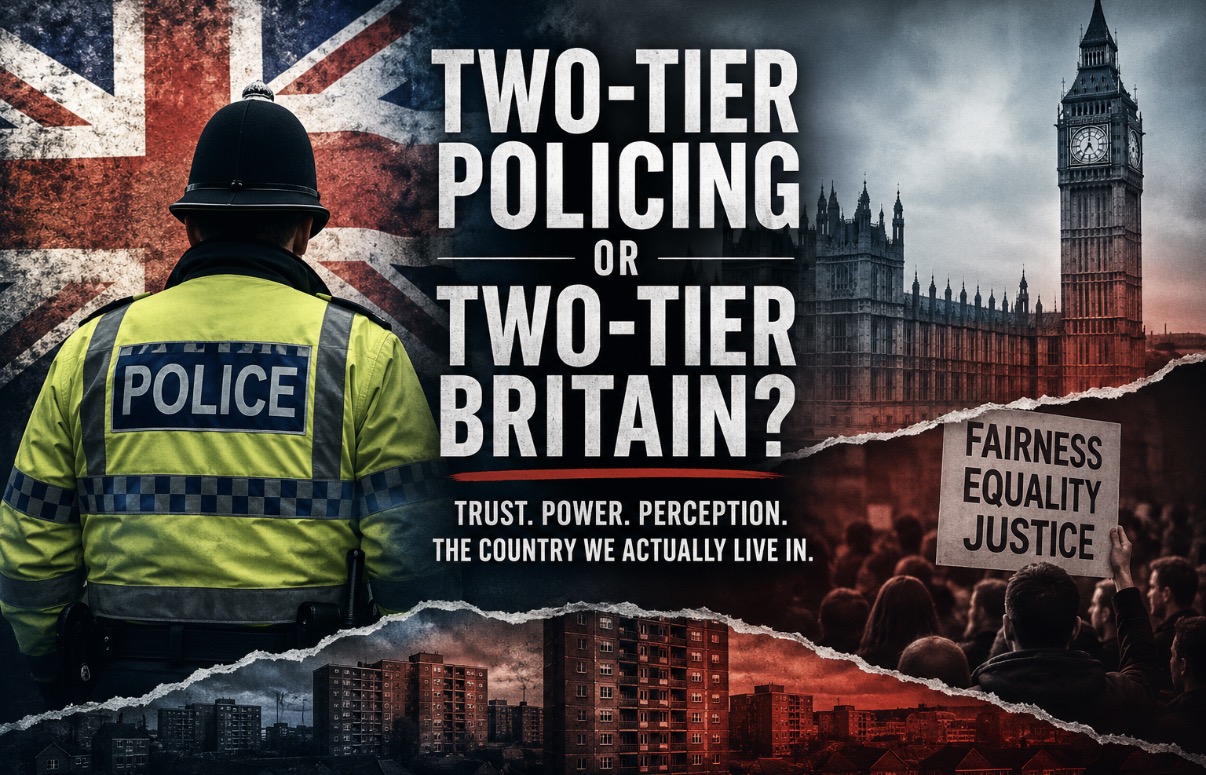
🇬🇧 Observation
Two-Tier Policing
or Two-Tier Britain?
The slogan dominates headlines. But the reality may be less about policing itself and more about trust, decline and the country we actually live in.
Every era creates its own political slogan.
Today, one of Britain’s most powerful slogans is “two-tier policing.”
Yet the more I listen to the debate, the more I wonder whether we are discussing policing at all.
Because before we can talk about two-tier policing, we should probably talk about Britain.
01 / DEMOGRAPHIC CONTEXT
The Country We Actually Live In
9.3%Asian
4.0%Black
2.9%Mixed
2.1%Other
2021 Census breakdown for England and Wales.
These figures matter because context matters.
Britain remains a predominantly white country. Historically, its institutions were built within that demographic reality.
None of this is controversial. It is simply history.
Which is why I find the modern debate fascinating.
The conversation is often framed as though Britain’s institutions appeared yesterday. As though there is no history. As though there is no context. As though discussions about unequal treatment, trust, discrimination and fairness suddenly arrived in Britain five minutes ago.
They did not.
For decades, minority communities raised concerns about policing.
The conversation itself is not new.
What is new is who is having it.
But they were never new.
The question is not whether those debates existed. The question is why some people have only recently become interested in them.
02 / INSTITUTIONAL CONFIDENCE
The Trust Problem
This is where I think the discussion becomes more interesting.
Because I am not convinced this is really a debate about policing. I think it is a debate about trust.
That trust has been falling for years. And when trust collapses, every institution becomes a target.
Nobody believes anyone anymore. Everyone suspects somebody else is receiving special treatment.
That is what declining trust looks like.
03 / MATERIAL PRESSURE
The Backdrop Nobody Wants to Discuss
This is also where Britain’s economic story matters. Because countries do not argue about identity in a vacuum.
Countries argue about identity when people feel anxious. When they feel poorer. When they feel ignored. When they feel left behind.
Britain has spent years debating culture, immigration and identity while often avoiding harder conversations about productivity, investment, housing and growth.
The result is a country that feels stuck.
Against that backdrop, every public institution comes under pressure. Every failure becomes symbolic. Every controversy becomes a national argument. And every disagreement becomes evidence for somebody’s existing worldview.
04 / POLITICAL INTERPRETATION
The Politics of Frustration
Across the political spectrum, there are people who have recognised that public frustration is real. The disagreement is over how that frustration should be interpreted.
All of them are competing to explain the same frustration. And that frustration is genuine.
The danger is assuming that every symptom points to the same cause.
A conversation about living standards becomes a conversation about identity.
A conversation about declining trust becomes a conversation about race.
A conversation about economic stagnation becomes a conversation about policing.
The underlying issue remains unresolved.
05 / CLASS AND EXPERIENCE
Representation and Reality
One of the strangest aspects of modern Britain is how often representation is confused with understanding.
That does not automatically mean it understands the lived experience of ordinary people.
Their experiences are often shaped more by class, income, housing and opportunity than by the culture-war narratives dominating social media.
That does not mean race is irrelevant.
It means reality is more complicated than slogans.
06 / EVIDENCE
Two-Tier Policing or Two-Tier Perception?
This is ultimately why I struggle with the phrase.
They clearly do.
But slogans are not evidence. And headlines are not analysis.
The challenge is understanding whether people are describing a genuine systemic problem or expressing a broader collapse of trust in institutions.
Those are not the same thing. Yet they are increasingly treated as though they are.