The Building That Became More Valuable Dead
Alfa Laval Tower has stood empty beside the M4 since 1996. It has been a hotel, offices, housing and a Hyundai showroom—on paper. Its only enduring purpose has been advertising Britain’s inability to build.
Every time I drive along the M4 flyover through Brentford, I see it.
A large tower standing beside one of the busiest roads entering London. Wrapped in another enormous advertisement. Apparently occupied by a company, a product or whatever image has been stretched across its side this time.
But nobody is working behind that advertisement.
Nobody is living there. Nobody is checking into a hotel room. Nobody is buying a car from a flagship showroom.
The building behind the image has been empty since 1996.
Alfa Laval Tower has now spent approximately three decades in one of the most valuable and connected parts of West London without performing the basic function of a building. It has provided no offices, no homes and virtually no permanent employment.
Yet it has not been economically useless.
That is the important distinction.
It has become useless to Brentford while remaining useful as land, an advertising structure, a planning opportunity and a speculative asset.
The tower did not simply die.
It became more valuable dead.
Thirty years of regeneration
The tower stands on the former Alfa Laval industrial site beside the Great West Road, directly underneath the elevated M4.
It was once occupied by Brentford Nylons and later became part of Alfa Laval’s operation. Alfa Laval left for Camberley in approximately 1996. The tower has been vacant ever since.
The wider site did not remain untouched. Homes and a Premier Inn were eventually built around it. Other parts of Brentford changed dramatically. New apartment blocks appeared. The football club acquired a new stadium. Entire pieces of the area were rebuilt.
The tower remained.
This was not because nobody could think of anything to do with it.
British development rarely suffers from a shortage of proposals. It suffers from an inability to convert proposals into completed places.
By the mid-1990s, plans had already been approved for new office buildings on the site. Further office proposals followed in 1998 and 2000.
A major mixed-use application arrived in 2007. It included offices, a hotel, serviced apartments, hundreds of homes, a health club and community space. That version did not proceed.
In 2010, developer Carlton Properties secured permission for a £100 million regeneration scheme. It promised 206 homes, two hotels, offices, retail or community space and new public areas. Approximately one-third of the housing was intended to be affordable.
The existing tower would be retained and transformed into a 180-bedroom hotel.
At the time, the developers talked about finally returning a strategic derelict site to use.
The surrounding development largely happened. The transformation of the tower did not.
Another permission followed in 2012, this time involving a 159-bedroom hotel, a large car showroom, vehicle servicing and MOT facilities.
Then came Hyundai.
The flagship that never opened
Hyundai originally agreed to occupy a five-storey dealership on the site. In 2016, Hounslow approved a more developed proposal to turn Alfa Laval Tower into a flagship Hyundai showroom and headquarters.
The tower would be converted. New podiums would stand on either side. There would be showroom space, vehicle storage, servicing, repair facilities and MOT testing.
Work began. Parts of the old structure were removed. The previous podium was demolished, leaving sections of the concrete frame exposed.
That beginning mattered legally. It meant the planning permission had been implemented and could remain alive rather than expiring like an entirely untouched consent.
But the flagship showroom was never completed.
Hyundai eventually decided that its business no longer required the project. In 2019, it announced that it would sell the site and concentrate on improving efficiency and securing sustainable growth elsewhere.
The tower was placed on the market for offers above £20 million.
By then, another transformation had been announced, approved, started and abandoned.
Britain had successfully converted an empty office tower into an incomplete car showroom that remained an empty office tower.
The one business that worked
There was, however, one consistently successful use for the building.
Advertising.
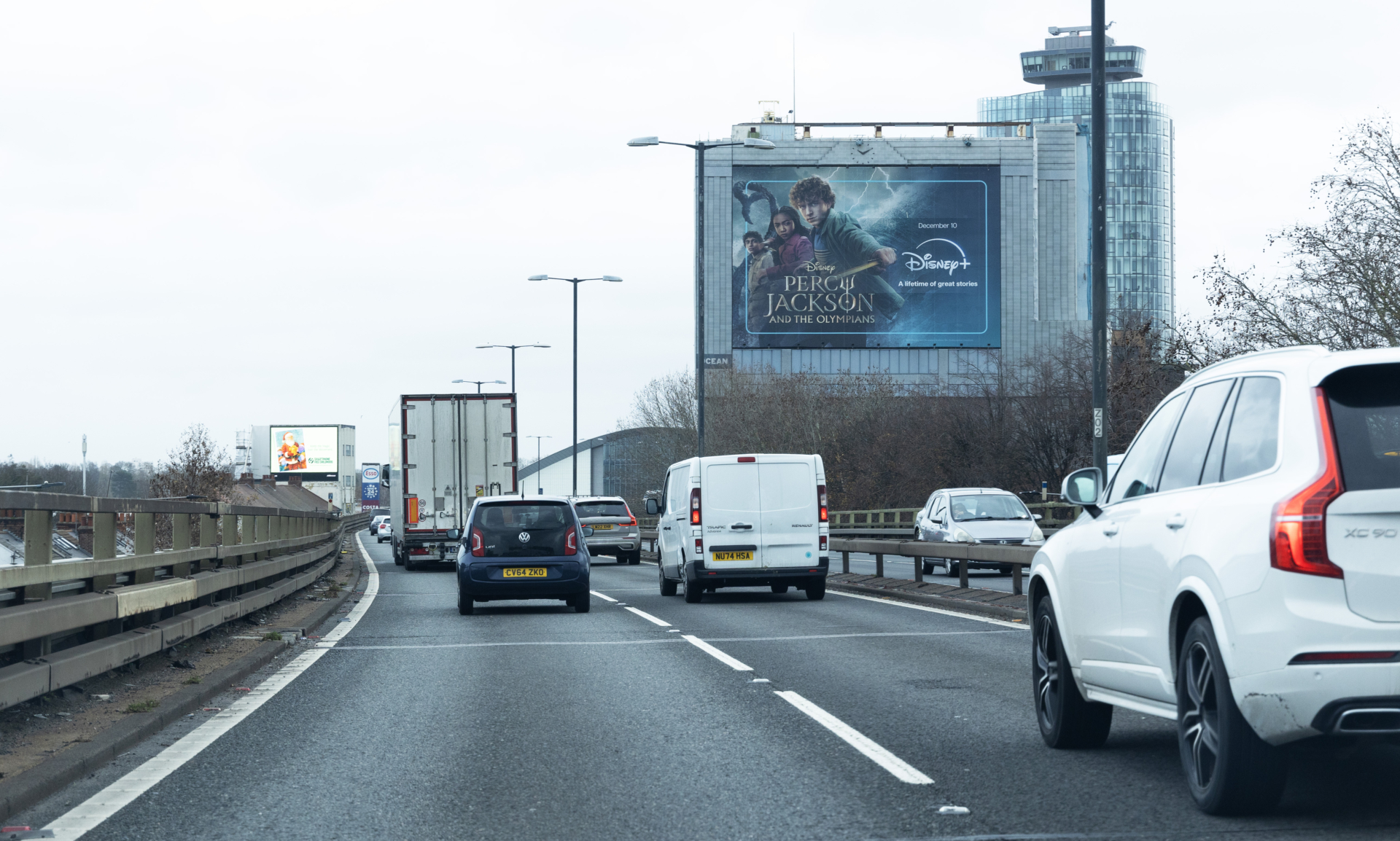
The tower occupies an extraordinary position beside the elevated M4 and Great West Road. The current sales agent estimates that approximately one million vehicle movements pass the property every week.
The walls may be commercially useless as offices, but they are extremely valuable as a place to display an enormous message to passing motorists.
Large advertisements have been attached to the building since approximately 2007. Scaffolding and decorative shrouds have partially concealed its deterioration while turning its western elevation into a giant roadside billboard.
When Hyundai marketed the property in 2019, its agent explicitly promoted the advertising consent as an opportunity to obtain a long-term income stream while retaining the site’s future development potential.
That combination tells us what the building had become.
It could earn something in its present condition while continuing to hold the possibility of a much more valuable development in the future.
The building did not have to function as a building to remain an asset.
It only had to stand there.
The advertisement hiding the advertisement
The absurdity becomes clearest in the planning appeals.
The advertising wrap was tolerated partly because it concealed an obviously deteriorating building while redevelopment was supposedly coming forward. The advert was temporary. The building would eventually be restored or replaced.
But temporary arrangements have a habit of becoming permanent when delay remains manageable.
In May 2024, a Planning Inspector dismissed an appeal seeking to retain a vast illuminated advertisement on the tower.
The Inspector noted that the building had been unoccupied since around 1996, that redevelopment work had ceased and that the structure continued to decay behind its shroud.
Previous inspectors had accepted advertising temporarily while redevelopment progressed. But those decisions stretched back to 2007 and 2019. The supposedly temporary arrangement had become part of the landscape.
The 2024 decision was remarkably blunt. It found no convincing evidence that the owner was actively pursuing a viable regeneration solution and no substantive evidence that a buyer was likely to be found during the requested extension.
The Inspector also recorded an objection suggesting that advertising revenue might itself be discouraging redevelopment.
There was insufficient evidence to establish whether that was true. But the fact that the possibility entered a formal planning decision reveals the central suspicion surrounding the site.
Had failure itself become profitable?
A refusal reversed
That was not the end.
Hyundai continued marketing the property and submitted another application to retain the illuminated advertisement. Hounslow refused it. Hyundai appealed.
In February 2026, a different Planning Inspector overturned the council’s decision and allowed the advertisement to remain until 31 December 2028.
The later appeal contained stronger evidence that the site was genuinely being marketed. Hyundai said it had attempted to sell it since 2019, although Hounslow disputed how continuous that activity had been. The most substantial evidence related to marketing from 2024 onwards.
At the January 2026 hearing, five parties were reportedly expressing positive interest, including several potential bidders. Most of the interest concerned residential redevelopment.
The Inspector concluded that there was now a realistic prospect of plans progressing before the advertising permission expired.
But the reasoning went further.
Hyundai argued that the advertising revenue paid for the shroud and the wider maintenance and management of the site. There was no substantiated evidence before the inquiry that the advertisement produced a meaningful net profit.
According to that argument, the advertisement was not a cash cow. It was paying to hide and maintain the remains of a failed development.
The Inspector accepted that removing it would probably make matters worse. Without advertising revenue, the shroud might not be maintained. Without the shroud, the public would see more of the broken windows, graffiti, exposed concrete and weather-damaged façade underneath.
The advertisement itself was considered harmful because of its enormous size.
But the uncovered building would be more harmful.
The appeal therefore succeeded.
Private neglect had created its own planning justification.
The tower had deteriorated so badly that the income-producing advertisement hiding the deterioration became preferable to the reality underneath it.
The failure had become the advertisement.
Who has paid for all of this?
It would be easy to look at thirty years of planning applications, committee meetings, legal agreements and appeals and declare that millions of pounds of taxpayers’ money had been poured into the tower.
The evidence does not support that claim.
The tower remained privately owned. The hotel, office and showroom proposals were promoted by private developers or companies. I have found no published record showing that Hounslow Council invested a large capital sum directly into renovating Alfa Laval Tower.
Planning applications also generate fees, while major developments can produce Section 106 contributions and Community Infrastructure Levy payments from developers to public authorities.
That is more than £1.5 million in identified developer contributions, although the money related to the wider development rather than the abandoned tower alone.
A later council report stated that the Section 106 contributions associated with the wider redevelopment had been made.
So this is not a straightforward story in which the council handed millions of pounds to a developer and received nothing.
The public cost is more dispersed and, in some ways, more revealing.
For decades, council planning officers have assessed applications, amendments and advertising requests. Committees have considered reports. Council lawyers have worked on agreements. The Greater London Authority and Transport for London have reviewed proposals. Planning inspectors have considered repeated appeals. The most recent appeal required written submissions, a formal hearing and a site visit.
All of that consumes publicly funded time.
But no authority has produced a consolidated figure showing how much it has cost the public sector to manage the consequences of this one privately owned building remaining empty for approximately thirty years.
The planning system divides the expense into so many individual decisions that nobody presents the final bill.
The cost that does not appear in an account
The largest loss may not be money that the council spent.
It is everything the site did not produce.
For approximately thirty years, this exceptionally prominent piece of London land provided no functioning offices, no hotel rooms and no homes. It generated few of the jobs repeatedly promised in its planning documents.
It sat beside major roads, close to Brentford station, around fifteen minutes from Heathrow by car and only a few miles from central London.
Its current sales brochure calls it a “prime residential/mixed-use development opportunity.”
It was a prime development opportunity in the 1990s.
It was still one in the 2000s.
It remained one in the 2010s.
It is apparently one again today.
Opportunity is the one thing this site has never lacked.
Why not just turn it into housing?
The answer is more complicated than shouting “build flats.”
The tower is a deteriorating concrete structure requiring expensive demolition or retrofitting. It stands beside an elevated motorway, with the noise and air-quality implications that follow. Existing homes border the site. It sits within the wider setting of Kew’s World Heritage Site. Planning policy has historically allocated the plot for commercial use, and the location has not automatically been accepted as suitable for another very tall residential development.
A 2019 attempt to obtain prior approval for residential conversion was refused.
None of that makes redevelopment impossible. It means a viable proposal must reconcile planning policy, design, heritage, transport, environmental conditions, construction costs and the price somebody expects to receive for the land.
That final issue matters.
A site can be technically developable and still remain untouched if the owner’s price assumes a level of development that the planning system will not permit or the market will not finance.
The current asking price has not been disclosed.
In 2019, Hyundai wanted more than £20 million.
A building can remain empty not because it has no value, but because it has too much speculative value for anybody to use it realistically.
Announcements are not buildings
When Andy Burnham—or any politician—talks about building homes, transforming regions or making Britain work again, Alfa Laval Tower is the kind of case they should be forced to explain.
Not because one politician is personally responsible for one tower in Brentford.
Because this is where the rhetoric meets the machinery.
Britain does not lack housing announcements. It does not lack regeneration strategies, opportunity areas, consultations, design documents or planning permissions.
Alfa Laval Tower has been offices, two different hotels, a car showroom, a service centre, an MOT station, housing and mixed-use redevelopment.
It has been all of them except in reality.
Politicians celebrate granting permission as if permission were the same thing as construction. Developers announce proposals as though a computer-generated image is evidence of delivery. Landowners retain assets through repeated economic cycles. Councils process one application after another but possess limited practical means to force a privately owned site into productive use.
Then everyone announces another housing target.
A serious system would eventually say:
You have had sufficient time.Build the approved development. Sell the site at a price that allows somebody else to develop it. Maintain the structure properly. Or face an escalating financial consequence for leaving scarce urban land unusable.
Instead, planning permission can become another feature in a sales brochure. The possibility of development adds value even if development never takes place. An advertising consent produces income or at least covers the cost of managing the decay. The owner waits for a buyer, a policy change or a more profitable proposal.
The building remains motionless while the paperwork around it continues to move.
Britain behind the curtain
Alfa Laval Tower is currently being marketed once again.
The agents describe a 12-storey shell prepared for demolition. Existing permissions could allow a hotel or the previously commenced car-showroom scheme. A future owner could pursue residential or mixed-use redevelopment, possibly incorporating additional height if the planning obstacles can be overcome.
Perhaps one of the interested parties will finally buy it.
Perhaps a viable housing proposal will emerge. Perhaps the tower will be demolished and something useful will eventually occupy the site.
But the advertising consent now runs until the end of 2028.
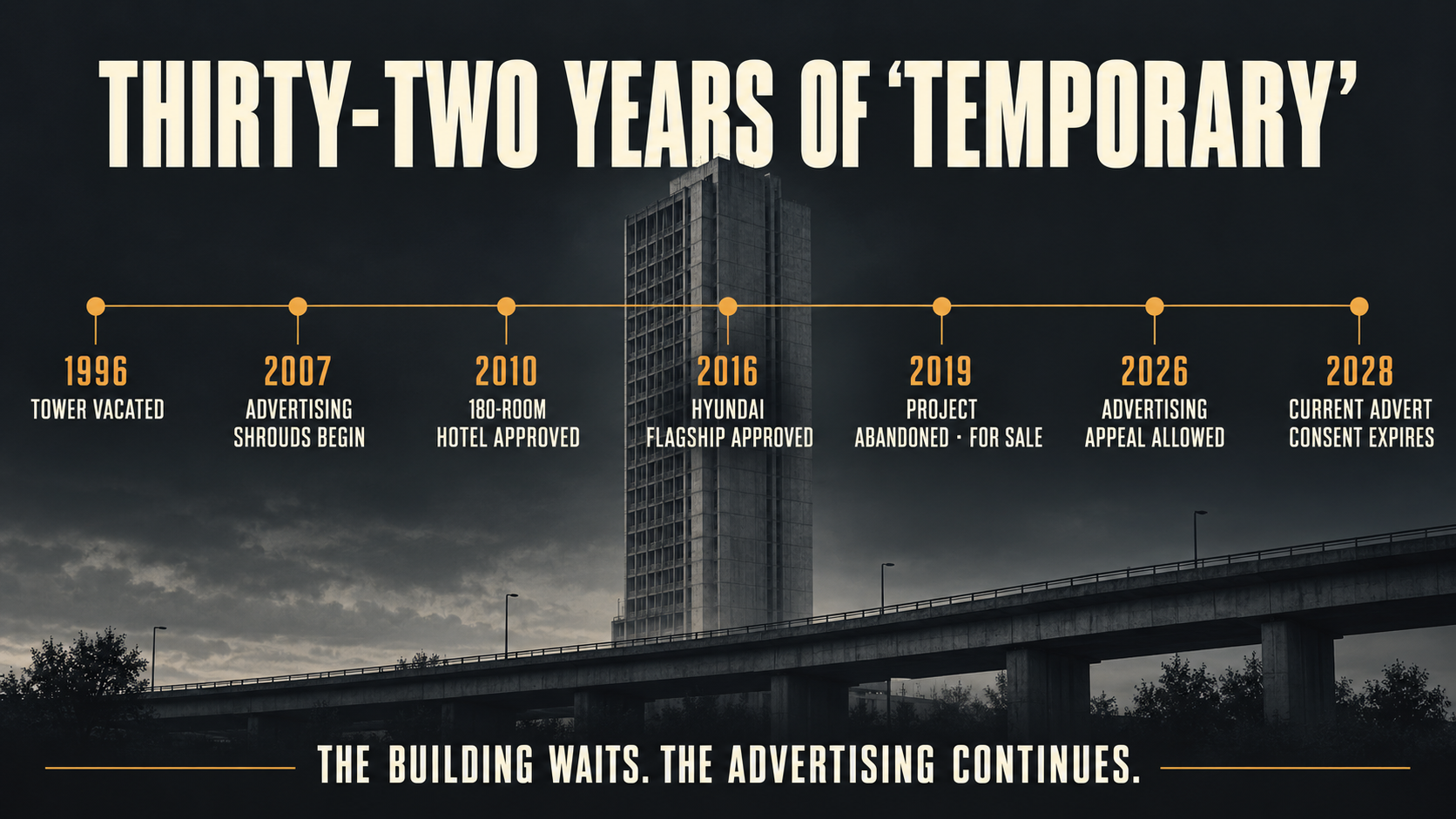
By then, Alfa Laval Tower will have stood empty for approximately 32 years.
A child born when Alfa Laval left the building could have completed school, graduated, started a career, bought a home—if they could afford one—and had children of their own.
The tower would still have spent that entire lifetime waiting to become something.
That is why it matters.
It is not merely an ugly building beside a motorway. It is a physical record of the distance between British announcements and British delivery.
The advertisement wants motorists to look at the product printed across the surface.
Look behind it.That is Britain.
Sources and records
- London Borough of Hounslow planning records: former Alfa Laval site applications 00505/Z/P33, P34, P35 and P36.
- Greater London Authority, Former Alfa Laval Site planning reports PDU/1455b/01 and PDU/1455b/02.
- Planning Inspectorate decisions APP/F5540/Z/23/3331032 and APP/F5540/H/25/3371898.
- Vail Williams, Alfa Laval Tower sales particulars, December 2024.
- Avison Young, “Hyundai to sell Alfa Laval Tower, West London”, 27 June 2019.
- Ocean Outdoor, ALPHA Banner location and campaign gallery.