Another Big Change.
Another PureGym.
I went back to a gym I once used with my brother and found another piece of post-COVID Britain being stripped down, standardised and sold back to us as progress.
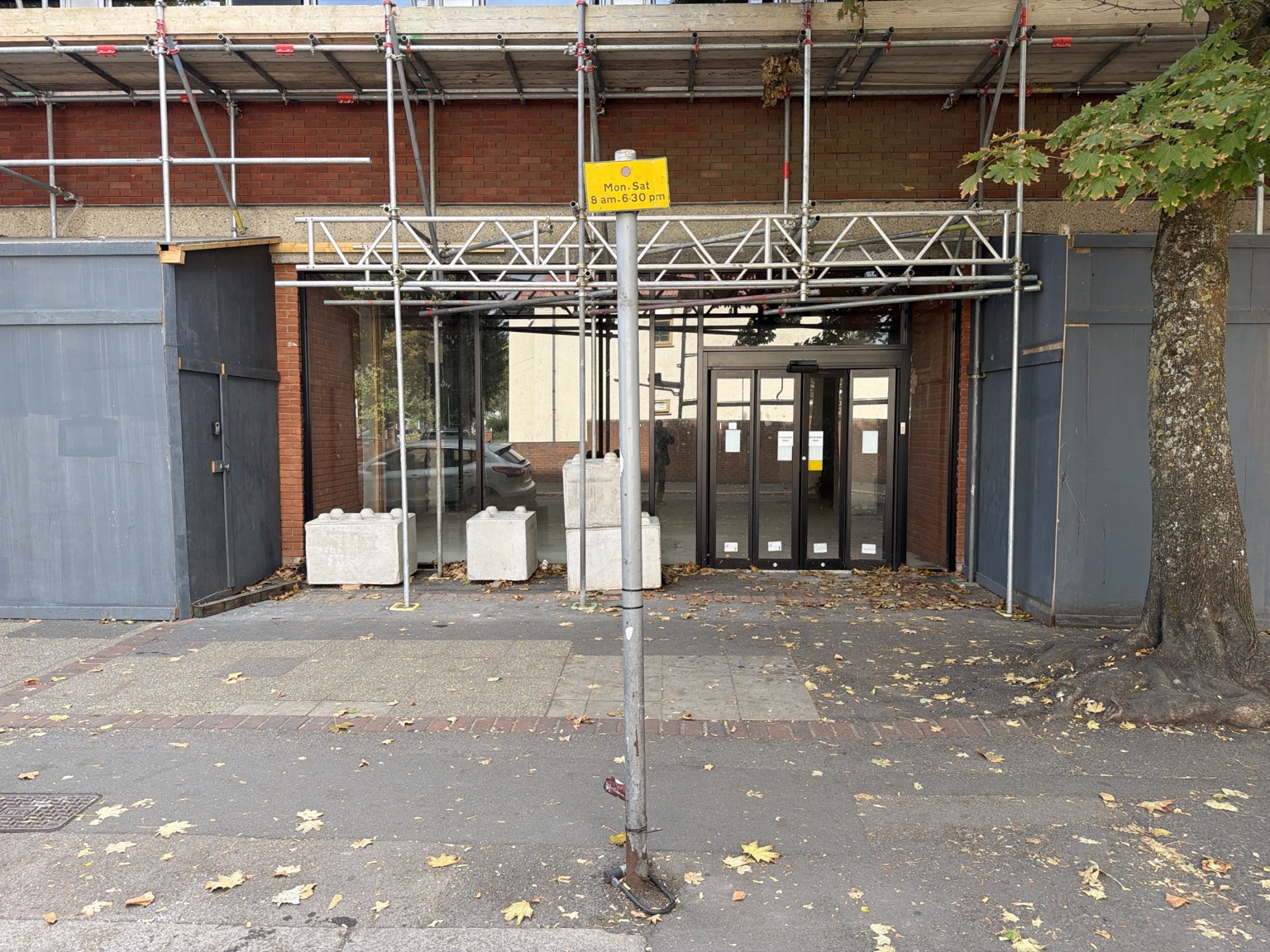
I was standing in New Malden looking at a red-brick building hidden behind scaffolding when the place began to feel familiar. I knew that entrance. I knew the shape of the building. Then I remembered: this was Fitness4Less, the gym I used to visit with my brother.
I had not come looking for a story about gyms. I had simply looked up and discovered that another ordinary part of my recent life had changed while I was somewhere else.
That keeps happening to me around London. A building is still standing, but the business has gone. A service is still advertised, but half of what made it useful has disappeared. A familiar name has been replaced by a national chain. The country has not vanished in one dramatic collapse. It is being altered unit by unit, lease by lease and app by app.
I remember the place because it was not merely a room containing treadmills and weights. It had a 15-metre swimming pool. It had a sauna and steam room. It had a jacuzzi. You could train, swim, sit in the heat and leave feeling as though you had actually been somewhere.
That was why the membership made sense to me. I was not paying only for access to equipment. I was paying for the complete experience.
Temporary became permanent
The jacuzzi disappeared first. It was covered during COVID and never reopened. Contemporary customer reviews remember the same thing. Other members complained about cold water, unreliable heating and wet facilities that no longer felt like the service they had originally joined.
My recollection is that heating and operating costs became part of the explanation. Whatever the precise internal decision, the result was familiar: an emergency measure became a permanent reduction.
That pattern now sits across post-COVID Britain. Something closes temporarily. The public adjusts. Months pass. The temporary closure quietly becomes the new operating model. The price may remain, but the provision does not.
I stopped seeing the value. If the jacuzzi was gone and the wider leisure offer was being hollowed out, I was no longer paying for the thing that had attracted me in the first place.
This is why the distinction between pre-COVID and post-COVID Britain matters. The country was already being hollowed out before the pandemic. Brexit added friction, cost and uncertainty to an already weak economic model. COVID then accelerated decisions, closures and consolidations that might otherwise have taken years.
I cannot prove that Brexit closed this particular gym, and I am not pretending that I can. The direct story here is about operating costs, competition, corporate scale and the survival of a smaller chain. But the building belongs to the wider landscape: a country emerging from two enormous shocks with less resilience, fewer independent operators and a growing habit of accepting reduced services as normal.
The gym survives by becoming something else
Fitness4Less has now left New Malden. PureGym is preparing to open at the same Blagdon Road address. Its advertised offer is familiar: 24-hour access, more than 80 pieces of equipment, app-based entry, classes and a lower introductory price.
For many people, that will be useful. Someone working late shifts may value being able to train at two in the morning. Someone interested only in weights may prefer a cheaper membership without paying for a pool. New equipment and longer opening hours are genuine benefits.
But they do not make this an equal replacement.
Fitness4Less New Malden
- Gym and instructor-led classes
- 15-metre swimming pool
- Jacuzzi before its closure
- Sauna and steam room
- A staffed health-club experience
PureGym New Malden
- 24-hour app-controlled access
- 80-plus pieces of equipment
- Gym-floor classes
- No pool advertised
- No jacuzzi, sauna or steam room advertised
The building will remain a gym. That is precisely what makes the loss easy to overlook. The lights will come back on. People will exercise there. The replacement may attract more members and remain open for more hours.
On a spreadsheet, this can be presented as an improvement. In lived experience, a health club offering several forms of exercise and recovery has become a room of machines accessed through a phone.
From a small British operator to American private equity
Fitness4Less is not a saintly community organisation. It is a private business and its British owner wanted to make money. But it was a small independent operator, founded in 2005, that once ran roughly a dozen clubs and now advertises only four. Its New Malden branch visibly invested in a complicated local service: a pool, heated rooms, changing facilities, water treatment, cleaning, maintenance and a large programme of classes.
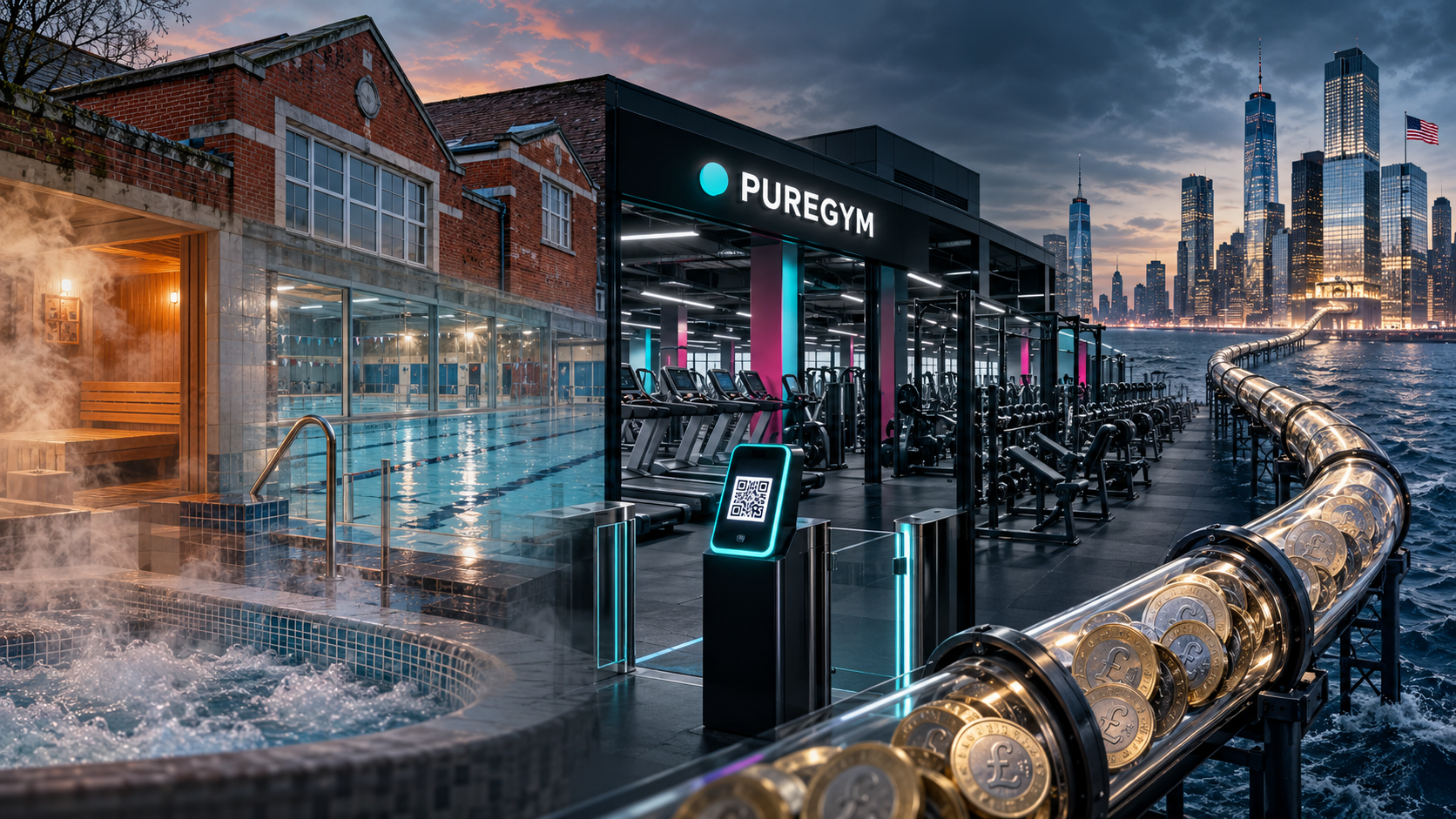
PureGym operates on another scale entirely. It is Britain’s largest gym chain and part of an international group with hundreds of sites and millions of members. The group is controlled by the American private-equity firms Leonard Green & Partners and KKR alongside management.
The distinction matters. PureGym still employs people in Britain. It pays rent, business rates, payroll taxes, VAT and any corporation tax arising on taxable profits. Foreign ownership does not mean that every pound immediately leaves the country, and this article is not alleging illegal tax avoidance.
But ownership determines who ultimately benefits from growth. It determines where strategic decisions are made and where profits, interest payments and investor returns can eventually flow.
Those figures do not prove wrongdoing. They show the financial architecture behind the brightly lit gym floor. Corporation tax is charged on taxable profit, not revenue. Large financing costs can reduce accounting and taxable profits. The honest question is therefore not whether PureGym pays “nothing”, but how much value generated by British members remains in British wages, facilities and reinvestment—and how much services debt or produces returns for international investors.
We also cannot state the exact reduction in employees at this one site without internal staffing records. Yet the operating logic is obvious. Remove the pool, jacuzzi, sauna and steam room and you also remove much of the heating, water treatment, cleaning, maintenance, supervision and customer service associated with them. Combine that with app entry and unstaffed hours, and the business can serve more memberships with a leaner physical operation.
The app economy does not merely replace the receptionist with a QR code. It replaces facilities, labour and local character with software, surveillance and scale.
Longer opening hours. Less underneath.
We are repeatedly told to count openings rather than examine replacements. Ten new branches are described as investment. A national brand taking another unit is called confidence in the high street. The number of available memberships rises, so the market appears healthier.
But ten app-controlled gyms do not necessarily replace ten health clubs. More outlets can coexist with fewer facilities, fewer workers per customer and less locally retained economic value.
That is the post-COVID landscape I keep encountering. The institution survives in name while its substance thins out. A bank becomes an app. A staffed counter becomes a QR code. A health club becomes a room of machines. The replacement is often more convenient and less human at exactly the same time.
Britain was being hollowed out before COVID. Brexit did not create every weakness, but it accelerated the separation from our largest market and added another layer of cost and friction. COVID then gave institutions an emergency language for reducing services. Energy prices supplied the next explanation. By the time normality returned, “normal” had been rewritten.
I do not expect every jacuzzi to be preserved forever. Businesses change, buildings change and customers change. Fitness4Less itself had clearly contracted and may no longer have been able—or willing—to support what it once offered.
But we should at least describe the exchange honestly.
New Malden is gaining a 24-hour PureGym.
It is also losing a swimming pool, the remains of a health suite and another small piece of local difference.
That is not nothing. And it is not automatically progress simply because the doors reopen.
I only noticed because I happened to look up.
Sources and notes
- PureGym: London New Malden gym listing — address, 24-hour model and advertised equipment.
- Royal Borough of Kingston: petition concerning the New Malden pool.
- Fitness4Less — current ownership description, history and remaining locations.
- Companies House: Fitness4Less Group Limited.
- PureGym corporate history — ownership and expansion.
- PureGym 2024 full-year results.
Personal recollections are identified as such. The private-equity illustration is editorial and metaphorical, not a diagram of individual payment transfers.