Public Observations · Britain after Brexit
Brexit Is Back.
The Bill Never Left.
The vote was delivered. The economic damage was absorbed. The politicians moved on. Now Brexit has returned for another conference-season performance—with a new cast, the same arguments and still no chain of accountability.
Brexit is back.
Not because Britain has suddenly developed a workable plan to rejoin the European Union. Not because Parliament has completed an honest assessment of what leaving cost. Not because the European Union is waiting outside with a membership form and a plate of humble pie.
Brexit is back because it is political conference season.
This is silly season with lanyards: the annual gathering at which politicians manufacture urgency, journalists manufacture contests and broadcasters fill entire programmes with questions that nobody in power is remotely prepared to answer.
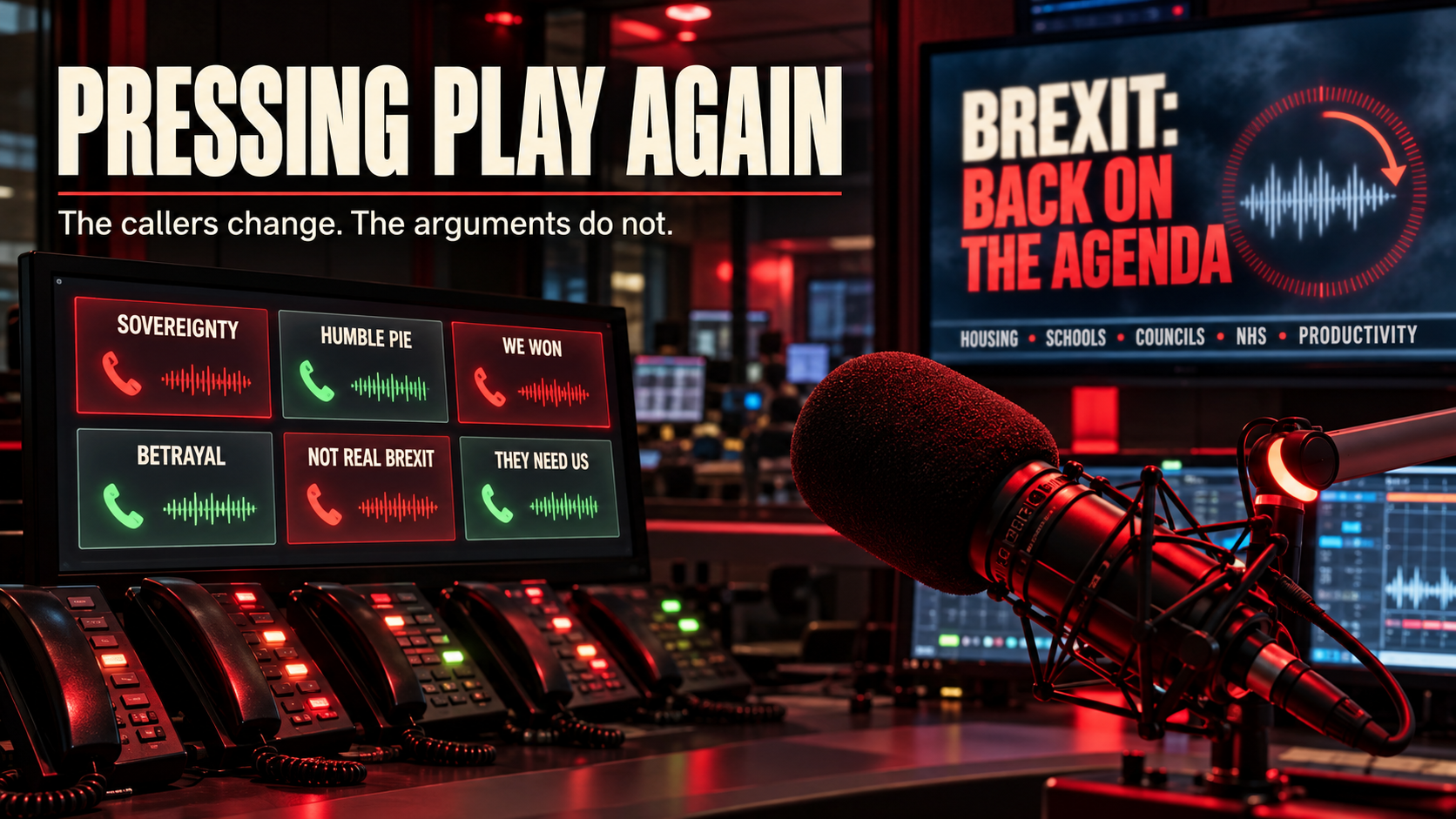
Before long, the phones light up. LBC has another debate. One caller says Britain must crawl back and apologise. Another says Brexit would have worked if only the politicians had believed in it. A third insists that the European Union needs Britain more than Britain needs the European Union.
The callers change. The arguments do not.
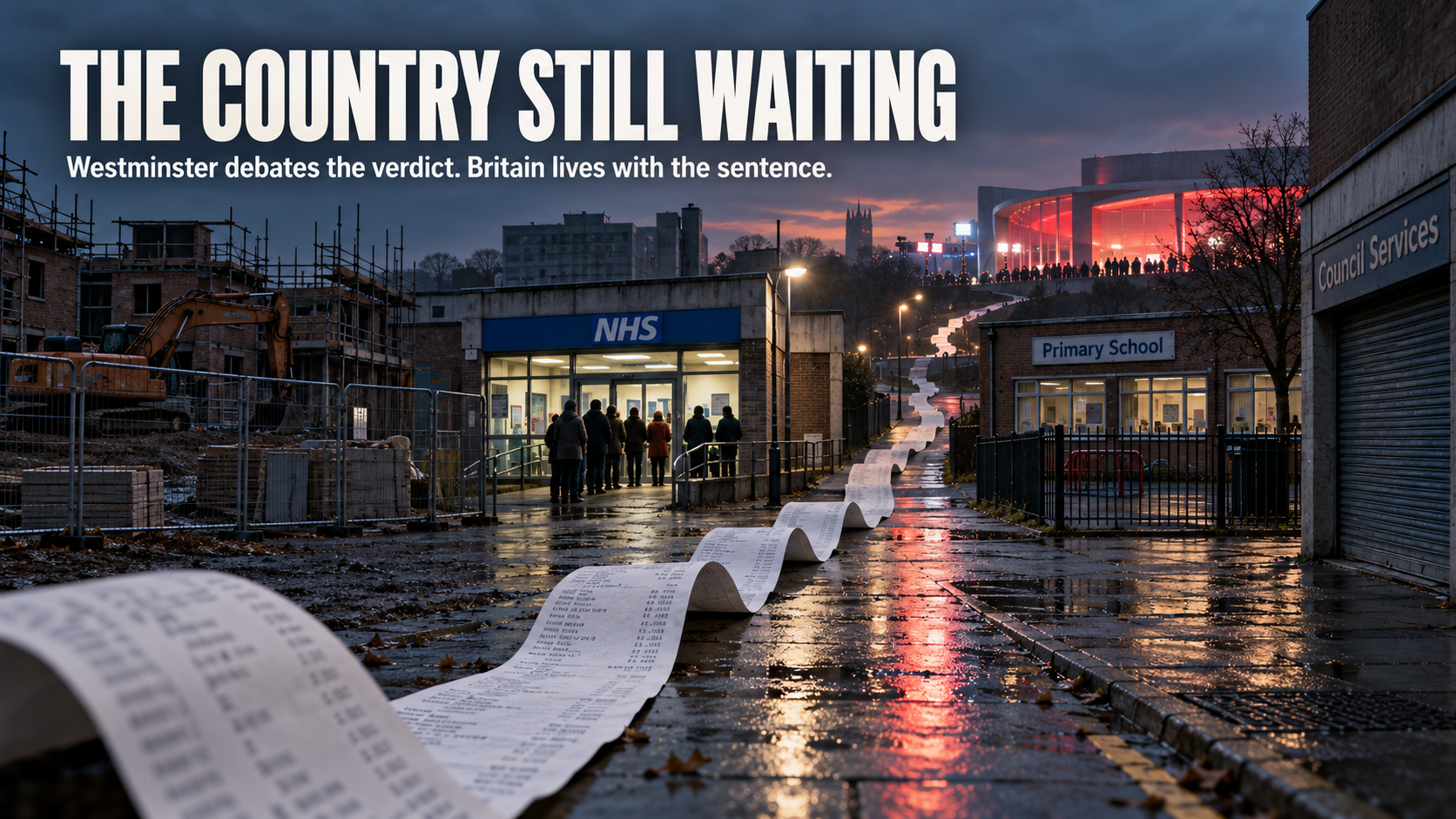
Meanwhile, Britain still has a housing shortage. Schools are struggling. Councils are cutting services. NHS patients are waiting. Productivity remains weak. Government debt is close to £3 trillion.
But for several days, the country can pretend that another argument about Brexit constitutes government.
That is the real attraction of reopening the debate: Brexit takes up airtime without requiring anybody to build anything.
The vote was delivered. The bill is still arriving.
THE WISH LIST
The Manifesto Before the Manifesto
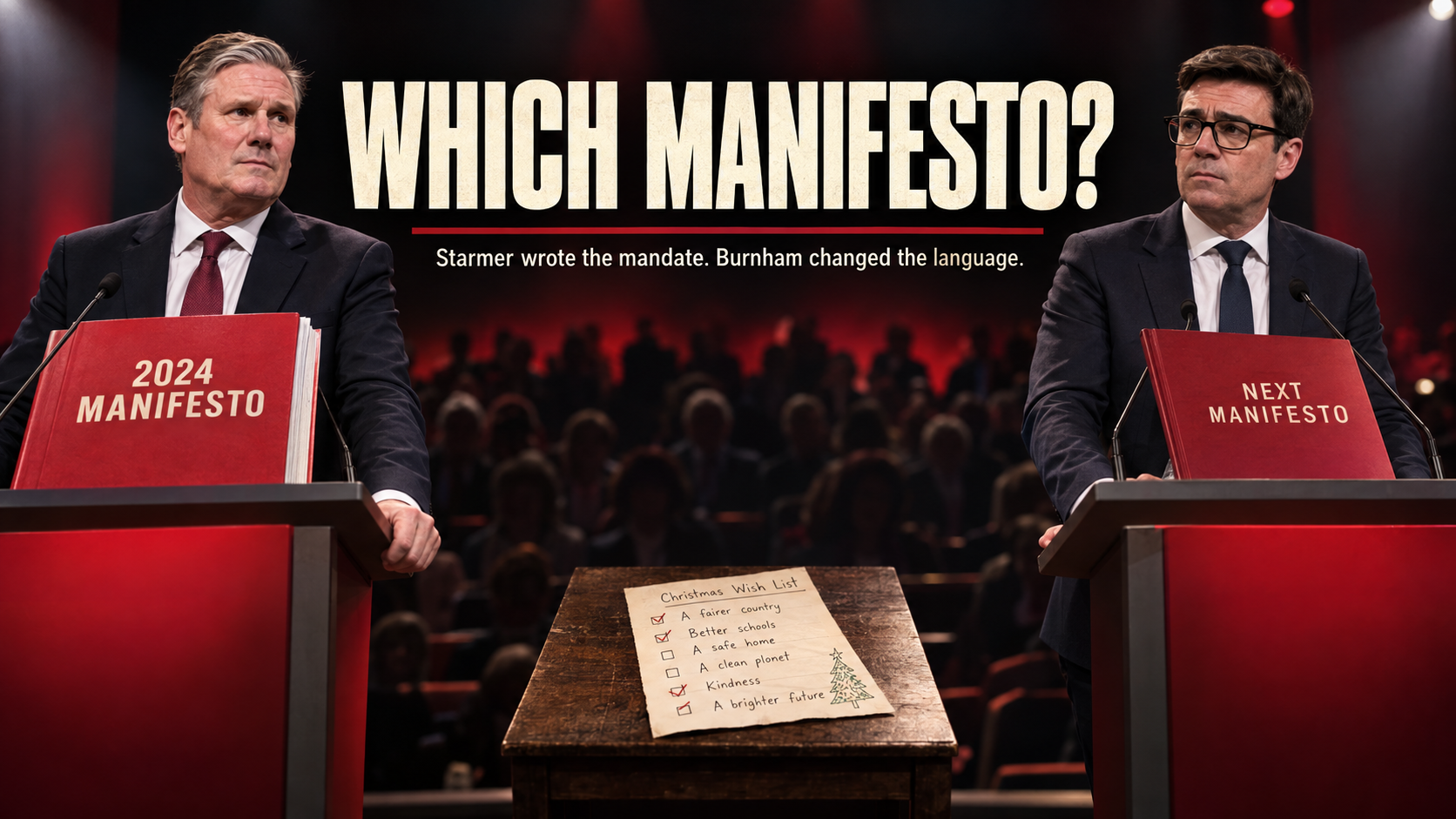
Before discussing what Andy Burnham might place in Labour’s next manifesto, it is worth remembering which manifesto produced the present government.
It was not Andy Burnham’s manifesto.
Labour won the 2024 general election under Keir Starmer’s leadership and on Keir Starmer’s programme. That manifesto explicitly rejected a return to the European Union, the single market, the customs union and freedom of movement. It promised a better relationship with Europe, fewer unnecessary trade barriers, a veterinary agreement, improved arrangements for professional qualifications and a security pact—but within the constitutional reality created by Brexit.
Starmer then went further during the campaign. He said he could not foresee Britain rejoining the EU, the single market or the customs union in his lifetime.
It was a ridiculous hostage to give to history.
A prime minister can describe the policy of his government. He can make a commitment for one Parliament. He cannot sensibly predict the strategic position of the country for the remainder of his life. Governments fall. Economies change. Wars happen. Institutions evolve. Public opinion moves.
Nevertheless, the statement revealed Labour’s political calculation. It wanted to improve Britain’s relationship with Europe without reopening the question of membership.
Burnham inherited that government and that parliamentary mandate. Britain has not had another general election. There is no new Labour election manifesto simply because Labour has changed leader.
A party conference speech is not a manifesto. A newspaper interview is not a manifesto. Refusing to rule something out is not a manifesto either.
Burnham has said that, before the next election, his government will retain Starmer’s existing red lines. But when he was asked whether reversing Brexit might appear in Labour’s next manifesto, he did not rule it out. Instead, he said that rejoining was an issue “for another day” and that his immediate priorities were practical agreements, trade and rebuilding Britain’s relationship with the EU.
That is a change of language, not yet a change of policy.
In May, Burnham said he was not proposing that Britain rejoin. He acknowledged the damage caused by Brexit but argued that reopening the old division could leave Britain trapped in a “permanent rut.” Now he is leaving the door slightly open for a future manifesto.
What else could he realistically do?
Rule it out for his lifetime, as Starmer did, and he repeats an unnecessary mistake. Promise it now, and he consumes his government with a fight for which it has neither prepared the country nor obtained a mandate.
So the wording changes while the immediate policy remains where it was.
Manifestos and Father Christmas
We sometimes discuss manifestos as though they were binding contracts. They are not.
A manifesto is a publication setting out the policies a party says it wishes to implement if elected. That is Parliament’s own definition. It carries political significance and, through the Salisbury convention, can carry constitutional importance. But it does not possess the force of a commercial contract.
A manifesto is closer to the Christmas list I used to give my mum for Santa.
Here is everything I would like. Here is everything I say I will do. Here is the world as I would prefer it to be. The list does not tell you what is affordable, what survives contact with reality or what will still be remembered by February.
Labour’s next manifesto could promise to explore rejoining. It could promise a referendum. It could promise a customs union or closer participation in the single market.
None of those promises would place Britain back inside the EU.
A British manifesto cannot bind 27 other governments.
That is the fact missing from most of the phone-in theatre.
POWER WITHOUT OWNERSHIP
The Parliamentary Chain
Brexit is repeatedly described as “the will of the people,” as though those five words suspend every institution that came afterwards.
They do not.
The 2016 referendum produced a political instruction to leave. It did not specify the eventual trade agreement, the treatment of services, the customs system, the regulatory settlement, the Northern Ireland arrangements or the long-term economic strategy.
Those decisions were made through a parliamentary chain:
The electorate voted. Parliament legislated. Governments negotiated. MPs approved the agreements. Institutions implemented them. Businesses and households absorbed the consequences.
At every link in that chain, somebody exercised power.
The referendum did not negotiate the Trade and Cooperation Agreement. The electorate did not decide to leave Erasmus+. Voters did not draft the Northern Ireland Protocol. A ballot paper did not choose between a customs union and a thin free-trade agreement.
Politicians did.
Yet when the consequences arrive, responsibility travels backwards. Ministers point to the referendum. MPs point to the electorate. Brexiteers blame civil servants, Remainers, Brussels, judges, businesses, migrants—or insufficient belief.
Everybody participated in delivering Brexit, but nobody appears to own the finished product.
That is parliamentary power without parliamentary accountability.
Brexit cannot be allowed to fail on its own terms because failure would require somebody to accept responsibility for the design. Instead, every failure becomes evidence that “real Brexit” was never attempted.
Brexit can never fail. It can only be betrayed.
Tony Blair eventually became the human container into which much of the responsibility for Iraq was poured. Whether one considers that fair, incomplete or overdue, the country attached the decision to a recognisable political author.
Brexit has no equivalent accountability.
David Cameron called the referendum and resigned. Theresa May negotiated and fell. Boris Johnson declared it done and left office. Parliament approved the withdrawal legislation. Successive governments administered the consequences. The opposition accepted the central settlement.
Now Britain discusses Brexit as though it were a natural disaster for which nobody could possibly have prepared.
Where is the comprehensive Brexit inquiry?
Where is the full examination of the promises, the decision-making, the trade-offs, the institutional damage and the difference between what Parliament was told and what it approved?
Parliament has conducted inquiries into parts of the UK–EU relationship and the attempted reset, but there has been no single public reckoning with Brexit comparable to the inquiries Britain demands after other major state failures.
The country was asked to vote once. It has been invoiced ever since.
THE CALL-IN LOOP
Pressing Play Again
LBC is useful here because talk radio reproduces the national argument in miniature.
One side says Britain must return to Brussels carrying humble pie.
The other says leaving was correct and that the problems have been caused by politicians failing to deliver it properly.
Both positions frequently turn a complicated institutional question into an emotional drama about national confidence.
Britain voted to leave. Sovereignty has been restored. Rejoining would betray the referendum. If Brexit is failing, it is because Britain remained too closely aligned for “real Brexit” to work.
Brexit was national self-harm. Britain should admit its mistake, accept less favourable terms and return. Economic necessity will eventually overwhelm the politics.
Neither side controls the offer. The terms would be negotiated with 27 EU member states.
The reality neither phone-in controls
The terms would be decided through negotiation with the European Union.
Britain cannot simply reverse the 2016 vote like restoring a deleted file. It would have to apply under Article 49, demonstrate durable political commitment, satisfy the accession criteria, negotiate every policy chapter and secure the unanimous agreement of all member states. National ratification would then be required across the union.
No country has ever left the EU and subsequently rejoined. Britain would be asking the EU to create the precedent.
Nor should Britain assume that its former privileges would be waiting in storage. The old budget rebate, bespoke opt-outs and carefully accumulated exceptions were features of Britain’s previous membership. EU diplomats have repeatedly indicated that a future application would not automatically recover them.
Freedom of movement would return as part of full single-market membership. Budget contributions would return. EU law and the jurisdictional structure supporting it would return. The questions of Schengen and eventual euro commitments would have to be negotiated, not dismissed on a British radio programme.
Most importantly, the EU would want evidence of lasting national consent.
Why would 27 countries spend years negotiating Britain’s return if a future British government might stage another referendum and leave again?
Before Britain could persuade Europe, it would have to persuade itself.
That consensus does not presently exist.
THE LEDGER
The Money We “Saved”
The crudest Brexit argument was always the easiest to remember: Britain sends money to Brussels, so leaving means Britain keeps it.
Before Brexit, the UK’s average net contribution between 2016 and 2019 was approximately £7 billion to £7.5 billion a year once public-sector receipts were included.
That was real money. Leaving ended the ordinary membership contribution.
But a saving is not the same thing as a profit.
If a company saves £100 by cancelling its internet connection and subsequently loses £1,000 of business, it has reduced one outgoing while making itself poorer.
The Office for Budget Responsibility’s central assessment remains that Brexit will reduce the UK economy’s long-run potential productivity by approximately 4% relative to remaining in the EU. It links that damage to lower trade intensity, with imports and exports eventually around 15% lower than they otherwise would have been.
More recent academic work has estimated that by 2025 Brexit may already have reduced GDP by 6% to 8%, investment by 12% to 18%, employment by 3% to 4% and productivity by 3% to 4%. Those estimates are higher than the OBR’s and should not be treated as identical measures, but they point in the same direction: the economic loss is substantially larger than the annual membership contribution.
That lost output matters because GDP is not an abstract scoreboard. A smaller economy means lower wages, weaker investment and a narrower tax base. A narrower tax base means either higher taxes, lower public spending or more borrowing.
This is how Brexit appears in everyday government—not as a line marked Brexit cost, but as less room to do everything else.
The Wrong Comparison
People still boast about the money Britain no longer sends to the EU while ignoring the amount Britain now sends to its creditors.
In the first five months of the 2026–27 financial year, debt-interest spending reached approximately £50 billion. August alone cost £8.8 billion, the highest August figure since monthly records began. Debt interest is expected to remain above £100 billion a year across the forecast period.
Brexit did not single-handedly create Britain’s debt or its interest bill. The pandemic, energy prices, inflation, quantitative easing, gilt structure and wider fiscal decisions all matter. It would be dishonest to present every pound of interest as a Brexit cost.
But the contrast destroys the fantasy of liberation through budget arithmetic.
Britain previously made an average net EU contribution of around £7 billion to £7.5 billion a year. It is now spending more than £100 billion a year servicing debt while operating an economy that official forecasters expect to be permanently less productive because of Brexit.
Saving the membership contribution did not make the country fiscally free.
It merely removed one visible payment while the wider economic bill became harder to identify.
Even the departure bill did not disappear. The Treasury’s estimated net cost of the financial settlement is around £30.2 billion, with some liabilities continuing for decades.
The number on the side of the bus was always the smallest part of the ledger.
LEAVE, REPLACE, RETURN
We Left the Programmes and Started Buying Our Way Back
Brexit was sold as escape from a system Britain could reproduce independently.
In practice, Britain has spent much of the period since leaving constructing replacements, underwriting disruption or paying to reassociate with programmes it once helped shape.
Horizon Europe and Copernicus
After years of delay and uncertainty, the UK associated with Horizon Europe and Copernicus from January 2024.
That was the sensible outcome. British researchers regained access to major European research networks and UK organisations could again compete for funding. But Britain returned as an associated country, paying an operational contribution and a participation fee rather than influencing the programme as an EU member from inside its institutions.
We left the room, spent several years arguing in the corridor and then paid for a visitor’s pass.
Erasmus+ and Turing
The UK left Erasmus+ and introduced the Turing Scheme as its replacement.
Turing supported outward placements for UK students, but it was not an equivalent institutional replacement. It did not reproduce Erasmus partnerships or reciprocal inward mobility on the same basis. Government education statistics explicitly note that Turing generated no export revenue because it supported outward UK mobility only.
For 2026–27, Turing’s budget is up to £78 million. It will then cease operating, because Britain has agreed to associate with Erasmus+ again from 2027. The estimated UK contribution for 2027 is approximately £570 million.
That does not prove the £570 million is wasted. Erasmus offers considerably more than Turing and may provide significant educational and economic value.
It proves something more awkward: sovereignty did not eliminate the need for shared European systems. It changed the terms on which Britain accesses them.
Leave. Replace. Discover the replacement is narrower. Negotiate to return. Pay for access.
That is not independence in any meaningful operational sense. It is interdependence with less influence.
Who Has Gone Back?
Nobody.
Croatia became the EU’s most recent new member in 2013. Since Brexit, no former member has rejoined—because no other member has left.
Several countries remain candidates or potential candidates, but their accession paths demonstrate the scale of the process. Membership requires legal alignment, institutional reform, economic preparation, political agreement and unanimous consent.
Britain would not be returning home after a brief misunderstanding. It would be making a fresh application to an institution that has changed since it left.
That is why the phrase “go back in” is misleading.
There is no reverse gear.
There is only a new negotiation.
THE ILLUSION BEFORE THE EXIT
Europe Did Not Save Britain From Britain
There is another myth hiding beneath the rejoining debate: that Britain was prosperous and properly governed until it left the European Union.
It was not.
Britain joined the European Economic Community in 1973. The European single market began in 1993, and the European Economic Area followed in 1994. As an EU member, Britain participated in the EEA through its EU membership. Goods, services, capital and people could move across a large integrated market under broadly shared rules.
That arrangement gave Britain access, investment, workers, research partnerships and considerable economic protection.
But membership never relieved Britain of the responsibility to govern itself.
Europe did not decide how many council houses Britain built. It did not force Westminster to sell public utilities. It did not instruct successive governments to concentrate growth in London, allow regional economies to weaken or build an economic model around finance, consumption, property and household debt.
Those were British choices.
What Britain Did While It Was Inside
- Allowed large parts of its manufacturing base to contract.
- Privatised water, energy, rail, telecommunications and other strategic assets.
- Sold more than two million homes through Right to Buy.
- Failed to replace most of the social housing it lost.
- Shifted economic power towards finance and property.
- Allowed regional productivity gaps to persist.
- Weakened organised labour and collective bargaining.
- Relied increasingly on imported goods, imported energy and international capital.
- Used rising house prices as a substitute for wage growth and productive investment.
- Expanded higher education without building an economy capable of using everybody’s qualifications.
- Introduced austerity after the financial crisis and hollowed out local government.
- Allowed essential services to depend on a constant supply of workers from abroad without investing adequately in domestic training, housing or infrastructure.
The European Union did not prevent any of this.
But it did not cause most of it either.
That distinction matters.
The Houses Were Sold Here
Since Right to Buy began in 1980, more than two million homes have been sold to tenants in England. Local-authority housing stock fell from approximately 4.8 million homes in 1981 to about 1.57 million in 2024—a reduction of 67%, partly through sales and partly through transfers to housing associations.
That did not happen because of Brussels.
It happened because British governments treated public housing as an asset to be disposed of rather than national infrastructure to be maintained and expanded.
Individuals understandably took the discount placed in front of them. The policy failure was selling the homes without replacing them.
For a time, the consequences could be disguised. Existing homeowners accumulated wealth as property prices rose. Banks extended more mortgage credit. Consumer spending increased. Government collected transaction taxes. The country appeared richer because the price of the assets it already owned was increasing.
But a more expensive house is not another house.
Britain confused asset inflation with national development.
By 2007, the average house in England and Wales cost roughly 6.5 times average annual household income, compared with around 3.5 times in 1997.
The country had not doubled the usefulness of its homes in ten years. It had made access to them substantially more expensive.
The Factories Closed Here
Britain’s deindustrialisation also took place while the country was inside the European project.
Some of that transformation was shared across advanced economies. Technology changed production. Globalisation moved lower-cost manufacturing. Services became more important. It would be simplistic to suggest that every closed factory could or should have been preserved indefinitely.
But Britain made a particularly aggressive political choice to abandon industrial capacity and trust that finance and services would replace it.
The result was not a country without work. Employment eventually recovered and, before the pandemic, reached historically high levels. But the composition and geography of employment changed.
Well-paid industrial work disappeared from many communities. The new jobs were often geographically concentrated, less secure or less productive. London became one of the richest and most productive regions in Europe while parts of the rest of Britain recorded productivity comparable with significantly poorer European regions.
The Midlands illustrates the shift. In the mid-1970s, average incomes there were slightly above the national average. By 2015–16, average incomes in the East Midlands were approximately 6% below the national average and those in the West Midlands around 9% below it.
Britain remained a rich country in aggregate.
The problem was where the wealth was generated, who owned the appreciating assets and how little of the prosperity was converted into durable national capacity.
Migration Helped Maintain the Model
Freedom of movement became the most emotionally powerful argument against EU membership.
But migration also helped keep Britain’s weak economic model functioning.
European workers staffed hospitals, care homes, hospitality, agriculture, construction, logistics and food production. They paid taxes, rented homes and supported demand. Most research found that the fiscal impact of EEA migration was positive but relatively small. One major assessment estimated that EEA migrants made a positive net contribution of approximately £8.8 billion over the period it examined.
Migration increased the size of the economy because more people were working, earning and spending. That allowed governments to advertise headline GDP growth even when productivity and output per person were far less impressive.
But migration was not the underlying failure.
The failure was that the state often expanded the workforce without expanding the physical and social infrastructure around it.
Britain welcomed additional workers but did not build enough homes.
It recruited overseas nurses while failing to train and retain enough nurses domestically.
It relied on migrant care workers while refusing to finance a sustainable care system.
It allowed businesses to recruit from a continent-wide labour market without demanding corresponding investment in skills, technology and productivity.
The government enjoyed the additional tax receipts but frequently failed to ensure that rapidly growing communities received matching investment in schools, surgeries, transport and housing.
That created a visible pressure which politicians could blame on migration while concealing the policy decisions underneath it.
The workers did not fail to build Britain.
The British state failed to build around the workers.
THE CONVENIENT OUTSIDER
The Foreign Criminal and the Innocent Briton
Then we arrive at the phrase British politics can never resist: foreign criminals.
Listen to the discussion for long enough and you could believe criminality was imported into a previously innocent country—that everybody arriving from Europe was potentially dangerous while everybody holding a British passport was presumed respectable.
Of course, when some people say “British,” what they frequently mean is white British. A non-white citizen can possess a British passport, be born here and spend their entire life here, yet still be asked where they are really from. Meanwhile, a white offender is simply an offender. His nationality disappears from the headline.
A crime committed by a British citizen is treated as an individual act.
A crime committed by a foreign citizen becomes an argument about immigration.
That distinction is political, not criminological.
Britain Did Control Its Border
It is not accurate to say that EU freedom of movement meant Britain had no border controls.
The UK was never part of the Schengen border-free area. British authorities retained the right to inspect the documents of everyone arriving from continental Europe, including EU citizens. The government itself emphasised this before the referendum.
Freedom of movement was also not an unconditional right for every European citizen regardless of conduct. EU law allowed a member state to refuse entry or remove someone on grounds of public policy, public security or public health.
The threshold was deliberately higher than simply disliking somebody’s nationality or discovering an old minor conviction. The authorities generally had to consider the individual’s conduct and whether they represented a genuine and sufficiently serious present threat.
Britain therefore had powers.
The question is how competently Britain used them.
What Britain Did Not Have
A passport check is not the same thing as comprehensive criminal vetting.
For much of the period of free movement, an EU citizen arriving at a British port was not routinely required to present a complete criminal-record certificate from every country in which they had lived. Nor did a border officer automatically receive a person’s entire European criminal history merely by scanning a passport.
Information depended upon alerts, database access, cooperation between national authorities and British agencies correctly entering, requesting and acting upon the data.
Britain did not join the second-generation Schengen Information System until April 2015—less than fifteen months before the referendum.
SIS II allowed participating countries to share real-time alerts concerning people wanted for arrest, suspected terrorists, missing people and stolen documents or property. The government presented Britain’s eventual participation as a major security improvement.
Between April 2015 and April 2016, more than 6,400 alerts created elsewhere in Europe produced matches in the UK, while more than 6,600 British alerts produced matches overseas.
That tells us two things.
First, European cooperation helped Britain identify wanted people.
Second, Britain had spent decades inside the European project before fully participating in one of its most important real-time alert systems.
That was not freedom of movement preventing Britain from protecting itself. It was a British government making a late decision about which European justice arrangements it wished to join.
The Government That Failed to Act
There were also people who committed crimes in Britain, completed prison sentences and should then have been considered for removal.
The National Audit Office repeatedly found failures in the management of foreign-national offenders.
Its 2014 investigation concluded that the Home Office had made slower progress than expected in identifying, managing and removing offenders. Despite additional resources and tougher powers, the number imprisoned and the number removed had remained broadly unchanged since 2006.
The report found that 1,013 foreign-national offenders had been released without first being considered for deportation.
That is an institutional failure.
But notice how responsibility is translated politically.
When the Home Office fails to identify an offender, exchange information, begin deportation proceedings or secure the necessary documentation, the resulting scandal is rarely presented primarily as a failure of the Home Office.
It becomes a failure of immigration.
The foreign national becomes the entire story. The British department that lost track of him becomes administrative background.
Once again, the parliamentary chain disappears.
The electorate did not administer the border. Brussels did not manage British prisons. Freedom of movement did not prevent the Home Office from knowing who was in its custody.
British institutions possessed information, powers and responsibilities. They did not always use them competently.
Europe Also Helped Britain Remove Criminals
The European system was not merely a route through which offenders could enter. It also supplied mechanisms through which Britain could identify, arrest and return wanted people.
The European Arrest Warrant allowed suspects and convicted offenders to be surrendered between participating countries without relying on the slower traditional extradition process.
SIS II distributed those warrants and other alerts directly to police and border authorities. When another European country issued an arrest warrant, it could appear in British systems—and British alerts could be acted upon elsewhere.
Following Brexit, Britain lost access to SIS II. The post-Brexit agreement preserved much police and criminal-justice cooperation, but it did not preserve that database access.
Britain gained greater discretion over the immigration treatment of EU citizens while losing access to one of the continent’s most immediate law-enforcement information systems.
That is the familiar Brexit exchange: more visible sovereignty, accompanied by less direct operational access.
A Passport Is Not a Character Reference
None of this means foreign-national offending should be ignored.
A government has an obligation to know who is crossing its border, act on credible security information and remove non-citizens who commit serious offences when the law permits it. People are entitled to expect basic competence.
But nationality is not a theory of crime.
Britain produces its own murderers, rapists, fraudsters, traffickers, abusers and organised criminals. A British passport does not provide evidence of good character any more than a foreign passport provides evidence of guilt.
The difference is that Britain cannot deport its own citizens and should not pretend that it can solve domestic criminality through border policy.
The political phrase “foreign criminals” performs a useful trick. It isolates a group of offenders whose nationality permits an additional punishment—removal—and encourages the public to imagine that the danger itself arrived from somewhere else.
There is rarely equivalent talk of:
- British criminals;
- British men committing violence against women;
- British fraudsters stealing public money;
- British employers exploiting workers;
- British landlords breaking housing law;
- British companies laundering criminal proceeds;
- British politicians misleading the public.
Their Britishness is considered irrelevant.
Foreignness, by contrast, becomes the entire explanation.
Who Was Actually Being Vetted?
Britain wanted the economic benefits of labour mobility without constructing an administration capable of managing movement properly.
Employers wanted workers.
Government wanted tax receipts and higher headline GDP.
Ministers wanted hospitals, farms, warehouses, hotels and care homes staffed without confronting the domestic failures that had produced labour shortages.
But the state did not consistently invest in enforcement, data systems, housing, inspections or local services.
Then, when an offender passed through the gaps, politicians presented themselves as spectators.
Who let this happen?They did.
Who controlled the Home Office?They did.
Who decided when Britain joined European information systems?They did.
Who failed to consider some offenders for deportation before releasing them?They did.
Yet the blame was transferred first to the offender’s nationality, then to freedom of movement and finally to the European Union.
The same British state that had failed to administer the system asked the public to believe that Brussels had removed its ability to act.
The Convenient Foreigner
The foreign criminal became useful because he carried several failures at once.
He could be used to represent uncontrolled borders, weak policing, dangerous migration and European interference. His individual crime could be expanded into an indictment of millions of people who had committed no crime whatsoever.
The British offender could never perform the same political function. He would force the country to examine its own families, institutions, poverty, violence, policing, courts and prisons.
The foreign offender allowed Britain to look elsewhere.
That does not protect the public. It protects the government.
A serious country would separate three questions:
- Did an individual commit an offence?
- Did the British authorities possess and use the information and powers available to them?
- What does the evidence establish about migration overall?
British politics collapsed all three into one word: foreign.
It was another way of making a British administrative failure somebody else’s fault.
Europe did not require Britain to assume that every arrival was a saint.
Britain simply preferred talking about foreign criminals to explaining why its own systems repeatedly failed to identify, manage and remove the people who posed a genuine threat.
The European Umbrella
EU membership helped hold this model together.
The single market gave British companies low-friction access to a vast customer base. Foreign firms used the UK as a platform for European investment. Universities participated in European research networks. British citizens could live, study and work across the continent. Agricultural support, regional development funding and European social programmes transferred resources into communities that Westminster had often neglected.
Shared European regulations established minimum standards in areas including employment rights, food safety, consumer protection and the environment.
This did not make the EU a charitable organisation, nor did it make every European rule wise. Britain contributed financially and accepted common obligations in return for participation.
But EU membership gave Britain a stable external economic framework while successive British governments neglected the country’s internal foundations.
Europe became the scenery behind an illusion of prosperity.
The City generated enormous income. Property values rose. Cheap goods arrived through integrated supply chains. Employers could recruit workers from across the continent. Governments could point to rising total GDP.
Underneath that performance, Britain was selling public assets, underinvesting in infrastructure, weakening its industrial base and becoming increasingly dependent on finance, housing wealth and consumption.
Then the financial crisis exposed the weakness.
Average income in 2016–17 was projected to be only about 5% higher than it had been in 2007–08. Regional disparities persisted. Productivity growth deteriorated. Austerity transferred the pressure into councils, benefits and public services.
By the time of the referendum, millions of people were being told that Britain was prosperous while living in places where the evidence of that prosperity was increasingly difficult to locate.
The EU became an easy container for grievances created in Westminster.
Brexit Was the Wrong Diagnosis
Britain correctly identified that something had gone wrong.
It incorrectly identified the institution responsible.
The communities that voted to leave were not imagining decline. Many had experienced deindustrialisation, insecure employment, weak wage growth, deteriorating high streets and disappearing public institutions.
The deception was telling them that these outcomes had been imposed primarily by Europe.
Leaving the EU could not rebuild council housing sold by British governments. It could not reverse privatisations enacted by the British Parliament. It could not create an industrial strategy that British ministers had chosen not to pursue. It could not redistribute wealth from London and the south-east. It could not repair local government or restore collective bargaining.
Brexit removed one of the external supports from an already weak domestic model.
It placed new barriers between Britain and its largest market without replacing the investment, institutional capacity or productive economy that Britain had allowed to decline.
The country blamed the umbrella because it was still getting wet. Then it threw the umbrella away without repairing the roof.
Rejoining Would Not Repair the Roof
This is also why rejoining cannot be presented as a complete economic programme.
Closer European integration could reduce trade friction, improve investment, expand opportunities and restore access to shared institutions. Those benefits matter.
But EU membership would not automatically build council houses, reconnect towns, reform planning, restore local government, train workers or rebalance the economy.
Britain managed to neglect all of those things while it was a member before.
The lesson is not that Europe was irrelevant. Brexit has demonstrated how economically important membership and market access were.
The lesson is that neither membership nor withdrawal can substitute for governing the country.
Britain declined under the European umbrella because Britain was dismantling itself underneath it.
Brexit did not start that process.
It merely removed the cover.
WHAT HAPPENS NOW
Rejoining Is Not the Immediate Answer
It is possible to believe that Brexit made Britain poorer while also believing that rejoining is not presently realistic.
Those positions are not contradictory.
The United Kingdom does not currently possess the political stability, institutional preparation or durable public consensus necessary to begin a credible accession process. Labour has no electoral mandate for it. Parliament has not established the terms it would accept. The country has not agreed whether it would restore freedom of movement. Nobody knows which former opt-outs, if any, could be recovered.
The EU is also dealing with enlargement, defence, Ukraine, industrial competition, migration, energy and its relationship with the United States and China. It does not exist to rehabilitate Britain.
The more credible path is less dramatic:
- Reduce agrifood barriers through a veterinary agreement.
- Improve mutual recognition of professional qualifications.
- Complete agreements on electricity trading and carbon markets.
- Protect integrated manufacturing and automotive supply chains.
- Expand youth mobility.
- Deepen security and defence cooperation.
- Align regulations where the economic benefit exceeds the value of theoretical divergence.
- Rebuild trust through stable commitments that survive British leadership changes.
This is less emotionally satisfying than “take back control” or “rejoin now.”
It is also more useful.
Britain does not need another fantasy in the opposite direction. It needs an honest policy for being a medium-sized European economy that has voluntarily placed barriers between itself and its largest market.
The Daydreaming State
The deepest problem is not that Britain talks about Brexit.
The problem is that political debate has become a substitute for economic capacity.
The country is not building enough homes. Local government has been hollowed out. Infrastructure is expensive and slow. Schools and hospitals are under pressure. Investment remains weak. Taxes rise because the state is trying to finance growing demands from an economy that struggles to produce enough growth.
Yet Parliament remains extraordinarily good at producing theatre.
MPs received a 5% pay increase in April 2026, taking the basic salary to £98,599. The increase was set independently by IPSA rather than awarded directly by ministers, but that distinction will mean little to households being told that their own services and living standards must remain constrained.
The public experiences government as higher tax, higher bills, longer waits and fewer functioning services. Politics experiences the same period as another opportunity to speculate about a manifesto that does not yet exist.
This is what a country does when it no longer believes it can change material conditions: it retreats into arguments about identity, sovereignty and symbolic victory.
It daydreams.
Brexit became the original fantasy. Rejoining can become another one if it is sold as an instant cure for problems Britain also created domestically.
Membership would not build homes, restore council capacity, reform planning, train workers, repair the NHS or produce an industrial strategy automatically.
But Brexit has made several of those tasks harder by weakening trade, investment, labour mobility and state revenue.
The answer is neither pretending Brexit succeeded nor pretending rejoining would absolve Britain of responsibility for everything else.
The answer is to understand the machinery.
The Bill Never Left
The referendum result happened.
Brexit happened.
Britain left the European Union, left the single market and left the customs union. Parliament approved the withdrawal settlement. The government negotiated the future relationship. The argument about whether the vote should have been respected is over because the decision was implemented.
What remains is accountability for the version of Brexit that Parliament chose.
Instead, we have developed a national system in which everybody can blame somebody else:
The Conservatives blame Europe.
Labour blames the Conservative deal.
Brexiteers blame Remainers.
Remainers blame the voters.
Politicians blame the referendum.
Parliament blames the government.
The government blames global conditions.
And the public pays the invoice.
That is why another week of Brexit broadcasting will resolve nothing. One side will demand an apology to Brussels. The other will demand another helping of sovereignty. Presenters will ask whether Britain should rejoin. Callers will repeat arguments they perfected years ago.
Then the political circus will move on.
The houses will remain unbuilt. The school will still need money. The council shutter will remain down. The patient will still be waiting.
Britain is unlikely to rejoin the European Union in the foreseeable future—not because Brexit worked, and not because membership would offer no economic benefit, but because the country lacks the mandate, consensus, negotiating position and institutional readiness required to make it real.
Until those facts change, rejoining is not a programme for government.
It is another talking point.
The vote was delivered.
The politicians escaped.
The bill never left.