Scene · Everyday
Brexit Took the Apple Pie Too
The deli survived. The meat is still good. But the chef left, his recipes went with him, and nothing replaced the pie.
I still go back occasionally.
It is an upmarket deli, the sort of place where the prices can make you hesitate until you compare them with what the supermarkets are charging.
Meat is expensive everywhere now. If Tesco or Sainsbury’s already wants serious money for something that seems to shrink the moment it reaches the pan, you may as well spend a little more with a proper butcher and come home with something better.
So I still buy meat there.
But I used to go much more often.
The reason was the apple pie.
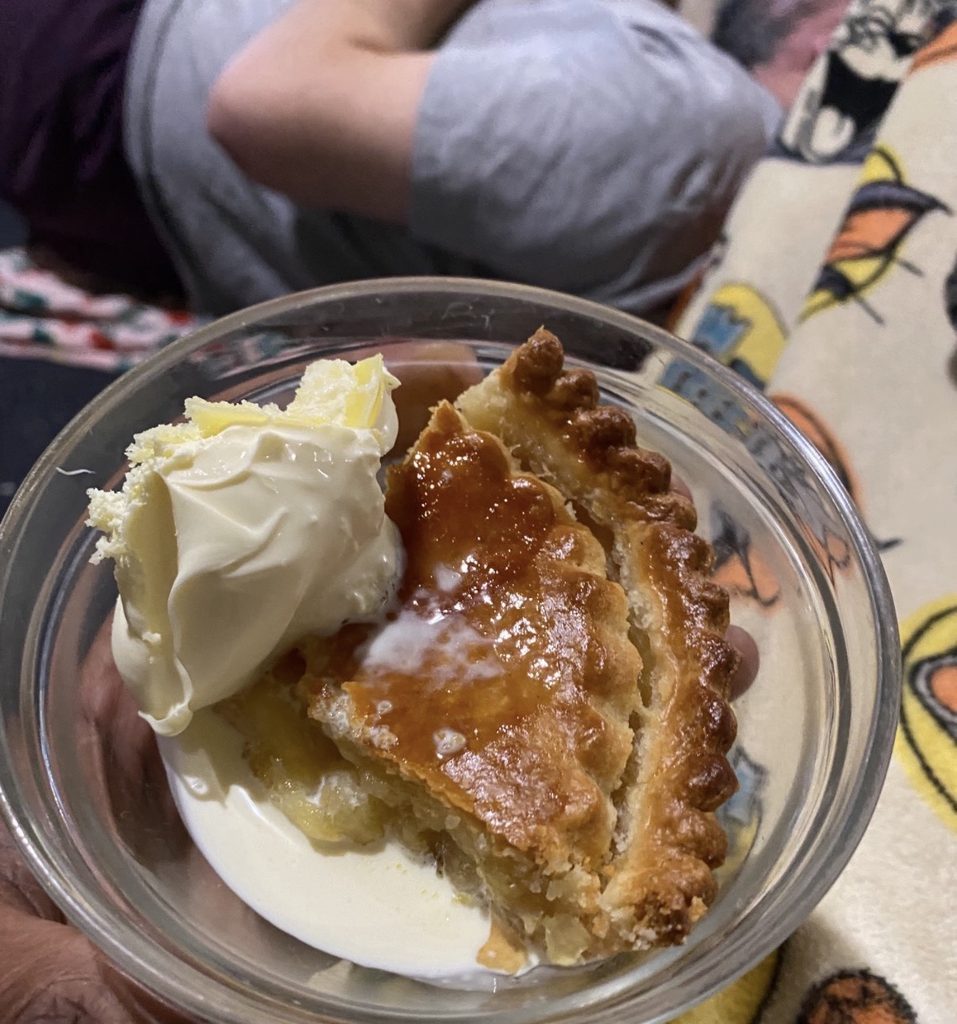
It was small, sweet and beautifully made: golden pastry, a little apple cut into the top and exactly the right amount of filling. More often than not, it was the reason I entered the shop.
I might buy some meat while I was there. I might pick up something else from the counter. But the pie was the anchor—the thing I had already decided to buy before I walked through the door.
Then the chef left.
This was during the long aftermath of Brexit, when Britain was beginning to discover what happens when a country makes itself harder to live in, work in and trade with.
The chef left Britain, and his recipes went with him.
The pie simply disappeared from the shop.
That sounds trivial. I know it does.
It was only an apple pie. The business survived. Britain carried on. Nobody compiled a report about it, and its disappearance did not trouble the national statistics.
But that is precisely why I remember it.
We expect decline to look dramatic. We imagine a shuttered factory, an empty high street or a company announcing hundreds of redundancies. We look for the moment when something visibly breaks.
Often, decline is quieter than that.
Something disappears, and nothing takes its place.
A supplier becomes too expensive. An imported ingredient becomes harder to obtain. A delivery takes longer. A skilled worker leaves. A business reduces its range.
The shelves are not completely empty. There is simply a little less on them than there was before.
Then a little less again.
Britain treated European workers as though they were interchangeable units of labour—as though one person could leave and another could simply be inserted into the same space.
But people carry things with them.
They carry knowledge, judgement, habits, standards and techniques. They know when pastry is right by touch. They remember quantities that may never have been properly written down. They know how something should look before it enters the oven and when it is ready to come out.
When they leave, that knowledge can leave too.
A vacancy can be advertised. Another person can be employed. A government can invent another visa.
But none of that brings the recipe back.
I still visit the deli. It still sells good meat, and there are still reasons to go.
But it is not the same.
There is simply less of what I went there for.
That is how much of Britain’s decline has felt: not complete disappearance, but gradual subtraction. The place remains. The sign is still above the door. The lights are still on. From the outside, everything appears to be functioning.
Only the people who knew it before can see what is missing.
This photograph is all I have left of that particular apple pie.
Britain carried on without it, of course.
So did I.
But neither of us was improved by its disappearance.