Britain Is Not Special — Lessons from Argentina
Published
Part 5 of 7
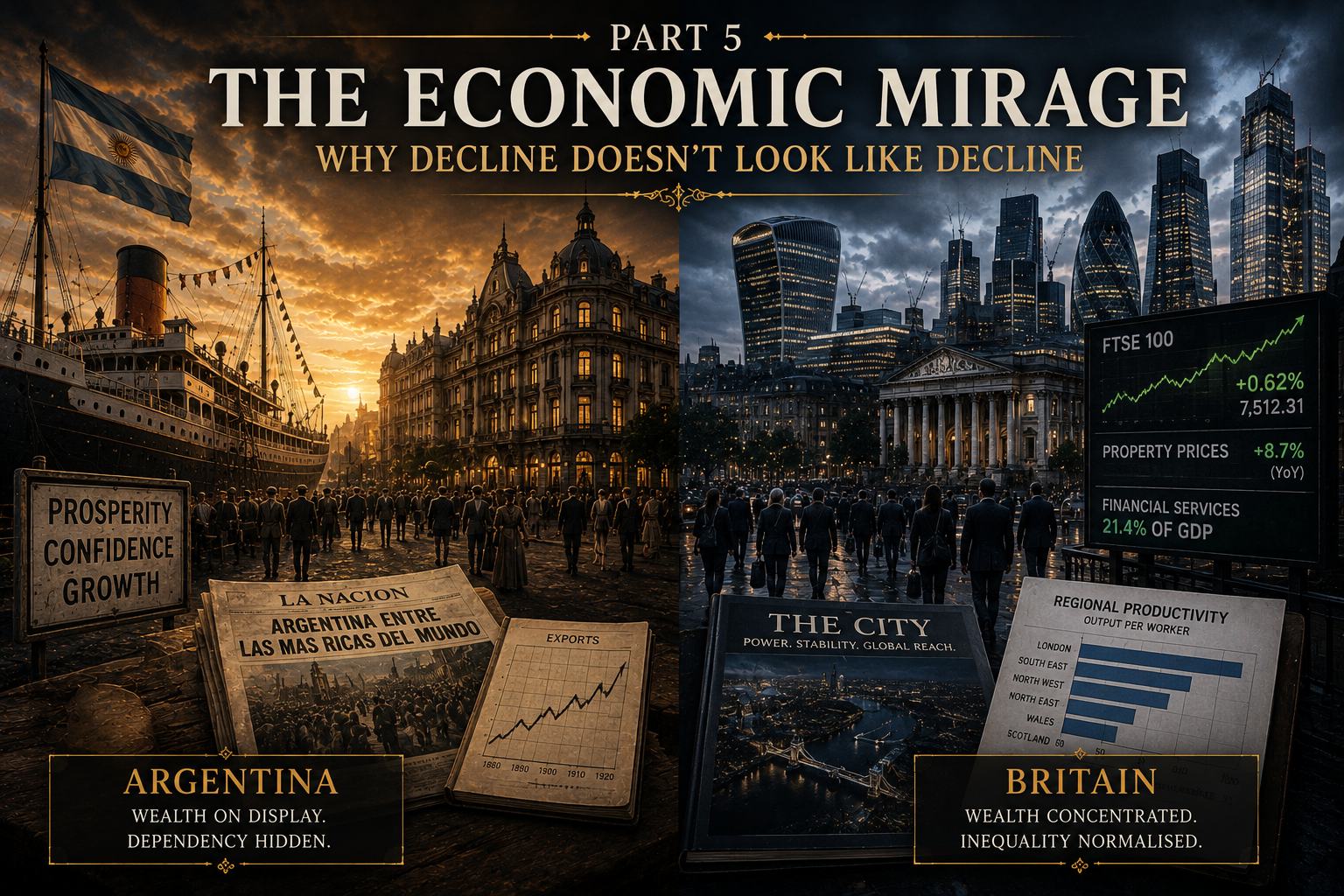
The Economic Mirage
Decline does not always look like decline. Sometimes the numbers still look respectable while the foundations beneath them quietly weaken.
The most dangerous stage of decline is not collapse.
It is the period before collapse is even imaginable.
The period when the country still looks rich.
When property remains expensive.
When financial markets still function.
When wealthy districts remain full of restaurants, offices and investment.
When governments can still point to GDP, employment, asset values and international influence.
That is when decline becomes hardest to recognise.
A country does not need to look poor to be getting weaker. Visible wealth can become the camouflage.
Argentina Looked Rich Because Argentina Was Rich
Argentina’s early wealth was not imaginary.
Buenos Aires was one of the great cities of the early 20th century.
European architecture, major public buildings, theatres, ports, railways and boulevards reflected a country that had become deeply integrated into the global economy.
Wealth flowed through agricultural exports.
Capital flowed in from abroad.
Migrants arrived because Argentina represented opportunity.
The country appeared modern because in many respects it was modern.
But visible prosperity concealed dependency.
The economy relied heavily on external demand, export earnings, commodity prices and foreign capital.
That meant the country could look strong while remaining unusually exposed to conditions it did not control.
Prosperity therefore created a problem of perception.
The wealth was visible.
The vulnerability was not.
Headline Wealth Can Survive Structural Weakness
Economic decline rarely moves in a straight line.
Countries grow.
Then stagnate.
Then recover.
Then suffer another crisis.
Argentina’s 20th century was full of these reversals.
That matters because temporary recovery can make a long-term problem look solved.
A strong harvest can improve export earnings.
A favourable global cycle can bring capital back.
A new government can restore confidence for a period.
Growth can return.
None of this necessarily means the underlying structure has changed.
Recovery is not the same as transformation.
A country can bounce repeatedly without ever fixing the mechanism that keeps producing the fall.
Inflation Changes the Meaning of Wealth
Argentina’s later history demonstrates another important problem: wealth itself becomes difficult to interpret when the monetary system becomes unstable.
Inflation changes behaviour.
People become less willing to hold savings in domestic currency.
Property becomes a store of value.
Foreign currency becomes protection.
Short-term survival becomes more important than long-term planning.
Businesses price defensively.
Households adapt.
Informal practices become normal.
The economy still functions.
But it functions differently.
People still work.
People still buy.
People still save.
But trust shifts away from the system itself.
Britain’s Mirage Looks Different
Britain does not have Argentina’s monetary history.
Sterling remains a major currency.
British institutions remain far more stable.
Inflation, when it rises, exists within a completely different institutional environment.
But Britain has developed its own version of the economic mirage.
It appears through assets.
Through property.
Through finance.
Through concentration.
Through the ability of one successful city and several globally competitive sectors to influence how the entire economy is perceived.
Britain can therefore feel richer than its productive performance suggests.
That is not because the wealth is fake.
It is because the wealth is distributed through structures that can conceal weakness elsewhere.
Property Is Not Productivity
One of the clearest examples is housing.
Rising property values create wealth for owners.
They increase household balance sheets.
They can support borrowing.
They create the impression that the country is becoming richer.
But a house becoming more expensive does not mean the economy has become more productive.
It does not mean more goods are being produced.
It does not mean infrastructure has improved.
It does not mean wages have risen in line with costs.
It does not mean younger generations have greater economic security.
Asset inflation can make a country look richer while making entry into that wealth harder.
This creates a divide between those who already own assets and those trying to build a life inside the same economy.
The City Can Distort the Country
London creates another form of distortion.
The city is genuinely extraordinary.
It is globally connected.
It attracts capital, talent, tourism, culture and business.
It contains sectors whose productivity and wages sit far above much of the national economy.
This is a national asset.
But it also changes the statistical picture.
A highly productive capital can raise national averages while large parts of the country experience much weaker outcomes.
The country can therefore look stronger from the outside than it feels from inside many of its towns and regions.
That gap matters politically.
It also matters economically.
Because national resilience depends on more than one successful metropolitan ecosystem.
Employment Can Hide Weakness Too
Employment statistics can create a similar illusion.
A country can maintain relatively high employment while the quality, productivity and security of work deteriorate.
A job is not simply a job.
The structure matters.
High-productivity industrial employment has a different economic effect from low-productivity service employment.
Secure work has a different effect from precarious work.
Career progression has a different effect from permanent wage compression.
An economy can therefore create large numbers of jobs while still weakening the relationship between work and prosperity.
The question is not only whether people are working. It is whether work still builds a future.
Consumption Can Continue After Production Weakens
Modern economies make another illusion possible.
Countries can consume extraordinary amounts of goods they no longer produce themselves.
Cars arrive.
Electronics arrive.
Clothing arrives.
Food arrives.
Energy arrives.
Financial systems allow households and governments to keep spending.
Global supply chains make scarcity less visible.
The shops remain full.
The restaurants remain open.
The country does not feel like a country losing productive capacity.
But consumption and production are not the same thing.
A wealthy country can afford to import what it no longer makes for a very long time.
The question is what happens when the ability to pay for that consumption becomes more constrained.
The State Can Maintain the Appearance
Governments can postpone recognition too.
Borrowing allows states to maintain services, investment and consumption beyond what current revenues alone would support.
Again, borrowing is not inherently evidence of decline.
Productive borrowing can strengthen a country.
Infrastructure, housing, energy systems, research and education can all justify long-term investment.
The danger appears when borrowing increasingly sustains the present rather than building the future.
That distinction is crucial.
Debt can finance transformation.
Debt can also finance delay.
National Narratives Lag Behind Economic Reality
This is where economics becomes psychological.
Countries do not update their self-image every time the economy changes.
Narratives survive.
Institutions repeat them.
Politicians use them.
Newspapers reinforce them.
Citizens inherit them.
Argentina spent decades living with the memory of extraordinary national promise.
Britain lives with an even larger historical memory:
empire, industrial leadership, military power, global finance and institutional prestige.
Those things do not disappear merely because the economic structure changes.
The economic mirage survives because national identity changes more slowly than national capacity.
The Parallel
Britain’s mirage is not Argentina’s.
Britain remains a richer, more institutionally stable and more diversified economy.
But the mechanism is recognisable.
Visible prosperity can delay recognition of structural weakness.
Successful sectors can conceal weaker ones.
Asset wealth can conceal stagnant productivity.
high employment can conceal low-value work.
consumption can conceal reduced production.
borrowing can conceal weak investment.
London can conceal regional weakness.
history can conceal trajectory.
Decline becomes dangerous when the country still has enough wealth to pretend nothing fundamental has changed.
Eventually, the exceptional becomes ordinary.
That is the final stage this series examines.
Decline does not need to arrive as catastrophe.
It can arrive as adaptation.
Services become slightly worse.
Infrastructure becomes slightly older.
Opportunities become slightly narrower.
Growth becomes slightly weaker.
Expectations adjust.
What would once have been considered failure becomes normal.
Argentina demonstrates how far that process can go.
Britain is nowhere near Argentina’s endpoint.
But Part 6 asks the more uncomfortable question:
how much decline can a country absorb before it stops recognising decline at all?