
I Haven’t Got Sonny in My Pocket
We have used algorithms, automation and machine learning for decades. Then a language model started writing back and suddenly everybody thought I, Robot had arrived.
People hear “AI” and imagine an autonomous intelligence: something that understands the world, observes what is happening, forms intentions, moves through physical space and acts independently.
In other words, they imagine Sonny.
That Is Not What You Have in Your Pocket
What you are using is a language model. It receives language, calculates a response and generates more language. It can search, analyse, draft, compare and—when connected to tools—perform certain defined tasks.
But it does not possess Sonny’s continuous existence in the world.
It is not standing beside you, watching the staircase, independently counting every step and deciding that now would be a useful time to mention it.
“Two thousand, eight hundred and eighty steps, Detective.”
Sonny
“Do me a favour. Keep that kind of shit to yourself.”
Detective Spooner
That is the AI people think they have: permanently present, physically embodied, independently observing its surroundings and volunteering knowledge without being prompted.
You do not have Sonny in your pocket. You have a language model behind an interface.
Cortana is another useful comparison—but she is also far beyond today’s ordinary chatbot. Cortana is essentially an always-present, context-aware digital intelligence: she sees systems, retains the situation, initiates actions and accompanies you through the world.
Sonny is that intelligence given a body, physical agency and—crucially—something resembling consciousness, emotion and free will.
ChatGPT is AI.
But AI is not ChatGPT.
And neither of them is Sonny.
Friendly Fire
This article began while I was fighting several battles simultaneously on LinkedIn.
Sometimes, when you do that, one of the good people gets caught in the crossfire.
That is what happened to one commenter.
“Brexit was sabotaged by its own architects and the fact that they lied, not by Remainers who were trying to prevent catastrophic damage to this country.”
I read the comment too quickly, misunderstood what he was saying and fired back:
“Who exactly were the architects? Boris Johnson, Michael Gove, Dominic Cummings, Matthew Elliott, Nigel Farage, Arron Banks, Theresa May, David Davis and David Frost? Leave won the referendum. Brexiters took control, established the red lines, negotiated the agreements, signed the deal and implemented it. Calling the consequences sabotage is not analysis—it is refusing to accept responsibility.”
It was a good response.
Unfortunately, it was directed at somebody making essentially the same argument.
Friendly fire.
Sorry. I was fighting a couple of deluded warriors simultaneously. Give me some slack.
The commenter was right.
The people who designed Brexit sold incompatible promises, took control of the government, controlled the negotiations, signed the agreements and implemented the result.
Then, when reality arrived, they blamed Parliament, civil servants, judges, businesses, the European Union and the Remainers who had warned them.
They got their Brexit.
What they could not accept was responsibility for the result.
The same commenter then made another important point:
“Brexit was delivered express from Moscow. And from Sydney—thanks, Murdoch, you ghoul. And from the USA—thanks, Heritage Foundation.”
Again, he was right.
Brexit was not formed entirely within Britain’s borders.
Russian interference and disinformation mattered. Rupert Murdoch’s media operation spent decades poisoning public attitudes towards Europe. American organisations saw an opportunity to pull Britain towards a more deregulated economic model.
Those external interests recognised something important about Britain.
We projected strength, but underneath we were weak—and everybody else knew it.
Weak politicians repeated the language, amplified the fear and converted it into policy.
But outside forces did not march into polling stations and mark the ballot papers.
The people did that.
Britain was vulnerable because too many people had been trained to behave like sheep: repeat the slogan, identify the enemy, follow the tribe and treat doubt as betrayal.
Even that behaviour did not appear overnight.
It was curated over forty years.
Industry was hollowed out. Communities were abandoned. Public services deteriorated. Trust collapsed. Newspapers supplied a succession of enemies—Europe, migrants, benefit claimants, trade unions, experts—and politicians discovered that directing anger elsewhere was easier than rebuilding anything.
By 2016, the ground had already been prepared.
That does not remove responsibility from the people who voted for it. Manipulation can explain a choice without erasing the fact that a choice was made.
Brexit was not imposed upon a confident, informed and economically secure country.
It was sold to a population that had been conditioned for decades to mistake grievance for analysis and slogans for answers.
The first commenter engaged with the substance of the argument.
Then one of the twats arrived.
The Em Dash Detective
Another commenter—an Operations Director—informed me that the extended hyphens in my writing proved it was produced by AI.
Apparently, the em dash—a piece of punctuation that existed for centuries before ChatGPT—is now forensic evidence of artificial intelligence.
That exchange crystallised something that has been irritating me for a long time.
It is fucking ridiculous.
Not because somebody disagreed with me. I enjoy disagreement when there is an argument attached to it.
What irritates me is the sheer confidence of people who have nothing to say about the substance but still feel compelled to parade their ignorance beneath an impressive job title.
It is twattish behaviour.
You have not identified an incorrect fact. You have not challenged the reasoning. You have not offered a competing explanation.
You have seen an em dash, remembered something you read about AI and decided that repeating it makes you technologically informed.
It does not.
It makes you somebody who has avoided an argument by commenting on the punctuation.
He introduced another dimension, made me reconsider what I had read and helped move the discussion forward.
One contributed an idea. The other tried to replace the argument with a label.
Facebook Wearing a Suit
LinkedIn is filled with Operations Directors, strategists, analysts, consultants, visionaries and thought leaders. Their biographies project authority, competence and professional judgement.
Then some of them enter a political discussion and reveal that they cannot distinguish a punctuation mark from an argument.
That contradiction is partly explained by what LinkedIn has become.
It still presents itself as a professional network, but much of it is essentially Facebook wearing a suit.
People perform expertise, advertise themselves, promote their companies, repeat fashionable management language and collect engagement beneath carefully polished job titles.
It is less a place where serious recruitment naturally happens and increasingly a marketplace of personal advertising.
But remove the biography, the corporate headshot and the impressive title, and much of the discussion is indistinguishable from any other social-media comment section: slogans, tribalism, shallow certainty, personal insults and people confidently discussing subjects they have never taken the trouble to understand.
The professional presentation gives ordinary ignorance an executive title.
That is why the job description matters here.
Not because an Operations Director must understand the architecture of a large language model. Most people do not need to.
But somebody employed to direct operations should presumably understand processes, tools, inputs, outputs and the elementary difference between how something was produced and whether the finished result is correct.
It has long dashes. Therefore AI. Therefore I do not need to answer it.
LinkedIn is advertising dressed as networking, personal branding dressed as expertise and social-media noise wearing a lanyard.
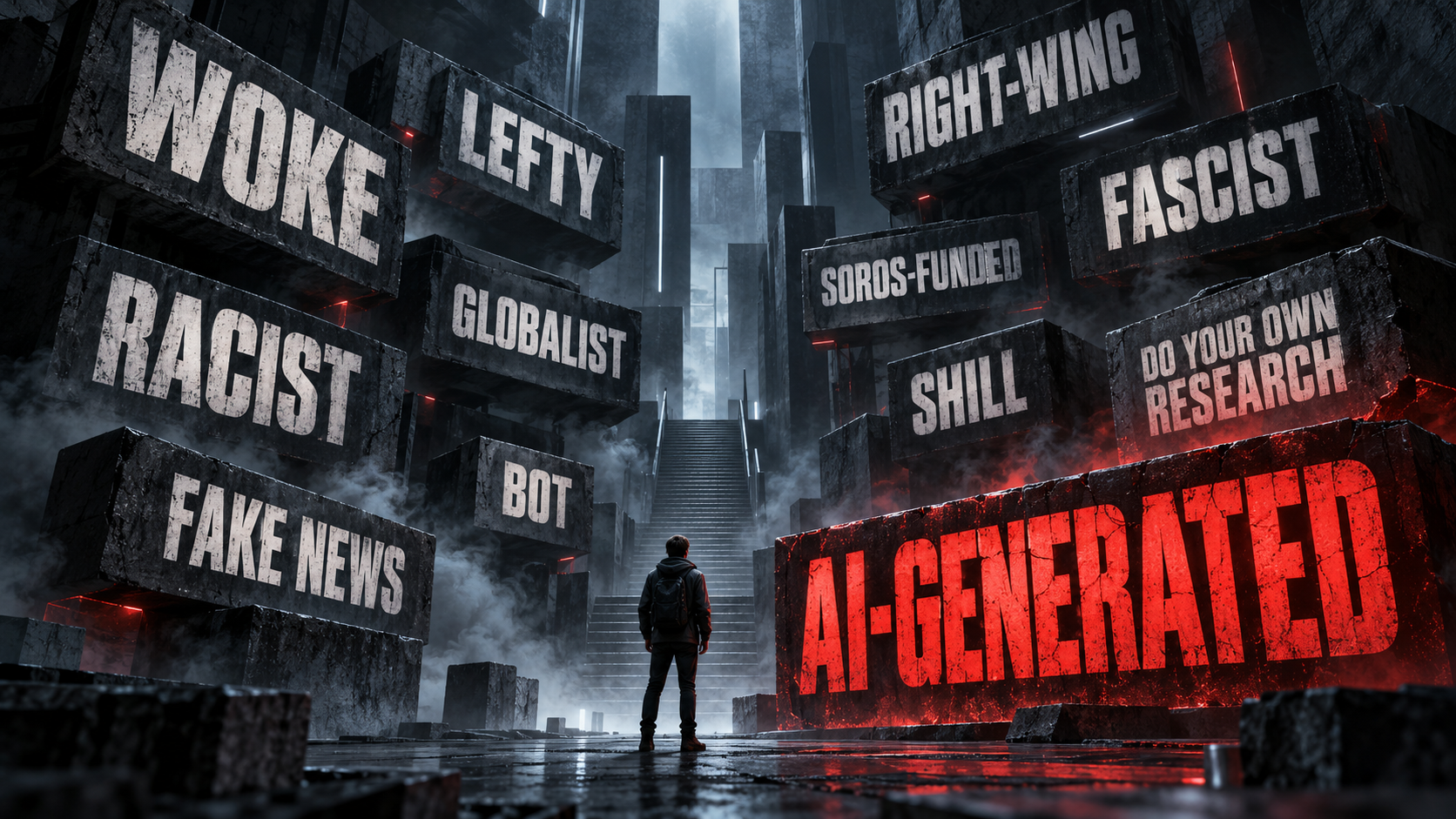
The Label Before the Argument
This is a country that was persuaded to vote against its own economic interests and call the result liberation.
We weakened trade with our largest market, introduced barriers against ourselves and then spent years discussing “growth” as though repeating the word could make growth appear.
Then many of the same people encounter a new technology and demonstrate the same vulnerability all over again.
They do not understand it, but they have already developed an absolute opinion about it.
They absorb a few phrases, identify a few supposed warning signs and begin repeating them with enormous confidence.
Nobody identifies the incorrect fact.
Nobody explains which inference is invalid.
Nobody demonstrates that the conclusion is wrong.
The label replaces the argument.
I have even had a Reddit moderator remove an original discussion under a rule intended to encourage “authentic and effortful human engagement”.
The post had attracted roughly 3,000 views and actual discussion, but once the presence of AI had supposedly been detected, everything inside the work became irrelevant.
The possibility that a person could supply the experience, knowledge, argument, judgement and conclusion while using a language model to help structure the finished writing was not allowed to exist.
The machine had touched it.
Therefore the human had disappeared.
That is not technological scrutiny.
It is intellectual avoidance.
We live in an increasingly polarised world in which identifying the supposed type of person speaking has become more important than considering what that person has said.
Someone expresses an opinion and, instead of answering it, the other person reaches for a label.
The label does the work that an argument once had to do.
It tells the audience which team the speaker supposedly belongs to, which motives should be assigned to them and why nothing they say needs to be considered seriously.
Once the person has been categorised, their argument can be discarded unopened.
The language changes, but the mechanism remains the same.
For a while, everything inconvenient was fake news. The person presenting it became a bot, a troll, a shill or a member of the mainstream media.
Depending on which corner of the internet you entered, they might be controlled by the establishment, the liberal elite, the far right, the radical left, the World Economic Forum, George Soros or whichever shadowy organisation had been selected that week.
Soros is particularly revealing. His name is routinely inserted into arguments in which he has no meaningful involvement.
Sometimes it is ordinary conspiracy thinking. Sometimes it carries the much older and uglier suggestion that a wealthy Jewish figure must secretly be directing migration, protest, politics or the media.
Prejudice gets dressed up as political analysis.
The Personal Exemption Certificate
A white person says something prejudiced, gets challenged and immediately produces a Black person from their private life as a character witness.
The relationship may be perfectly real.
It is also irrelevant to whether the particular statement was racist.
Knowing, loving, marrying or being related to a Black person does not make somebody incapable of prejudice. Human beings can feel genuine affection for an individual while retaining assumptions about the wider group to which that individual belongs.
Nor does being Black make someone incapable of expressing racism, prejudice or hostility towards others.
The point is not the speaker’s family tree.
The point is what they said.
It is borrowed innocence: another certificate presented so the substance never has to be examined.
And now we have the technological version.
Not an explanation of which technology was used.
Not evidence that the information is wrong.
Not a serious discussion about authorship, accuracy, copyright or accountability.
Just the accusation itself.
Those three words are increasingly treated as though they settle everything.
The facts no longer need checking. The reasoning no longer needs challenging. The accuser does not have to identify one false claim or explain where the argument fails.
“AI” becomes a permission slip not to engage.
That is why the obsession with em dashes matters.
The punctuation is not the real subject. The dash merely provides an escape route for somebody who does not want to confront the paragraph surrounding it.
The first sentence does not become true because a human typed it unaided.
The second does not become false because software helped present it.
Accuracy depends on facts, evidence and reasoning—not whether somebody manually pressed every key.
AI Did Not Arrive in 2022
Part of the confusion comes from pretending that artificial intelligence suddenly appeared when ChatGPT became widely available.
It did not.
The term artificial intelligence emerged from the Dartmouth research project in 1956.
Since then, the field has passed through early conversational programs, expert systems, chess engines, speech recognition, computer vision, machine learning, recommendation systems and natural-language processing.
ChatGPT represents a major development within that history.
It is not the beginning of it.
The field acquires the name artificial intelligence.
Japan begins high-speed rail operation.
Guidance computers help carry people to the Moon.
A language model becomes visible to the mass public.
The Moon landing and Japan’s first high-speed railway make a slightly different but equally important point.
Apollo was not artificial intelligence, and neither was the original Shinkansen.
They were extraordinary achievements of engineering, computing, coordination and human knowledge.
Apollo 11 reached the Moon in 1969 using onboard guidance computers designed to perform the calculations necessary for navigation and control.
Japan’s Tokaido Shinkansen had already begun operating in 1964.
We could land people on another world and run high-speed trains between cities in the 1960s, yet we now speak as though sophisticated technology appeared from nowhere in November 2022.
It did not fall from the sky.
It emerged from decades of mathematics, software, engineering, semiconductor development, public research, private investment and accumulated human knowledge.
The technology changed.
The public vocabulary failed to keep up.

We Were Already Living With It
Most people were using forms of artificial intelligence long before they began announcing their opposition to it.
Nobody looked at their fraud alert and demanded that the bank employ a small man to inspect every transaction personally.
Nobody accused Spotify of destroying musical independence because an algorithm suggested Luther Vandross.
These systems are not all the same. They include ordinary algorithms, automation, machine learning, computer vision, recommendation systems and natural-language processing.
Calling every automated system “AI” is technically sloppy.
ChatGPT is one particular kind of generative AI built around a large language model.
It processes language and generates likely responses from patterns learned during training, along with whatever instructions, context and tools it has been given.
It is, in simple terms, predictive text operating at an extraordinary scale.
ChatGPT is AI.
But AI is not ChatGPT.
And neither of them is Sonny.
The Machine Learned to Write Back
For years, algorithms operated quietly behind the screen.
They arranged search results, recommended videos, filtered information and shaped what people saw.
Then the machine learned to answer in complete sentences.
That visibility changed the public reaction.
People who had trusted algorithms to select their news, entertainment and political content suddenly became technological purists when a language model helped somebody construct a paragraph.
Apparently, it was acceptable for a machine to decide what you should watch, buy, fear and resent.
The crisis began when it helped somebody write.
That does not mean every concern about AI is ignorant.
There are serious questions about employment, copyright, surveillance, bias, energy use, misinformation, ownership and the concentration of power.
Those subjects deserve scrutiny.
But declaring, “This sounds like AI,” is not scrutiny.
It is usually a way of avoiding the argument standing in front of you.
Did Their Families Protest Calculators?
I sometimes wonder whether the people shouting AI beneath everything come from a long and distinguished family of technological resistance.
Did their parents picket the calculator?
Did their grandparents denounce the washing machine?
Was spellcheck considered the death of literacy?
Did somebody stand outside a library protesting the photocopier?
The typewriter altered the relationship between the hand and the finished page.
Word processors allowed sentences to be moved, deleted and reconstructed without retyping an entire document.
Calculators automated arithmetic.
Spellcheck began identifying errors.
Search engines reorganised access to information.
Wikipedia disrupted the traditional encyclopaedia.
Sat-nav replaced printed road atlases for millions of journeys.
Predictive text began completing words and sentences before language models became a public obsession.
Did the calculator abolish mathematicians?
Did spellcheck abolish literacy?
Did the word processor become the author because it allowed somebody to move a paragraph?
Does using sat-nav mean the driver did not complete the journey?
Does searching a digital database mean the researcher did not conduct research?
Every tool changes part of the process.
The relevant question is what the human being still contributes and whether the result can withstand scrutiny.
can produce an answer. It cannot tell you whether you asked the correct question.
can retrieve a source. It cannot decide whether you understood it.
can produce fluent paragraphs. It cannot guarantee that the argument is knowledgeable, honest or worth making.
The subscription does not include judgement.
What I Actually Give the Model
I have used ChatGPT for roughly a year.
During that time, it has accumulated context about my voice, interests, arguments and preferred way of working.
When I say it “knows me”, I do not mean it knows me as a human being does.
It has not developed consciousness, affection or an independent understanding of my life.
It has context.
That context allows it to respond more usefully than a blank system encountering me for the first time.
My process normally begins with speaking.
I speak through the idea, sometimes cleanly and sometimes in fragments.
The model helps organise the material, compare sources, test the structure and turn those spoken thoughts into a workable draft.
Then I interrogate it.
The thinking has not disappeared. The route between thought and production has become shorter.
I have spent more than forty years reading, listening, learning, arguing and connecting information.
I have been to university twice.
I know how to research.
I know how to Harvard-reference.
I actually enjoy proper referencing.
I could still sit with books, take notes, construct a bibliography and type everything out from the beginning.
But why must I perform every mechanical part of that process in precisely the same way I did twenty years ago merely to prove that I possess a brain?
I can speak a thought as it forms.
I can ask for the competing evidence.
I can inspect the sources, challenge the answer and shape the final argument.
What once required several separate stages can now happen in one working exchange.
That is not the disappearance of knowledge.
It is a different method of applying it.
Give the same language model to somebody who knows nothing about politics, economics, electrical systems or the subject in front of them and it will still produce paragraphs.
That does not mean those paragraphs contain understanding.
Fluent language can disguise an empty argument—but only until somebody knowledgeable starts checking it.
Where Does the Misinformation Come From?
People often talk as though ChatGPT independently decides to manufacture political propaganda.
That is not usually how the process works.
A user can begin with a false premise, demand a predetermined conclusion, supply unreliable material, ignore qualifications, select only the answer that supports their position or publish an unchecked hallucination.
You do not need a special “dodgy ChatGPT” to produce misinformation.
You need an ordinary tool, a dishonest or poorly informed user and no meaningful checking.
That is why I find some of the accusations peculiar.
I can see that polished, repetitive misinformation is often being produced with assistance of some kind.
But the machine did not independently develop the prejudice, choose the political objective and publish the finished post.
A tool can amplify what it is given.
The human being still decides what to ask, what to keep and what to release.
AI does not remove human responsibility.
If anything, it makes editorial judgement more important because producing plausible material has become easier.
The Productivity Miracle
I find language models genuinely useful.
They help me process ideas faster.
I no longer need to write down every thought manually before I can begin developing it.
Speaking removes a bottleneck between the argument in my head and the first draft on the screen.
But that does not mean AI improves every person or every task.
My other half is already skilled and efficient in his office role.
His workplace wants employees to adopt AI, but for some of his work it simply slows him down.
He already knows what he is doing.
Adding another system creates an extra stage rather than removing one.
That is the part missing from the productivity sermon.
The value depends on the worker, the task, the organisation and the way the tool is introduced.
Producing twice as many emails, reports, presentations and images does not automatically represent an economic miracle.
Sometimes it simply means producing twice as much shit for somebody else to read, check and delete.
A language model can accelerate a task.
It cannot repair an underinvested economy, rebuild industrial capacity or install judgement inside someone’s head.
It cannot construct a house, rewire a property, repair Hammersmith Bridge, clean a river or rebuild the public services hollowed out over decades.
It may assist the people doing those things.
That is not the same as doing them.
AI should improve capable human beings—not be sold as a substitute for capability, education, investment or judgement.
Everybody Can Be a Billionaire
The mythology surrounding AI is not separate from the business model.
The tech billionaires and their evangelists sell a familiar dream: use the product, embrace the revolution, become more productive, build a company and perhaps you too can become spectacularly wealthy.
Yeah, right.
The most certain financial outcome is not that every subscriber becomes a billionaire.
It is that millions of people and businesses keep paying the companies whose owners are already billionaires.
The fear of being left behind is part of the sales pitch.
The technology can be useful while the mythology around it remains self-serving.
Those two things can be true simultaneously.
And now the commercial pressure is becoming more visible.
ChatGPT is no longer being sold only through subscriptions and business integrations.
The companies are looking for ever more creative ways to convert attention into revenue—including advertising.
That does not automatically make the product corrupt or useless.
It does show that this is an enormously expensive commercial system that requires a continuing supply of money.
The people declaring AI inevitable are not disinterested prophets descending from the mountain.
They are also selling something.

The Great Slop Machine
Then there is the question nobody promoting the productivity revolution seems particularly keen to answer:
What are people actually using it to produce?
Because much of it is not improving the world, transforming a business or making anybody genuinely more productive.
It is producing slop.
More content does not necessarily mean more value. Sometimes it simply means more noise.
That is the contradiction at the centre of the sales pitch.
We are told that this technology will unlock human creativity and release us from repetitive work.
Yet much of the commercial incentive is pushing it in the opposite direction: automating creativity itself while producing an endless supply of disposable material for people to scroll past.
It becomes another layer of distraction.
More things competing for attention in a world already drowning in things to read, watch, answer and ignore.
That is not the use of AI I want to defend.
I do not use a language model merely to pump out material and fill space.
I use it because I already have something I want to say.
The tool helps me research it, interrogate it, structure it and move it from spoken thought to finished work.
The distinction is purpose.
If you begin with no knowledge, no argument, no experience and no judgement, AI can help you manufacture the appearance of all four.
That is where the slop comes from.
The system produces something technically polished, but there is nobody behind it asking whether the thing needed to exist.
Productive use begins with a human objective.
It might help somebody analyse information, organise a project, explain a difficult concept, reduce repetitive administration or communicate an idea they were struggling to put into words.
That is assistance.
Generating industrial quantities of synthetic rubbish because the machine makes it cheap is not a productivity miracle.
It is automated landfill.
And it exposes the emptiness of the claim that access to AI will allow everybody to create a business and become wealthy.
If millions of people receive the same tool, use the same prompts and produce the same interchangeable content, where is the value?
Who is paying for all of it?
Who is reading it?
Who even wanted it?
The advert presents a frictionless world in which everybody becomes a creator, entrepreneur or expert.
The reality is that a tool cannot supply purpose.
It cannot make an unoriginal idea original.
It cannot turn misinformation into truth.
It cannot transform endless output into economic value.
And it cannot guarantee an audience merely because pressing “generate” made the production easier.
AI can help a person do something useful.
It can also help millions of people produce nonsense more quickly.
That is why human judgement remains the dividing line.
The question is not simply whether somebody used AI.
The question is what they used it for.
Back Beneath the Stairs
And that brings me back to Sonny.
Sonny is not a language model waiting for Detective Spooner to type a prompt.
He occupies the physical world.
He sees it, interprets it and acts within it.
He has a body, memory, apparent emotion, independent agency and something resembling consciousness.
A language model does not.
It can be enormously useful without being a mind.
It can extend a person’s abilities without replacing the person.
It can shorten the route between thought and production without supplying the thought itself.
So yes, I use AI.
I use it regularly, openly and productively.
I use it because it allows me to speak, research, organise and publish ideas more efficiently than I could before.
But I haven’t got Sonny in my pocket.
If I want a language model to discuss the staircase, I must show it the staircase, explain why the staircase matters, provide the surrounding context and probably correct it twice after it confidently tells me the wrong number of steps.
If Sonny were standing beside me, he would already know.
He would look up, count every step and volunteer the answer without being asked.
And I would probably tell him to keep that shit to himself.