Observation Manchester
I Needed an Hour.
Manchester Sold Me Four.
The parking system could count every second of the time it sold me. It simply could not sell me the sixty minutes I actually needed.
I needed to park in Manchester for about an hour.
Nothing complicated. I was not leaving the car there for the afternoon. I did not need a day rate, a season ticket or some elaborate parking package. I needed approximately sixty minutes at Bridge Street Car Park.
The system charged me for four hours.
There was no useful one-hour option available to me. If I wanted to leave the car legally, I had to purchase a block four times longer than the stay I actually needed. The payment went through at around 12:25 and the screen proudly confirmed that I had three hours, fifty-nine minutes and thirty-four seconds remaining.
Wonderful.
I had bought three hours of parking I already knew I would not use.
We are constantly told that digital services are about flexibility. Apps are supposedly more efficient than machines. They know exactly when the parking session begins, exactly when it ends, which vehicle is parked and where it is parked. The technology is perfectly capable of measuring time by the minute.
Yet somehow, when it comes to charging me, that precision disappears.
The system can count down every individual second of the four hours it sold me, but it cannot apparently sell me the sixty minutes I actually wanted.
Then came the advert
Having charged me for four hours, the confirmation screen was covered by a sponsored advert.
Not information about the car park. Not a clear receipt. Not directions, parking conditions or a simple message telling me that my vehicle was now safely covered.
A car-finance claims advert.
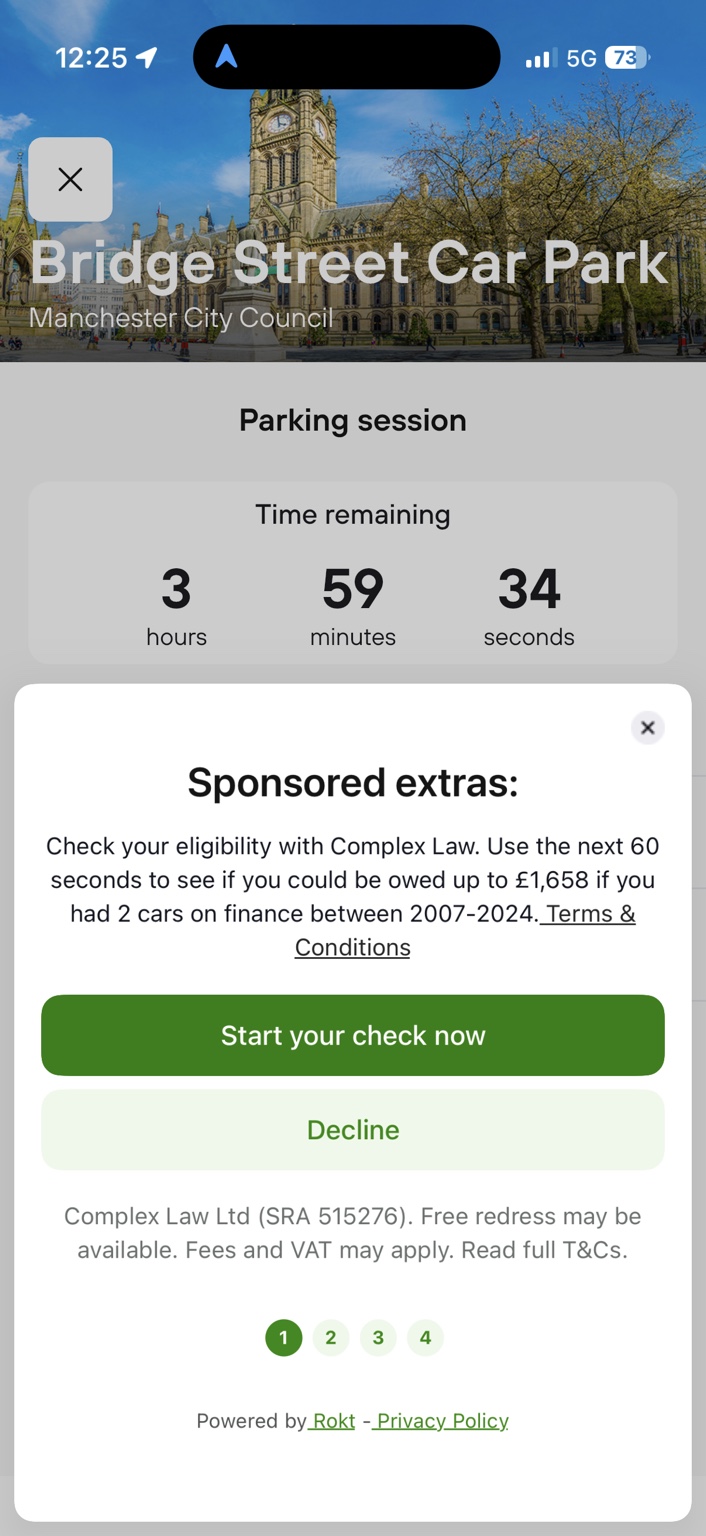
“Check your eligibility with Complex Law,” it announced, offering to determine whether I could be owed up to £1,658. Beneath it was a large green button encouraging me to “Start your check now.” The button to reject it was naturally quieter and less prominent.
There were four little numbered circles at the bottom.
This was not even one irritating advert that I could dismiss and forget. It was the first stage of a sponsored sequence inserted directly into the parking confirmation journey.
Behind the screen
The “Transaction Moment”
The advertising technology company Rokt calls the stretch from payment to confirmation the “Transaction Moment”. Its own material describes payment processing as something that can be turned from a cost centre into a profit engine, with the post-purchase moment opened to additional offers.
In other words, the advert was not an accidental interruption. The interruption was the product.
That is what makes this more than a complaint about an irritating app. It captures the direction in which everyday public life is moving. A straightforward civic function—parking a car in a council car park—has been broken into layers of contractors, payment platforms, digital interfaces and advertising technology.
The physical space belongs to the public system. The parking rules carry the council’s name. But the moment you try to pay, you enter a commercial funnel.
And the priorities of that funnel are revealing.
It could not accommodate my actual requirement of sixty minutes. It could not offer the flexibility that digital payment is supposed to make possible. It could not avoid charging me for three hours that I did not need.
But it could identify the exact moment after payment when my attention might be worth money.
That worked perfectly.
Britain has become very good at this. Basic services become less flexible and more expensive while the systems surrounding them become increasingly sophisticated at extracting value. We are told that digitisation will make life easier, but too often it merely removes the human being, restricts the available choices and creates another surface on which somebody can sell us something.
The four-hour charge and the sponsored advert are therefore connected. They come from the same way of thinking.
The system is not organised around what the person needs. It is organised around what can be extracted from the person.
I wanted one hour.
Manchester sold me four—and then somebody tried to sell me a compensation claim before I had even put my phone back in my pocket.