SCENE · POWER · AMERICA
Most of the Faces
Look the Same
America elected one Black president. The backlash tells us more than the breakthrough.
At first glance, it is simply a joke.
More than two centuries of white male faces. Barack Obama appears near the end as the only Black man. Then come two clowns: Donald Trump—twice, with Joe Biden between them.
It is crude, funny and instantly legible. But the longer you look at it, the less amusing it becomes.
Because most of the faces really do look the same.
That is not an accident of design. It is a compressed history of who America has traditionally considered presidential—and, more importantly, who it has considered entitled to power.
The United States likes to tell its history as a story of uninterrupted progress: slavery was abolished, segregation was defeated, civil rights were secured and eventually a Black man entered the White House.
Barack Obama’s election in 2008 appeared to complete that arc.
America had elected its first Black president. Commentators declared the arrival of a “post-racial” nation. His victory was treated not simply as an electoral result, but as evidence that the country had overcome the deepest contradiction in its founding story.
But one Black president could not erase more than two centuries of political power looking almost exactly the same.
Obama did not prove that race had ceased to matter.
He proved how extraordinary it remained for somebody who looked like him to reach the presidency at all.
Power Likes Familiar Mirrors
Power is most comfortable when it can recognise itself.
For generations, the American presidency reflected a remarkably narrow image: white, male, Christian and usually drawn from a socially acceptable class of men. Individual presidents differed enormously, but the visual language of authority barely moved.
Then Obama appeared.
He was not simply another Democrat following a Republican. His presence altered the image of the office itself. A Black family occupied the White House, a building constructed in part through enslaved labour. A Black woman became First Lady. Black children could see themselves reflected at the centre of American power.
For millions, that was progress.
For others, it felt like displacement.
When people have spent their lives seeing themselves represented as the natural centre of a nation, equality can feel remarkably similar to loss.
Nobody has to take anything material from them. The image changing is enough.
Obama became the screen onto which those anxieties were projected.
His citizenship was questioned. His religion was treated as suspicious. His intelligence was simultaneously dismissed and portrayed as the product of elite manipulation. Even his family, mannerisms and clothing became objects of political outrage.
The Backlash Was Already Waiting
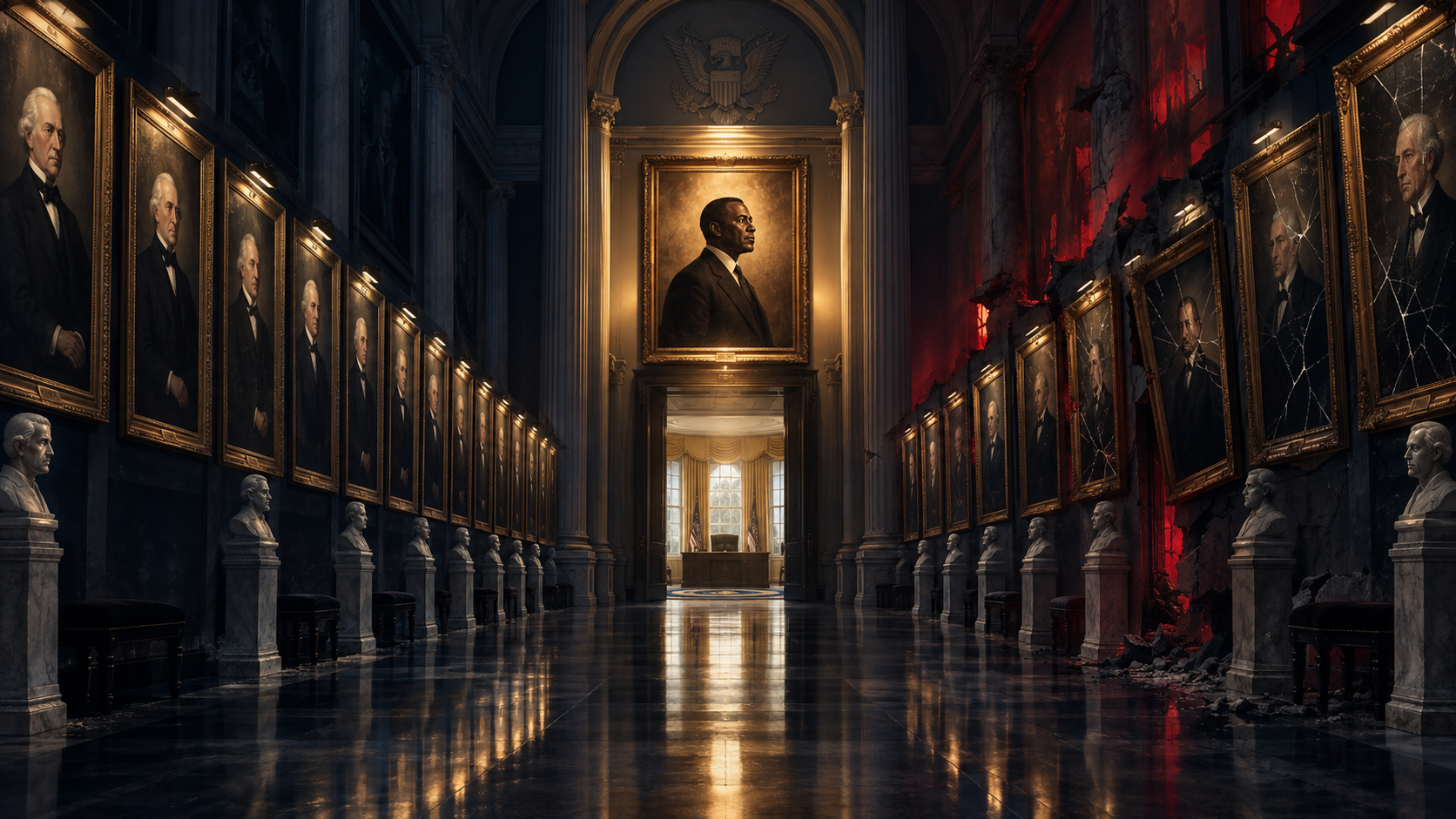
Donald Trump did not create every resentment that followed Obama’s election.
He recognised them, legitimised them and gave them a political home.
Before Trump entered the White House, he built his national political identity around the lie that Obama may not have been born in the United States. Birtherism was not an incidental controversy attached to Trump’s rise. It was the prototype.
It taught millions of people that the first Black president was not merely wrong, liberal or ineffective. He was fundamentally illegitimate.
Trump understood something about modern politics that many conventional politicians did not: people do not always need a coherent programme.
Sometimes they need permission.
Obama represented a changing America. Trump offered himself as the instrument through which the old image could reassert control.
Make America Great Again was therefore never only a promise about jobs, factories or economic growth. It invited voters to imagine an earlier America and decide who had been more securely positioned within it.
The slogan did not need to specify the date.
The audience supplied its own.
Poisoning the Well
Trump’s most enduring political achievement may not have been any particular law or executive order.
It was the destruction of a shared standard for reality.
Every investigation became a conspiracy. Every criticism became persecution. Every institution that resisted him became corrupt. Every election was legitimate only if it produced the correct winner. Journalists were enemies. Experts were frauds. Civil servants formed a hidden state. Opponents were not merely mistaken; they were traitors.
The well was poisoned so thoroughly that nothing drawn from it could be trusted.
Joe Biden inherited that country in 2021.
He also inherited a pandemic, economic disruption, damaged institutions and a public already trained to interpret ordinary government failure as proof of total national catastrophe.
That does not absolve Biden of his mistakes. His presidency should be judged on its own decisions, silences, compromises and failures. Nor does it mean that criticism of him was manufactured.
But Biden governed inside an information environment Trump had helped transform.
Facts no longer had to be disproved. They merely had to be contaminated.
Once people have been persuaded that every institution is lying, evidence becomes almost powerless. The politician who created the distrust is then uniquely equipped to benefit from it.
The Two Clowns Are Not the Same Clown
The image places Trump in the clown’s face twice: once after Obama and again after Biden.
It is funny because the second appearance completes the joke. Trump was not merely the disruption that followed Obama. America returned him to power after being given the opportunity to move beyond him.
But the ordinary face between the two clowns deserves some scrutiny too.
Biden can be criticised without pretending that Biden and Trump represented the same kind of presidency. They differed on healthcare, climate, taxation, immigration, labour, judicial appointments, international alliances and the limits of executive power.
The differences are not erased because both were old white men, because both presided over American military power or because neither delivered the transformation many voters wanted.
There is continuity within the American state—especially in foreign policy, defence and the protection of American power. Presidents do not enter an empty building. They inherit institutions, interests, alliances and machinery constructed long before them.
But continuity does not mean equivalence.
“All presidents are the same” may sound radical, but it often functions as an excuse not to examine power closely. It replaces analysis with posture.
Two governments can both fail while failing differently.
Two presidents can both deserve criticism without presenting an equal threat.
The same office can contain profoundly different forms of power.
One Black Face Is Not the End of Racism
Obama’s presidency is sometimes used as evidence against the continued importance of race.
America elected a Black president, the argument goes, therefore racism could no longer be a decisive political force.
But Obama’s election and the reaction to it cannot be separated.
The breakthrough and the backlash belong to the same history.
His victory showed that the barrier was no longer absolute. The response showed that the underlying hierarchy had not disappeared. Progress entered the room, and the system revealed how much of itself it was willing to damage in order to put progress back in its place.
That is the uncomfortable story hidden inside this apparently simple collection of faces.
It is not that America experienced centuries of normal presidents, briefly elected a Black man and then accidentally lost its mind.
The “normality” is part of the story.
The sameness is part of the story.
The single face breaking the racial pattern is part of the story.
And what followed him is part of the story too.
History Keeps Receipts
Political history is often cleaned up after the event.
The hatred becomes “division.” The lies become “controversy.” The people who encouraged the breakdown later present themselves as responsible adults who were merely responding to public concern.
But history keeps receipts.
It remembers who questioned Obama’s right to hold office.
It remembers who transformed resentment into a movement.
It remembers who attacked elections, institutions and any version of reality that placed limits upon personal power.
And it will remember the people who saw all of this happening and decided that every politician was basically the same.
The image is funny because it reduces American history to a grid of faces.
It is revealing because the reduction still manages to expose something real.