Writing · Housing · Britain’s Property Economy
The Last Buyer Has Run Out of Money
Britain built an economy that required every house to become more expensive. Now the next buyer is poorer than the last one.
The government has introduced another permanent mortgage guarantee scheme.
The promise is familiar: buyers with deposits as small as 5 per cent receive another route onto the housing ladder. The state guarantees part of the lender’s potential losses, lenders offer more high loan-to-value mortgages, and ministers announce that homeownership has been “opened up.”
But opened up to whom?
A government guarantee does not reduce the price of the house. It does not increase the buyer’s salary. It does not reduce the monthly repayment, build the missing home, make childcare affordable or protect the borrower from the next interest-rate shock.
It helps somebody borrow more.
That is not major housing reform. It is another attempt to preserve the existing price structure by stretching the next buyer further.
Britain’s housing market is being kept upright by longer mortgages, smaller deposits, two incomes, parental wealth, government guarantees and the assumption that another buyer will always arrive with more money.
But the next buyer has less.
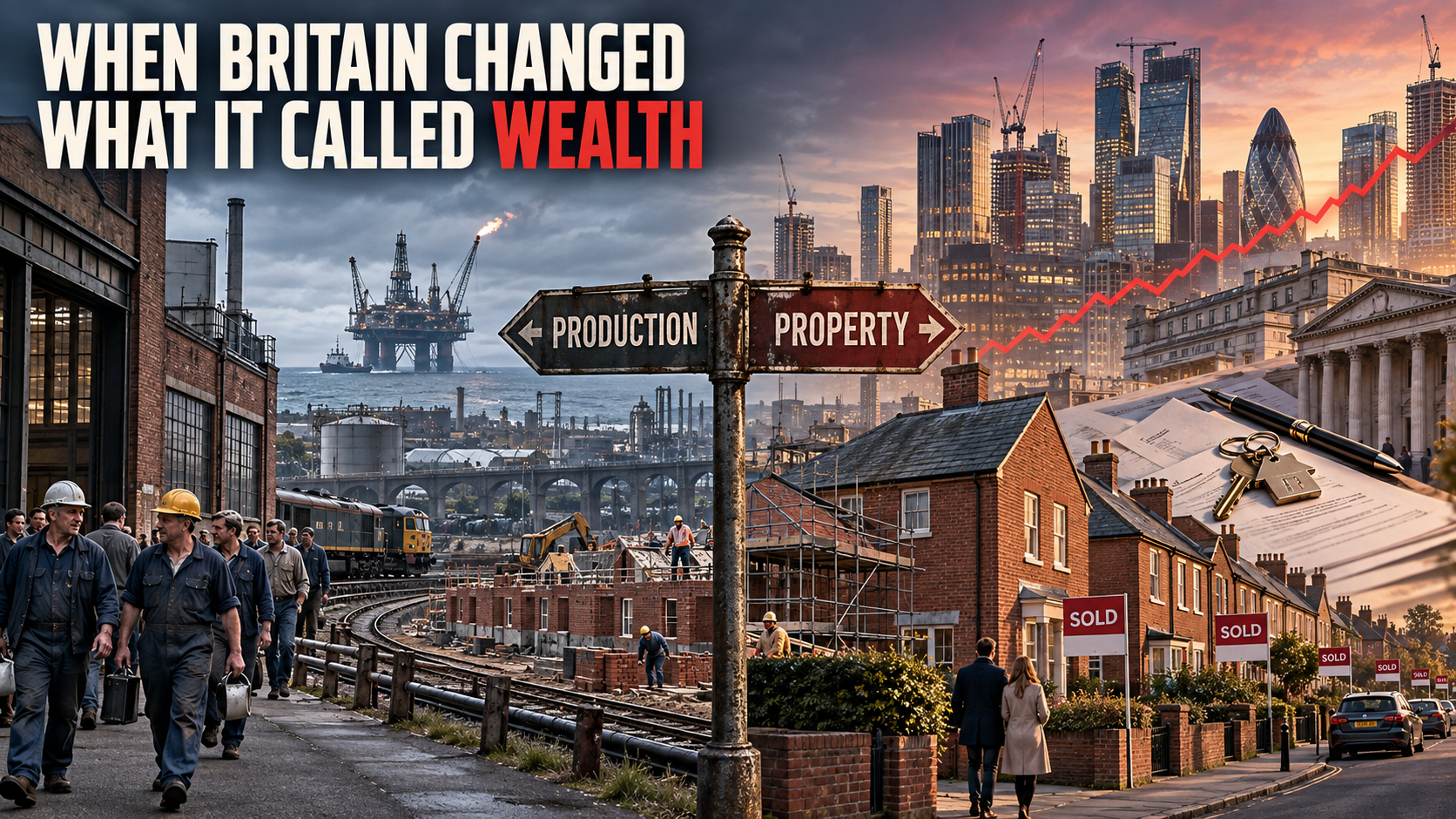
When Britain changed what it called wealth
Britain did not arrive here accidentally.
From the 1980s onwards, the country began changing what it regarded as economic success. Council homes were sold through Right to Buy, but replacement building never matched the scale of the sell-off. Public assets were privatised. North Sea oil revenues flowed through the Treasury instead of being converted into a sovereign wealth fund on the Norwegian model. Manufacturing declined. Finance expanded. Credit was liberalised.
Britain increasingly stopped asking what it could make and started asking what its existing assets were worth.
A more productive factory can create additional goods, exports, skills and wages. A more expensive house does not create another bedroom. It simply increases the amount the next buyer must borrow to acquire the same bricks.
For existing owners, it often felt like prosperity. Their homes increased in value while they slept. But that apparent wealth was somebody else’s future debt.
Every £100,000 added to an ordinary house had to be found by the person coming next. That person required a larger deposit, a larger mortgage, a higher salary or richer parents.
Eventually, the country was always going to reach somebody who could not pay.
New Labour did not reverse the model
This is why describing modern Labour as straightforwardly “socialist” is historically illiterate. The same people shouting about socialism often confuse socialism, communism and capitalism as though they were interchangeable swear words. I am not going to explain all three here. Go and do some research.
New Labour inherited the market settlement and largely operated within it. It accepted privatisation, embraced financial services, expanded private involvement through PFI and allowed housing wealth to become even more central to the economy.
New Labour was, in many ways, new Conservative Labour.
The population grew. EU freedom of movement increased labour mobility. Demand rose, particularly in London and southern England. The failure was allowing demand to grow without building sufficient housing and infrastructure around it.
Migrants did not force Britain to sell council housing without replacing it. They did not invent restrictive planning, land speculation, PFI or the financialisation of property. They entered a system Britain had already chosen.
The crash that should have ended it
The 2008 financial crisis exposed what happens when an economy mistakes expanding credit for expanding wealth. Banks lent aggressively. Rising prices reassured lenders because the property itself appeared to provide protection. Then the system seized up.
Northern Rock required emergency support and was ultimately nationalised. The financial system had to be rescued because the collapse of credit threatened the wider economy.
That should have forced Britain to reconsider an economy organised around debt and property inflation. Instead, the system was rescued and restarted. Lower rates and quantitative easing protected the economy, but they also boosted asset prices. Existing owners benefited most because they already owned the things rising in value.
Before entering Parliament, Rishi Sunak worked at TCI, the activist hedge fund that pressured ABN Amro to consider a break-up, merger or sale. An RBS-led consortium later bought the bank in one of the most disastrous acquisitions in British corporate history. The deal significantly weakened RBS; the taxpayer ultimately injected £45.5 billion to rescue it. TCI profited from its ABN Amro investment.
There is no evidence that Sunak personally directed that investment, and TCI’s founder has said he did not. The point is not to invent personal responsibility. The point is the system: private investors can extract their return and move on; when a systemically important bank collapses, the public absorbs the consequences.
When finance makes a profitable decision, the profit belongs to finance. When the system creates a national emergency, the liability belongs to everyone.
The house that earned more than its occupants
I once lived in a three-bedroom house off Northfield Avenue in Ealing. My former partner and his partner had bought it before the full insanity of London property prices became obvious. Within only a few years, it was worth vastly more.
Not because they created another floor. Not because they discovered oil beneath the kitchen. It was the same house.
That is not a criticism of them. Most people would accept the money. But we should stop pretending that this is equivalent to earning wealth through production.
A house can increase in value by hundreds of thousands of pounds while the person inside it sleeps. Someone working full time can save carefully for years and still move further away from ownership because prices rise faster than wages.
The deposit has disappeared before
Before the 2008 crash, 100 per cent mortgages were widely available. Northern Rock’s Together mortgage went as far as 125 per cent of the property’s value. When prices fell, borrowers with no equity cushion became trapped and lenders faced losses.
Those products largely disappeared after the crisis. But zero-deposit mortgages have returned. Skipton’s Track Record mortgage can lend up to 100 per cent to eligible renters with a reliable payment record. Other products use parental income, family savings, collateral or very small fixed deposits.
This is presented as innovation. It is really an admission: deposits have become so difficult to accumulate that the industry is trying to remove them from the transaction.
Removing the deposit does not remove the price. It converts the missing deposit into additional debt.
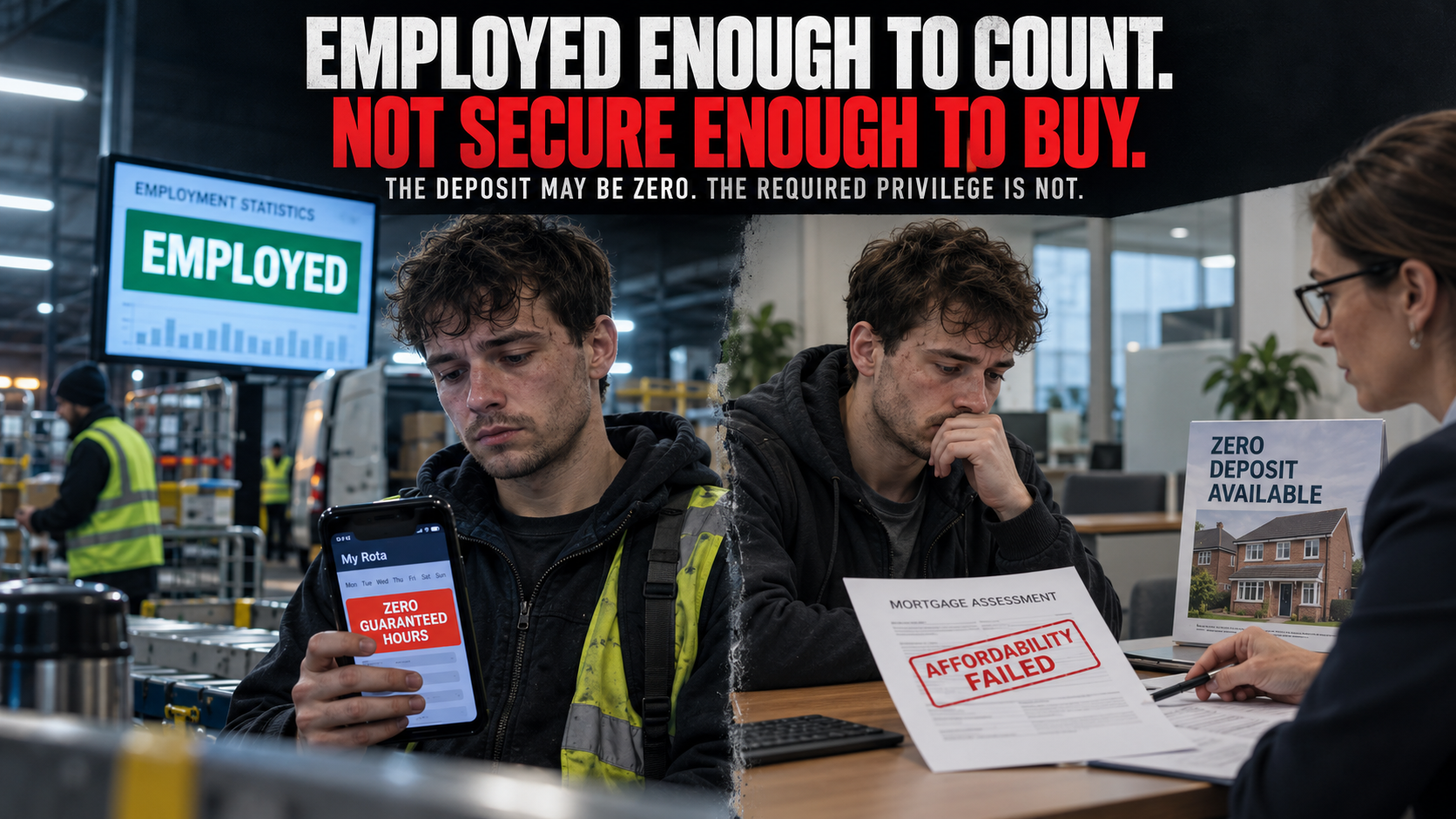
Employed enough to count. Not secure enough to buy.
A zero-deposit mortgage removes the deposit test. It does not remove the income test, credit test, affordability test or employment-security test.
Someone with a secure professional salary, clean credit and parents capable of intervening during a crisis may qualify. Someone moving between temporary jobs, relying on variable overtime or working under a zero-hours arrangement may not.
A worker can therefore be employed enough to disappear from unemployment statistics but not securely employed enough to purchase a home. That is Britain’s low-wage, low-security employment model colliding with its high-price housing model.
Generational wealth still matters even when the official deposit is zero. Wealthier parents can pay legal costs, clear debts, cover repairs, provide collateral, support maternity leave or prevent a missed payment becoming repossession.
The deposit may be zero. The required privilege is not.
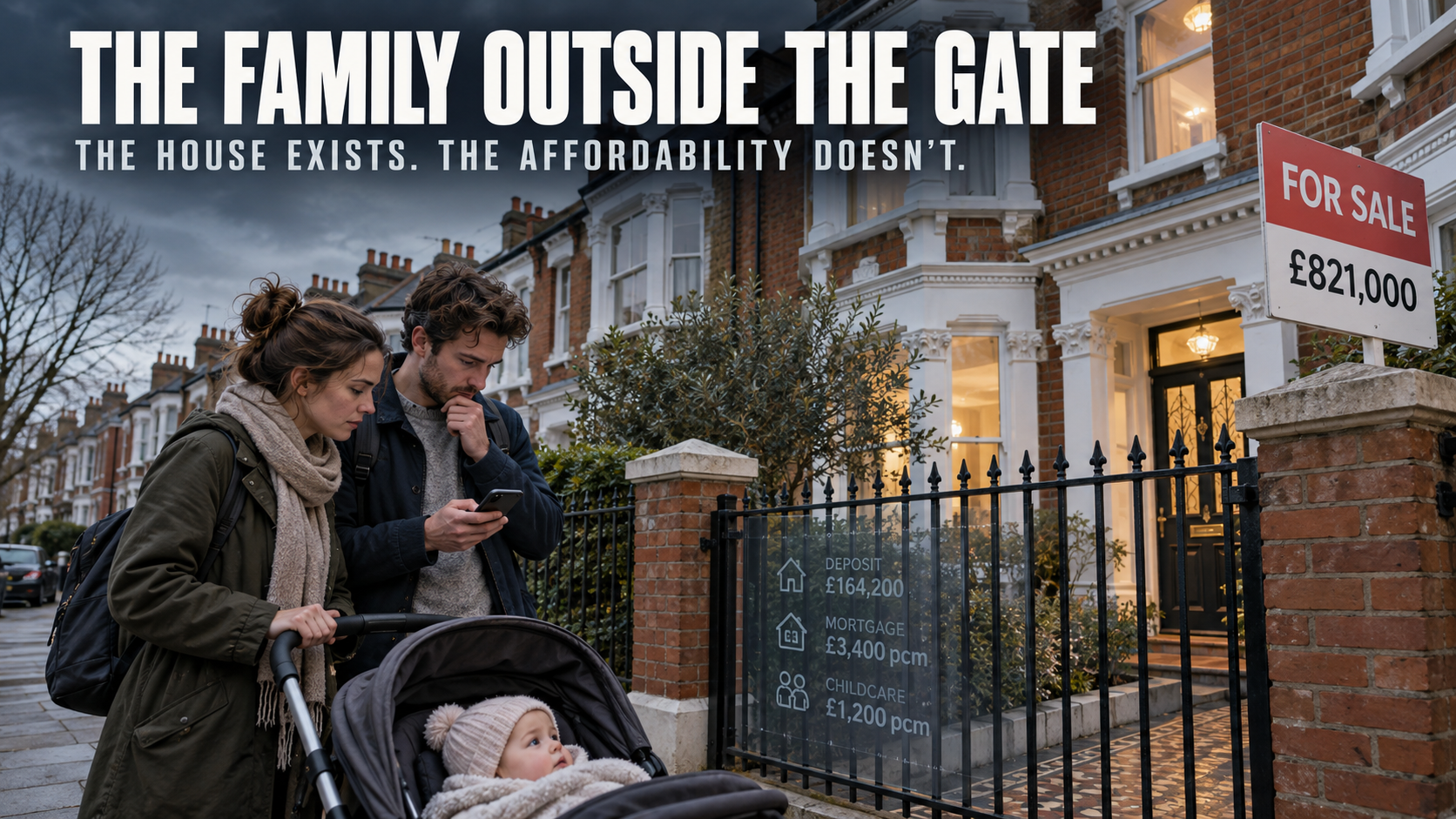
The family outside the gate
Take an ordinary three-bedroom West London house priced at approximately £821,000. A 20 per cent deposit would be £164,200. The remaining mortgage would be roughly £656,800, with repayments potentially around £3,400 a month depending on rate and term.
That is more than £40,000 a year after tax—before council tax, utilities, insurance, repairs, food, transport or childcare.
“Bank of Mum and Dad” sounds warm and harmless. In reality, it is an inheritance system operating while the parents are still alive. If the parents do not own a valuable home or possess substantial savings, the young couple begins the race hundreds of thousands of pounds behind.
Nationally, the median home in England cost £300,000 in 2025—7.6 times median full-time annual earnings of £39,300. Easier borrowing can sustain the price responsible for the exclusion.
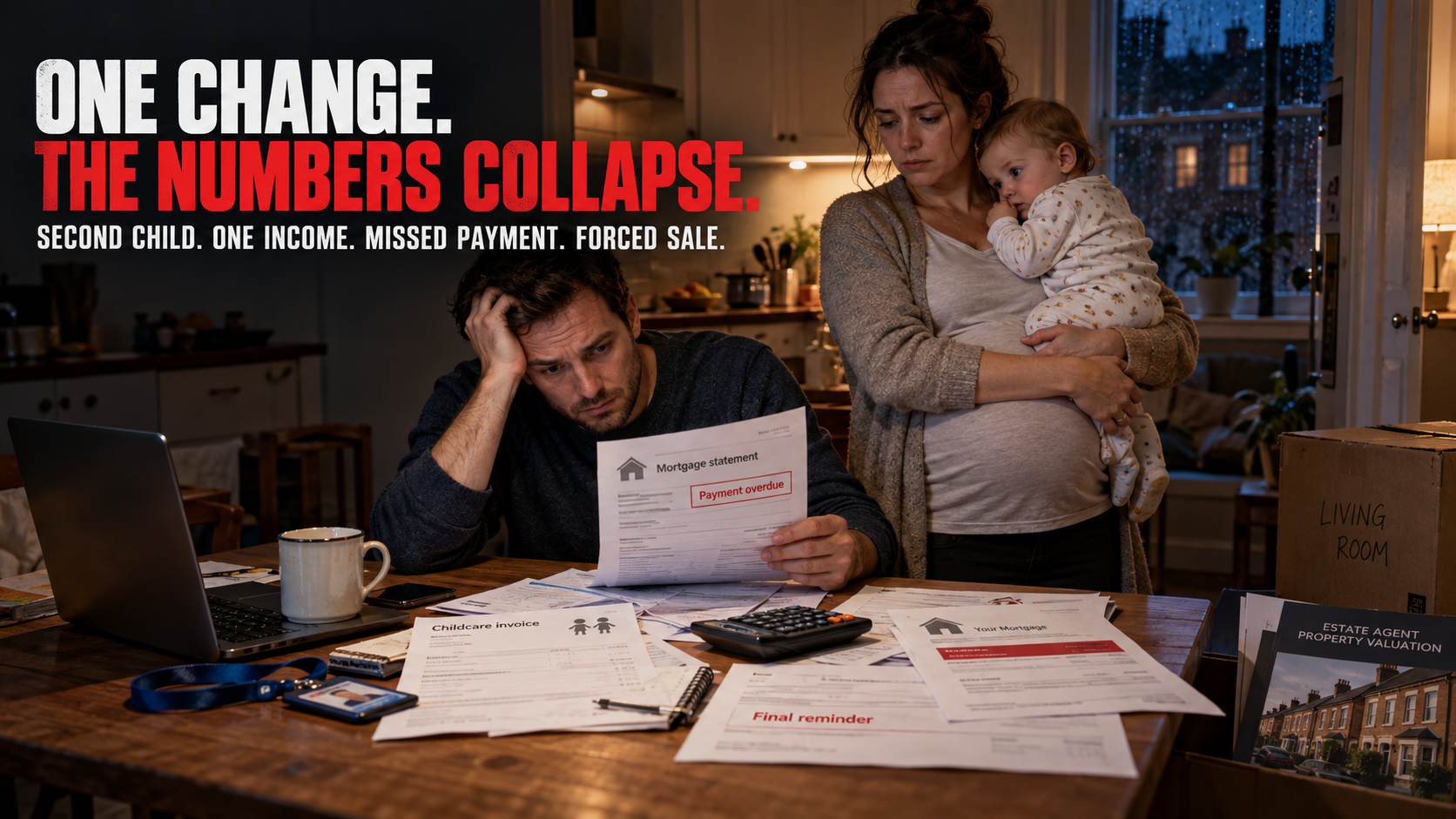
One change and the numbers collapse
Imagine that the couple somehow gets through the gate. Both work. The lender approves the mortgage. The spreadsheet works—but only just.
Then they have a second baby. Two childcare bills make one parent’s return to work barely worthwhile. Hours are reduced. One income disappears, but the mortgage does not shrink in sympathy.
That is not a feckless family living irresponsibly. It is a housing market requiring ordinary people to maintain near-perfect economic conditions for 25, 30 or 35 years.
A country that attacks the generation it needs
Turn on LBC, the BBC or almost any political phone-in and somebody will be discussing NEETs, worklessness, mental health, benefits or young people who supposedly lack resilience. The conversation is nearly always detached from the structure surrounding them.
Britain tells young people to remain in education, take on student debt, rent at market rates, pay for expensive transport, accept insecure employment and somehow save a six-figure deposit. It then calls them lazy when they cannot reproduce the living standards achieved when prices and earnings had a radically different relationship.
The country needs younger workers to pay taxes, staff public services, support pension expenditure and purchase the homes of older owners. But it has made that generation poorer, more indebted, less secure and increasingly unwell.
We do not even build for the life cycle
A functioning system would provide genuinely affordable starter homes, secure family homes and suitable bungalows and accessible properties for older people wishing to downsize.
Britain does not build enough of any of them. If the suitable property does not exist at one stage, movement slows everywhere else. The answer is not to blame the pensioner in the three-bedroom house or the young family in the rented flat. It is to build the missing options.

You bought the flat. They kept the control.
After Grenfell, thousands of leaseholders discovered that “ownership” did not necessarily mean control. They could own the lease and pay the mortgage while having limited power over the freeholder, managing agent, insurer, contractor or pace of remediation.
Some received waking-watch bills. Others faced insurance increases, remediation uncertainty and collapsed sales because lenders required satisfactory fire-safety information.
Who earns money from the waking watch? Who appoints the contractor? Who checks the invoice? Why does the leaseholder—the person with the least control—so often receive the demand?
It is not meaningful ownership. It is liability with a set of keys.

The markets send the bill
Liz Truss did not personally create every increase in mortgage rates. Global inflation and monetary tightening were already raising borrowing costs. But the September 2022 mini-budget added a specifically British shock.
Large unfunded tax cuts and the absence of a credible fiscal framework triggered severe turmoil in the gilt market. The Bank of England intervened because the dysfunction posed a material risk to UK financial stability.
If a future government—whether led by Nigel Farage or anybody else—produces another fiscal event that convinces investors Britain has stopped taking its obligations seriously, the consequences will arrive through mortgage offers, refinancing costs, rents and business loans.
Governments are free to make choices. Nobody is entitled to choose the market’s reaction.
Britain’s capitalism ran out of road
Margaret Thatcher is famously associated with the line that the problem with socialism is that eventually “you run out of other people’s money.” Britain’s property economy has its own conclusion:
Eventually, you run out of the next person’s borrowing capacity.
This is not an argument that all capitalism inevitably reaches the same destination. Norway, France, Germany, the United States and Britain are capitalist countries. They make different choices about ownership, strategic industries, investment and where the return flows.
Norway retained a controlling interest in Equinor and directed petroleum wealth into a sovereign fund. France returned EDF to full state ownership because energy and nuclear capability are matters of national sovereignty. Germany owns its public investment bank KfW and intervened to control Uniper during an energy emergency.
These systems are not perfect. State companies can be inefficient and governments can waste money. But the country retains a stake: engineers, knowledge, infrastructure, dividends and the power to decide what happens next.
Small state, large bill
Britain sold the asset, lost the skills, surrendered the control and hired the service back at a higher price.
Small government does not mean power disappears. It moves. If the state does not own the energy company, the private owner exercises the power. If the council does not build the home, the developer and landowner decide what exists. If transport does not connect the places people need, the household must purchase a car.
The state becomes smaller. Your personal liabilities become larger.
That is why the panic over 15-minute cities is revealing. A neighbourhood placing work, shops, healthcare, schools and transport nearby reduces compulsory consumption. A capable state does not make every decision for citizens; it ensures citizens are not forced to purchase a private solution to every public failure.
Jackdaw ain’t jack shit
Jackdaw now forms part of Adura, jointly owned by Shell and Equinor. Equinor is 67 per cent owned by the Norwegian state.
Norway’s government therefore has an indirect commercial interest in a company extracting gas from beneath the British continental shelf. The British government does not hold an equivalent stake.
Britain can tax the profit. That revenue matters. But tax is not ownership. Ownership brings the dividend, asset, expertise and seat at the table.
The gas enters a commercial market. British households do not receive it cheaply merely because it came from British waters. Jackdaw’s own assessment identifies only 27 additional direct jobs specific to the project.
Britain owns the resource but not the commercial vehicle converting it into wealth. When the field is empty, the gas is gone.
A home became a financial forecast
My Polish husband often makes a simple observation: in Poland—and in much of the world—you buy a home primarily to live in it.
In Britain, people discuss the home as though it were a corporate earnings forecast. What will it be worth next year? How much equity has it gained? Can it fund retirement? Can it provide the children’s deposits? Can it be flipped?
If my house must rise from £300,000 to £500,000, the next person needs another £200,000. If they require it to rise to £700,000, the person after them must find another £200,000.
What happens to the tenth person in the chain?
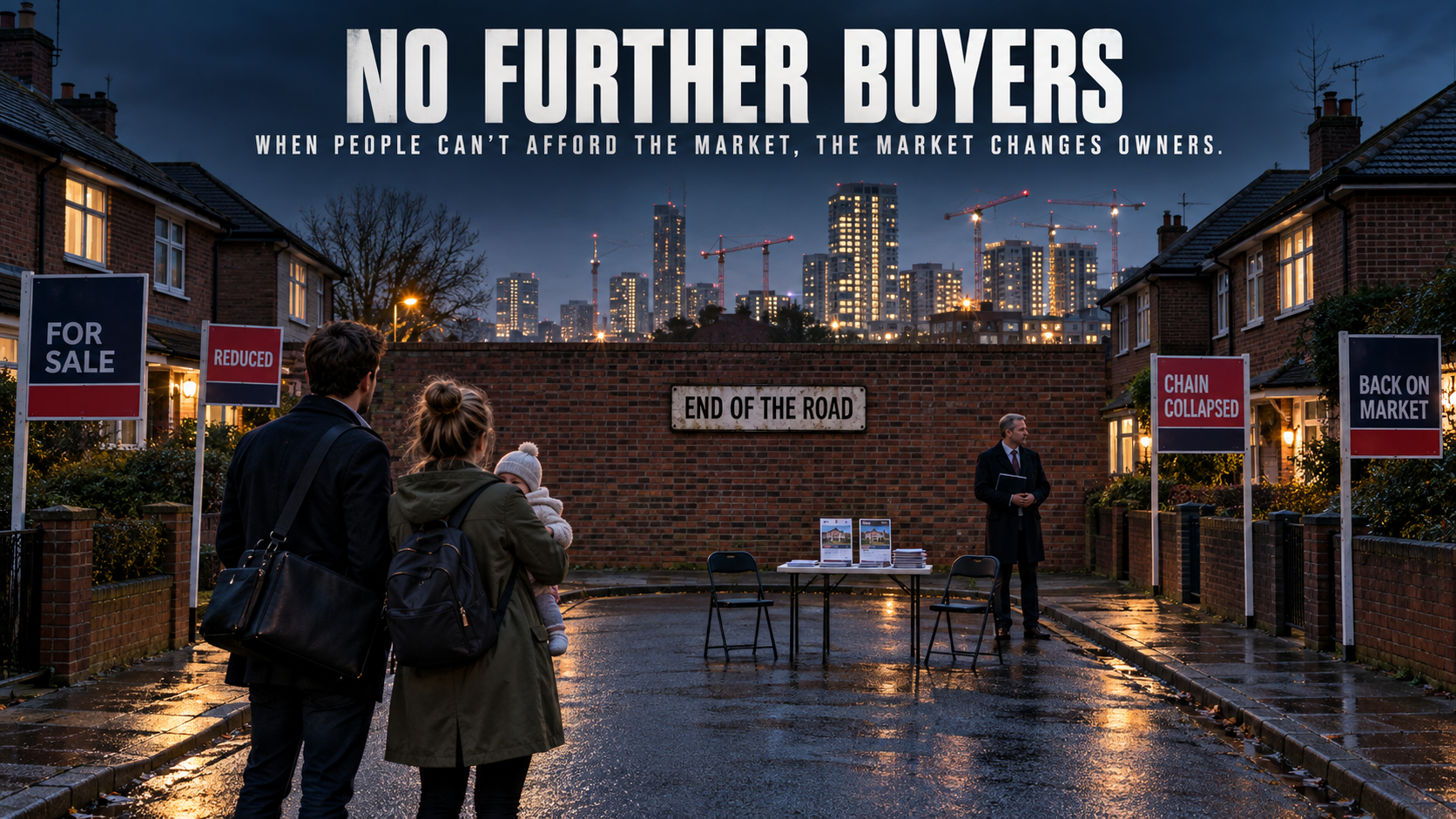
No further buyers
When ordinary buyers disappear, the housing market does not vanish overnight. It freezes.
Transactions fall. Chains collapse. Sellers withdraw rather than accept lower offers. Developers delay construction. Banks become more cautious. People who absolutely must move become the first to reduce their prices.
Eventually, assets move towards whoever still possesses cash, collateral or access to finance: wealthier households, landlords, investment funds and international capital.
That is not a conspiracy. It is what markets do when access becomes unequal. The person with the strongest balance sheet waits for the distressed person with no time left.
A 5 per cent deposit on an unaffordable house is still unaffordable. A zero deposit is not a zero mortgage. A longer mortgage is not a cheaper house. A government guarantee is not a wage rise. More debt is not more supply.
Major reform means building council and genuinely affordable homes; reforming planning and land compensation; restoring councils’ capacity to build; constructing homes suitable for older people; resolving leasehold and cladding liabilities; and investing in transport, skills, industry and secure employment.
Housing cannot become substantially cheaper for buyers while remaining permanently more valuable for every existing owner.
Someone’s paper wealth is somebody else’s purchase price.
But the next ordinary British buyer has run out of money.
NO FURTHER BUYERS.
Sources and further reading
- HM Treasury — 2025 Mortgage Guarantee Scheme
- ONS — Housing affordability in England and Wales: 2025
- Bank of England — Gilt market operation, September 2022
- National Audit Office — Nationalisation of Northern Rock
- Skipton — Track Record mortgage
- UK Parliament — Remediation of dangerous cladding
- Norwegian Petroleum — Government revenues
- Equinor — Shareholders
- EDF — French state becomes sole shareholder
- KfW — Public mandate and ownership
- Uniper — Shareholder structure
- Shell — Formation of Adura