The Outsiders
Who Create
the Culture
Why women and queer people have shaped the world we live in.
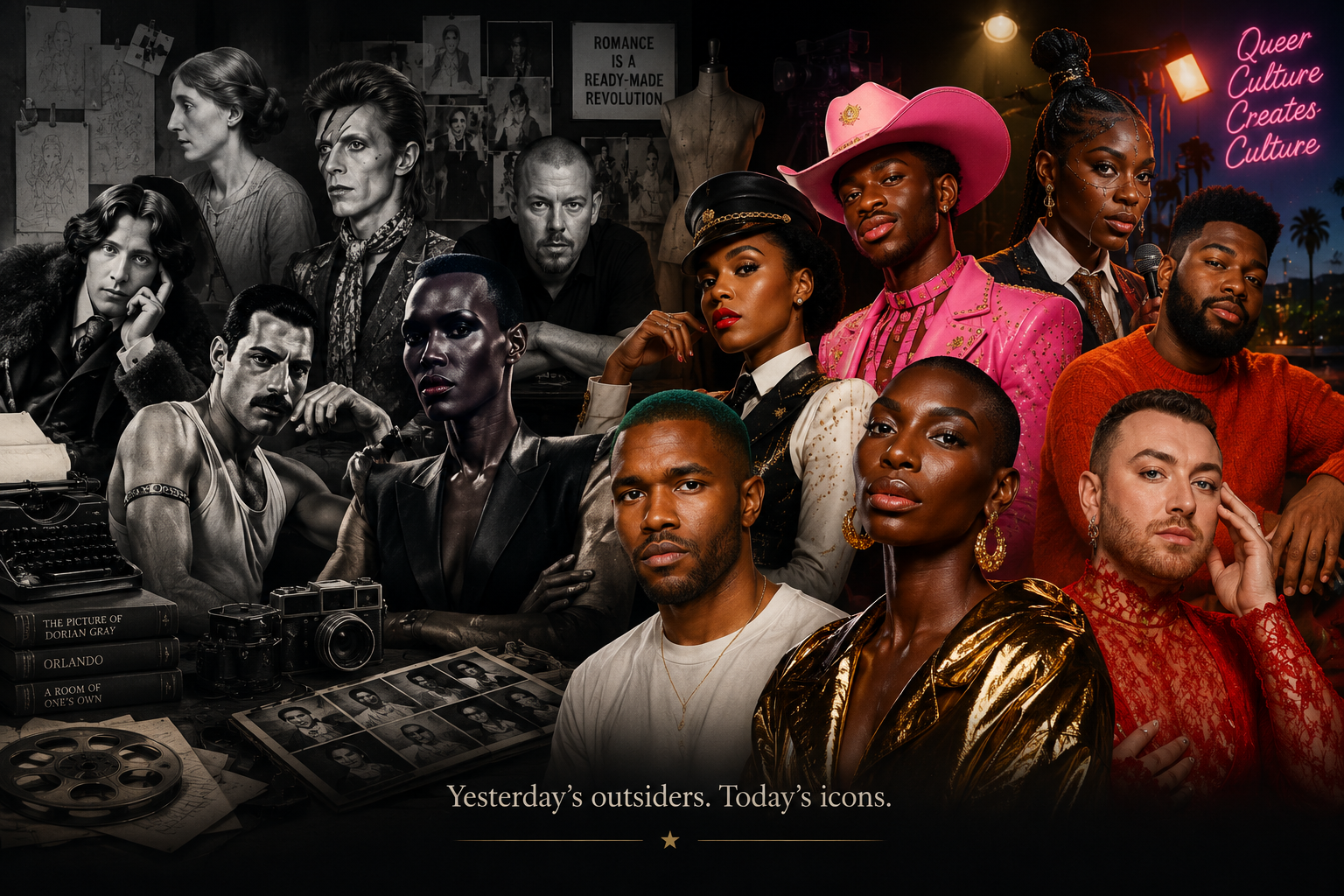
There is a phrase I’ve heard repeatedly over the years.
“Gay people run Hollywood.”
Sometimes it’s said jokingly.
Sometimes admiringly.
Sometimes suspiciously.
And sometimes — particularly in certain corners of music, politics and the internet — it comes wrapped in something considerably uglier.
But the phrase interests me because underneath the stereotype sits a much more interesting question.
Who actually creates culture?
Not who owns the studio.
Not who controls the corporation.
Not who ultimately signs the cheque.
Who imagines the clothes?
Who writes the songs?
Who designs the sets?
Who invents the characters?
Who photographs the faces?
Who creates the language, aesthetics, sounds and identities that everybody else eventually consumes?
Because those are not necessarily the same people.
Ownership is not the same as creativity
This distinction matters enormously.
When somebody says that gay people “run Hollywood”, several completely different ideas are being collapsed into one sentence.
Who owns Hollywood?
Who occupies senior executive positions?
Who finances films?
Who directs them?
Who writes them?
Who designs the costumes?
Who creates the performances, choreography, photography, music and aesthetics around them?
Those questions can produce very different answers.
Creative influence is not the same thing as institutional power.
A group can be enormously influential culturally while historically possessing considerably less economic or institutional power.
In fact, that tension is part of what makes this subject so interesting.
Look at who keeps changing the rules
Think about some of the people who changed Western culture.
Different people.
Different generations.
Different disciplines.
Different relationships with sexuality and gender.
But again and again, we encounter people whose relationship with the social mainstream was complicated — and whose relationship with creativity was transformative.
Wilde turned language, sexuality and social hypocrisy into art.
Woolf helped transform literary modernism while interrogating gender, identity and the structures surrounding women’s lives.
Bowie repeatedly dismantled expectations around masculinity, sexuality, fashion and the very idea of the fixed pop-star identity.
Freddie Mercury became one of the defining performers of twentieth-century popular music.
Grace Jones turned Blackness, femininity, androgyny, fashion, performance and physicality into something almost architectural.
Alexander McQueen repeatedly transformed discomfort, beauty, violence, sexuality and spectacle into fashion.
They weren’t all doing the same thing.
That’s precisely the point.
And it didn’t stop with Bowie
Look at the contemporary landscape.
Music alone gives us completely different expressions of Blackness, queerness, masculinity, femininity and sexuality.
Frank Ocean didn’t need to become Lil Nas X.
Lil Nas X didn’t need to become Janelle Monáe.
Janelle Monáe didn’t need to become Grace Jones.
Khalid doesn’t need to perform queerness in the same way as anybody else.
That difference matters.
Because there is no single queer aesthetic.
There is no single Black aesthetic.
There is no single female aesthetic.
What connects these people isn’t that they all make the same art.
It’s that they expand the space in which art can exist.
And then there are women
The same question becomes even bigger when we move beyond sexuality.
Women spent most of recorded history living inside institutions overwhelmingly controlled by men.
Political power.
Property.
Universities.
Publishing.
Studios.
Galleries.
Banks.
Churches.
The institutions controlling culture were frequently male.
Yet women were continuously creating culture inside, around and sometimes directly against those structures.
That distinction matters.
Being excluded from power does not mean being absent from influence.
The outsider notices the rules
I don’t think women are biologically more creative.
I don’t think gay people possess some creativity gene.
I don’t think bisexuality automatically makes somebody interesting.
And I certainly don’t think every outsider becomes an artist.
The argument is different.
If you fit comfortably inside a system, its rules can become invisible.
They simply feel normal.
But if the system repeatedly tells you that something about you is unusual, unacceptable, feminine, queer, foreign, improper, unattractive or simply wrong, you become unusually aware that those rules exist.
And once you recognise that a rule is constructed, another possibility appears.
It can be reconstructed.
Yesterday’s weird becomes tomorrow’s normal
Culture does this constantly.
Something begins on the margins.
The mainstream laughs at it.
Then it becomes controversial.
Then interesting.
Then fashionable.
Then marketable.
And eventually everybody forgets that it was ever considered strange.
Fashion does it.
Music does it.
Language does it.
Nightlife does it.
Film does it.
Even capitalism does it.
The mainstream is remarkably good at eventually selling us things it previously told us were unacceptable.
So, do gay people “run Hollywood”?
No.
Not in the conspiratorial sense in which the phrase is sometimes used.
Hollywood is a vast industrial system involving corporations, shareholders, executives, financiers, producers, distributors, platforms, agencies and thousands upon thousands of workers.
There is no secret queer control room underneath the Hollywood sign.
But have LGBT people had an enormous influence on Hollywood, theatre, fashion, music, photography and popular culture?
Absolutely.
And those are two completely different statements.
Which brings me back to Sam Smith
I ended up thinking about all of this because of something much smaller.
A Facebook argument about Sam Smith.
The clothes.
The body.
The pronouns.
The endless insistence that somehow the person singing Stay With Me became less talented when their presentation changed.
But that reaction is part of the story.
Because culture rarely changes without somebody first being accused of looking ridiculous.
And eventually the thing that looked ridiculous becomes familiar.
This isn’t romanticising exclusion
There is one final distinction worth making.
None of this means discrimination is somehow good for creativity.
Homophobia didn’t give Freddie Mercury his voice.
Sexism didn’t give Virginia Woolf her imagination.
Racism didn’t create Grace Jones.
Exclusion has destroyed opportunities, careers and lives.
Countless extraordinary people never received the platform they deserved.
So the lesson isn’t:
suffering creates great artists.
The lesson is that people have repeatedly created extraordinary things despite the structures surrounding them.
And sometimes being positioned outside the dominant culture gives somebody a perspective from which its assumptions become easier to see.
The edge keeps moving
That is perhaps the strange cycle of culture.
Society creates outsiders.
Outsiders create subcultures.
Subcultures create new aesthetics.
The mainstream discovers them.
Business packages them.
Everybody consumes them.
And twenty years later we forget that anybody objected in the first place.
Then another group appears at the edge.
Another argument begins.
Another boundary gets pushed.
Another generation says:
“That isn’t normal.”
Until eventually it is.