WHO TOUCHED YOUR FOOD?
If prejudice matters that much, try shopping by it.
Modern Britain is built on millions of interactions between people who may never know one another’s nationality, race, religion, sexuality or politics.
Which raises a fairly simple question for anyone who genuinely believes some of those people should not belong here: how much of their labour are you prepared to stop using?
The Woman Who Was Sick
There is a Little Britain sketch that has stayed with me for years.
Maggie eats something perfectly happily. Then she discovers that somebody from a group she dislikes has been involved with it.
Suddenly she is horrified.
Then she vomits.
The joke is grotesque because it takes prejudice and makes it physical.
The food hasn’t suddenly changed. Nothing poisonous has appeared in it. The only new information is who was connected to it.
Watching Britain now, I sometimes wonder why people who genuinely hold those prejudices aren’t doing exactly the same thing.

Stand By Your Principles
Britain undoubtedly has racists.
I don’t mean somebody asking difficult questions about immigration numbers, housing, wages, integration or public services. Those are legitimate political arguments.
I mean actual racism: believing somebody is inferior, threatening or less entitled to belong because of their race or ethnicity.
And prejudice rarely seems to live neatly inside a single box.
Research into generalised prejudice has found associations between hostility towards different out-groups.
That doesn’t mean every racist is automatically homophobic, or every homophobe automatically sexist. Human beings are more complicated than that.
But different prejudices can cluster.
Which makes the everyday practical question fascinating.
Pick up your strawberries.
Who picked them?
Pick up your chicken.
Who processed it?
Who packed it?
Who drove it?
Who unloaded it?
Who maintained the machinery?
Who wrote the warehouse software?
Who stacked it?
Who served you?
Was everybody acceptable?
More importantly: how would you ever know?
The White-British Supermarket
Imagine opening a supermarket for somebody who genuinely wants an ethnically exclusive supply chain.
Not simply a Union Jack printed on the packet.
I mean the whole thing.
Everybody involved must satisfy the test.
Now start removing things.
Tea becomes awkward.
Coffee becomes awkward.
Chocolate, bananas, rice, spices, citrus fruit and countless other ordinary products immediately reveal the international system sitting behind the British supermarket.
In 2025, Britain produced only around 58% of the food consumed here on Defra’s farm-gate measure.
And even a product labelled British doesn’t imply an exclusively British workforce.
Census analysis found that around four in ten workers in food manufacturing in England and Wales were born outside the UK. ONS Census 2021 analysis puts the figure at 40.4%.
So our fictional supermarket starts looking rather empty.
Tell Us Who Touched It
Perhaps every product needs another label.
Follow every human being who contributed to the product from the field to the checkout.
It becomes absurd almost immediately.
The man complaining about gay people needs a plumber.
Is the plumber gay?
Someone furious about Muslims has a broken car.
Is the mechanic Muslim?
Somebody who dislikes immigrants requires surgery.
Where was the surgeon born?
Suddenly principles become expensive.
Modern prejudice can become remarkably flexible the moment maintaining it becomes personally inconvenient.
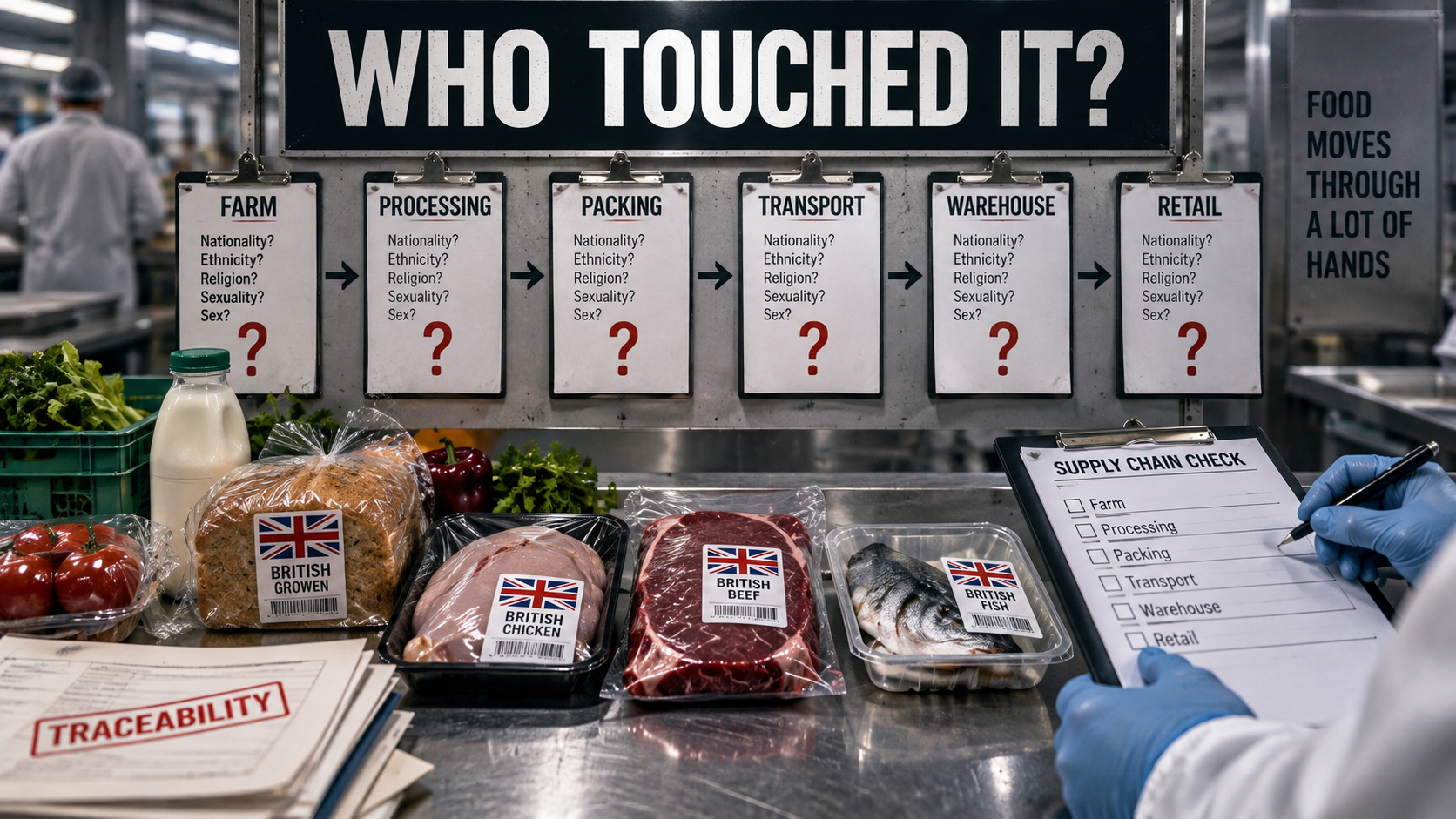
What About Gay Hands?
This part interests me personally.
I’m bisexual.
Somebody is perfectly entitled to hold a religious belief about homosexuality. I don’t require every stranger on Earth to approve of my sexuality.
But if that objection is important enough to influence what rights gay or bisexual people should have, let’s take the principle into ordinary life.
Would you refuse food prepared by a gay chef?
Would you refuse medication developed by a gay scientist?
Would you change doctors?
Would you refuse to fly because a lesbian engineer had maintained the aircraft?
Would you demand heterosexual certification before somebody repaired your boiler?
Of course, there is another rather large problem.
You don’t know.
Sexuality isn’t printed on somebody’s forehead.
The sandwich has already been made.
Brexit Didn’t Remove the Foreign Worker
In some ways, Brexit gave Britain something close to a real-world version of this experiment.
Britain ended free movement.
And the composition of the migrant workforce changed.
HMRC’s payrolled-employment data show that between December 2020 and December 2024, payrolled employments held by EU nationals fell by around 134,000, while those held by non-EU nationals rose by 1.9 million.
By the end of 2025, Indian nationals accounted for just over one million UK payrolled employments, the largest total for any non-UK nationality, according to HMRC’s December 2025 data.
Britain didn’t abolish its dependence on migrant labour.
It changed where much of that labour came from.
I noticed something changing before I ever went looking for the statistics.
Motorway services.
Coffee shops.
Restaurants.
Hospitals.
The eastern-European workforce I had become accustomed to seeing seemed less visible, while I increasingly saw Black and Asian workers in many of the same parts of everyday life.
Of course, a face cannot tell me somebody’s passport.
The brown man behind the counter might have been born in Birmingham.
The white woman beside him might have arrived from Poland six months ago.
Appearance does not establish nationality, birthplace, religion or immigration status.
But when I eventually looked at the labour-market numbers, the broader change I thought I was seeing was there.
Then You Walk Into Hospital
Food is the easy version of this argument.
Your principles become considerably more interesting when something has gone wrong with your body.
In June 2025, around 325,000 of the NHS’s 1.5 million staff in England reported a nationality other than British, according to the House of Commons Library’s analysis of NHS workforce data.
That’s roughly one in five.
Among doctors, the proportion reporting a non-British nationality was around 36%.
Among nurses, it was around 30%.
In London, around 32% of NHS staff reported a nationality other than British.
So what happens?
You’ve spent the morning complaining about foreigners.
By the afternoon you’re in A&E.
Do you ask where the doctor was born before they stop you bleeding?
Do you ask the nurse’s nationality before accepting the medication?
Or does the ideological border suddenly disappear when you’re frightened and somebody knows how to help you?
And Eventually, Someone Has To Care For You
Then the thought experiment reaches old age.
The 2016 referendum had a pronounced age divide.
Lord Ashcroft’s referendum-day polling found that around 60% of voters aged 65 and over voted Leave.
That doesn’t mean every older Leave voter was racist.
It doesn’t mean racism explains every Leave vote.
But it creates an uncomfortable collision with what happened afterwards.
Skills for Care estimated that in 2024/25, 31% of workers in the local-authority and independent adult social-care sectors had a non-British nationality.
That represents hundreds of thousands of people helping other people eat, wash, dress, move, take medication and live with some dignity.
In just 2022/23 and 2023/24, around 185,000 international recruits entered direct-care roles, according to Skills for Care.
That pace has since slowed: Skills for Care recorded around 50,000 international recruits in 2024/25, down from 105,000 the previous year. In July 2025, care workers and senior care workers were removed from the overseas Health and Care Worker visa route for new recruits.
Meanwhile, Skills for Care projects that England may need roughly 470,000 additional adult-social-care posts by 2040 to keep pace with demographic change.
What happens when the person you’ve been told to fear becomes the person helping you out of bed?
What happens when you’re 86 and the person preparing your breakfast is Indian?
Or Nigerian?
Or Filipino?
Or Ghanaian?
Or Romanian?
Again, skin colour cannot tell us whether somebody is an immigrant.
A Black or Asian care worker may have been born here.
But the workforce figures tell us something that doesn’t depend on looking at anyone’s face:
modern English social care genuinely depends heavily upon workers with non-British nationalities.
Maggie vomited when she discovered who was connected to her food.
Food is easy.
Dependency is harder.
What If They Don’t Want To Serve You?
There is another side to this relationship.
What happens when the person providing the service decides they don’t want to provide it?
In June 2025, Stephen Yaxley-Lennon, better known as Tommy Robinson, was dining with a group at Hawksmoor Air Street in London.
The party had already been served starters when they were asked to leave.
In footage of the encounter, the manager said members of staff felt uncomfortable serving the group.
Hawksmoor subsequently framed its response around its duty of care towards staff.
I’m not interested here in pretending I know the personal background, politics, ethnicity or religion of individual workers involved.
I don’t.
The interesting thing is the relationship itself.
Political rhetoric often talks about groups of people as abstractions.
Then somebody has to bring the steak to the table.
Somebody has to pour the drink.
Somebody has to clean the room.
Somebody has to drive the taxi home.
Suddenly the culture war has a human face standing three feet away.
I Already Check Where My Food Comes From
There is another side to this argument, and I’m not going to pretend I’m some perfectly neutral consumer.
I already discriminate when I shop.
Just not between human beings.
Since Brexit, and particularly after everything I’ve read and watched about environmental standards, sewage, regulation and food production, I’ve increasingly found myself checking where things come from.
In some circumstances, I’ve actively started buying away from Britain.
I look at imported meat.
I think about where fish has been caught.
Seeing a Union Jack on a packet does not automatically reassure me.
But my own behaviour has to survive exactly the same test I’m applying to everybody else.
Imported does not automatically mean better.
British does not automatically mean worse.
A foreign flag isn’t a certificate of quality any more than a Union Jack is.
If the evidence shows a British producer is operating to excellent standards, dismissing that product simply because it’s British would be irrational.
The distinction is important.
What Touched Your Food?
Human beings absolutely should discriminate when buying food.
We do it constantly.
How was the animal raised?
What pesticides were used?
What antibiotics were used?
Was the processing environment clean?
Was the cold chain maintained?
Where was the fish caught?
What pollutants were present?
What additives were used?
What were the animal-welfare standards?
How effective was the regulator?
Those are legitimate questions.
Because those things can actually affect the food.
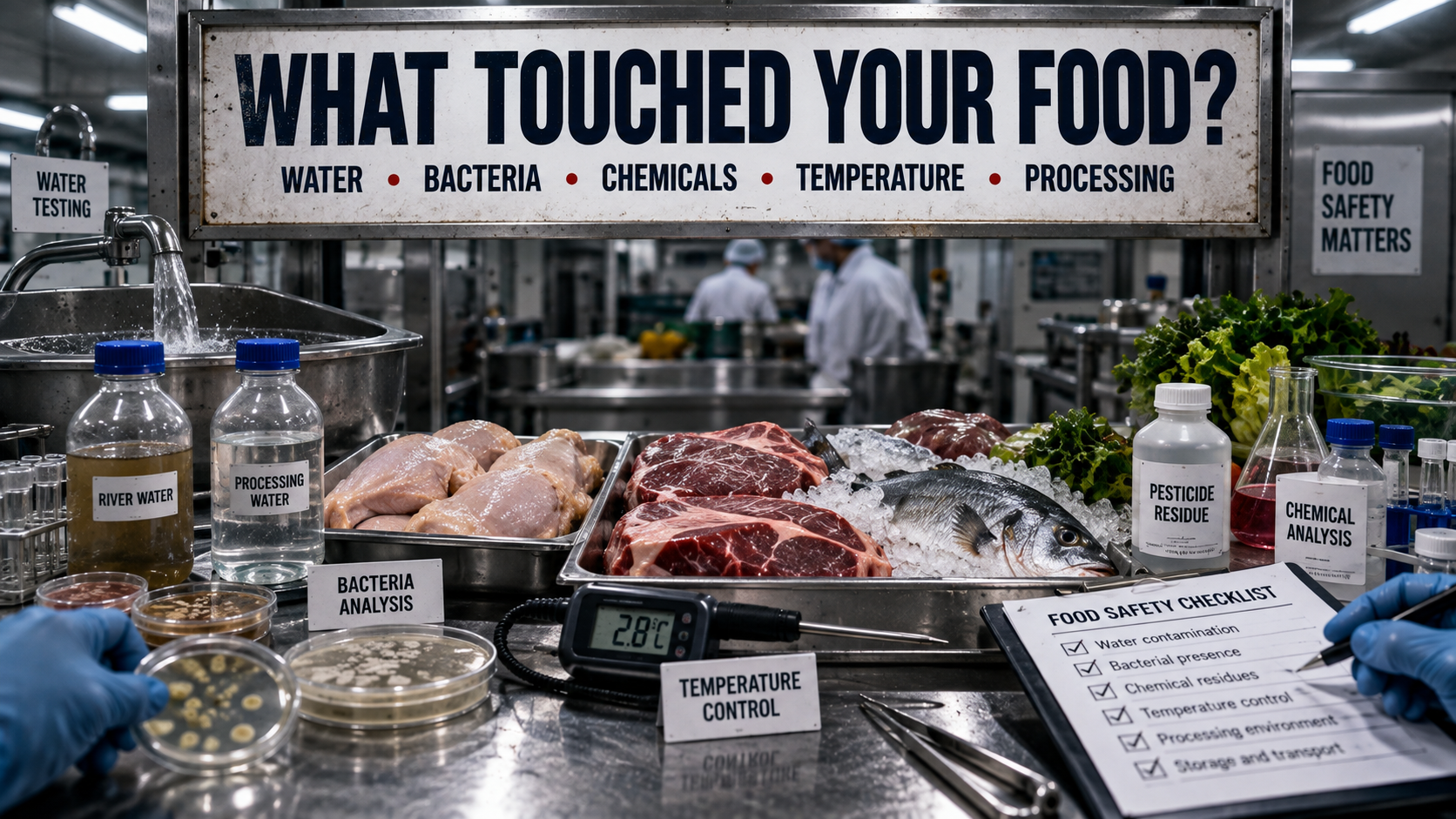
This is where the entire argument turns.
The rational question isn’t:
Who touched my food?
It’s:
What touched my food?
Bacteria can hurt you.
Sewage can hurt you.
Chemicals can hurt you.
Bad refrigeration can hurt you.
Unsafe processing can hurt you.
The ethnicity of the person holding the packet cannot.
When Food Really Was the Experiment
There is a reason modern countries developed food-safety regulation in the first place.
Industrial food production created extraordinary abundance.
It also created extraordinary opportunities to sell people things that could make them ill.
One of the strangest examples came from the United States at the beginning of the twentieth century.
Government chemist Harvey Wiley recruited volunteers for experiments that became popularly known as the Poison Squad.
The volunteers consumed meals containing preservatives and additives while their effects were investigated.
The experiments belonged to a much larger struggle over adulterated food, industrial production and the need for stronger consumer protection.
That history matters because it reminds us what food scrutiny is actually supposed to do.
Ask what is in it.
Ask what happened to it.
Ask whether the system around it is safe.
Ask whether somebody is cutting corners.
Ask whether the regulator is doing its job.
Those questions can keep people alive.
Asking whether the person who packed it was Black, Indian, Muslim, Polish or gay cannot.
Try It For A Week
So here’s the experiment.
If you genuinely believe a particular group of people is destroying Britain, spend seven days avoiding everything those people contribute to.
No cheating.
Don’t simply avoid the Indian restaurant.
Trace the entire chain.
Find out who picked your vegetables.
Find out who processed your meat.
Find out who drove the lorry.
Find out who built your house.
Find out who maintains your electricity.
Find out who wrote the software running your bank.
Find out who made your coffee.
Find out who cleans the hospital.
Find out who dispenses your prescription.
Find out who looks after your parents.
Then apply the same experiment to sexuality.
That’s where things become impossible.
You don’t know.
That uncertainty destroys the fantasy.
Modern economies are giant networks of cooperation between strangers.
We Already Live Together
Political rhetoric can make Britain sound as though completely separate tribes are being forced together for the first time.
They aren’t.
The integration has already happened.
It’s in your refrigerator.
It’s in your hospital.
It’s inside your phone.
It’s underneath your bonnet.
It’s in the warehouse that delivered your parcel.
It’s in the restaurant kitchen.
It’s driving the bus.
It’s maintaining the electricity network.
It’s helping somebody out of bed in a care home.
It’s writing the software.
Black people make things white people use.
Muslims provide services to Christians.
Christians work for atheists.
Gay people repair heterosexual people’s houses.
Immigrants care for people who complain about immigration.
Women treat men who think feminism has gone too far.
Brexiteers eat European food.
Remainers buy British products.
Most of the time nobody checks.
Most of the time nobody even knows.
Modern Britain isn’t a collection of hermetically sealed racial, religious and sexual communities.
It is an interconnected system.
You can argue for lower immigration.
You can practise your religion.
You can disagree with homosexuality.
You can argue about feminism.
You can dislike me.
But there’s a harder question underneath all of it.
Because if somebody’s existence is unacceptable enough that you want to restrict their rights, remove them from the country or prevent them participating fully in society, surely they’re unacceptable enough that you shouldn’t quietly benefit from their labour.
Stand by your principles.
Check every packet.
Investigate every worker.
Trace every supply chain.
Ask your surgeon.
Interrogate your mechanic.
Check your pharmacist.
Find out who wrote your software.
Discover who touched your food.
And eventually you’ll discover something rather wonderful.
You can’t.
We built this world together.
WHO TOUCHED YOUR FOOD?
I couldn’t care less.