SYSTEMS · STRUCTURES
Britain lets political parties campaign around one leader, replace them with another and call the mandate unchanged. The Crown makes the appointment—but the public may be nowhere near the decision.
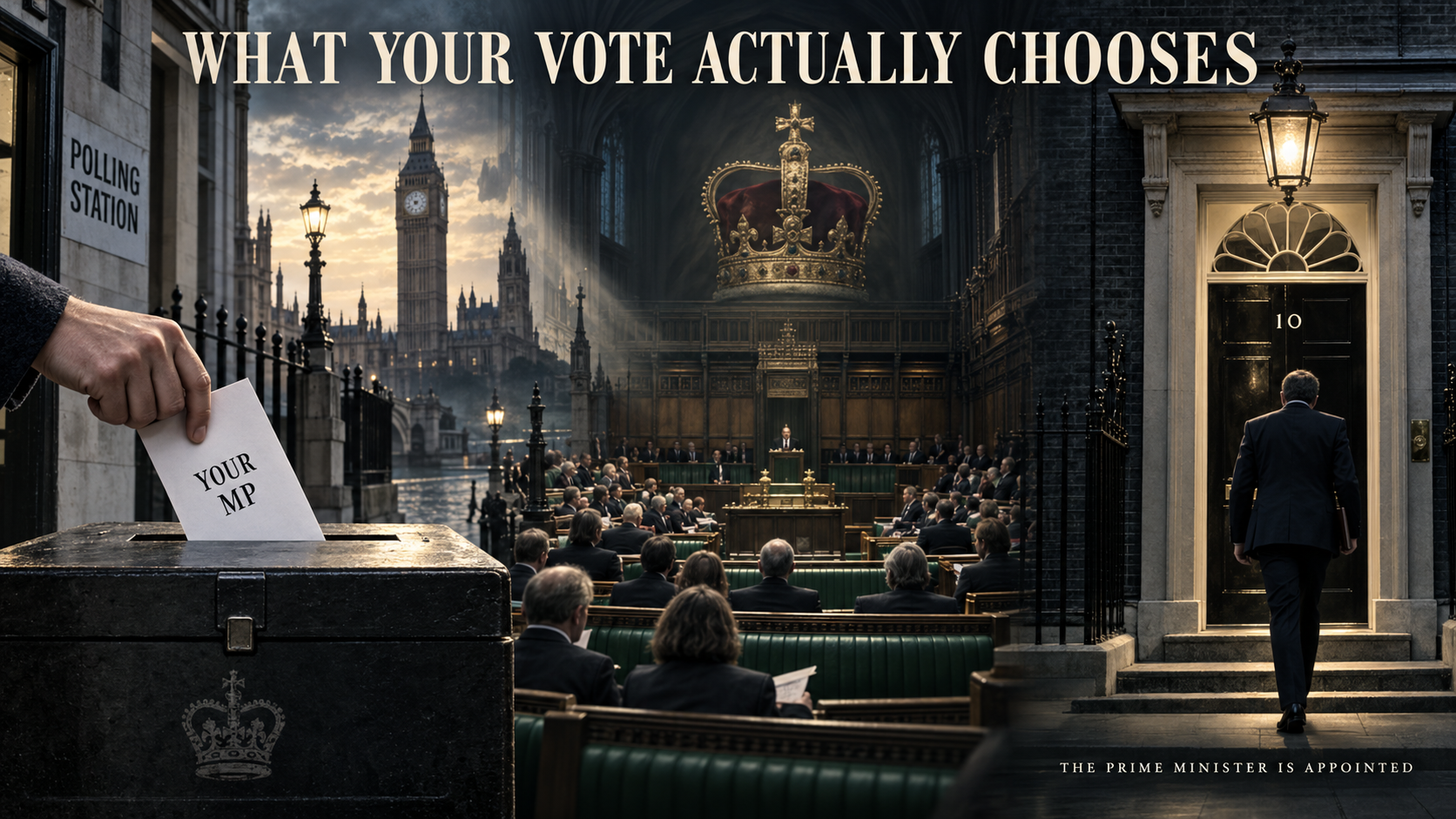
Britain likes to pretend that it elects a prime minister. It does not.
At a general election, every voter chooses one candidate to represent one constituency. There is no national box marked prime minister. Even somebody living in the prime minister’s constituency votes only for that person as their local MP.
The prime minister is formally appointed by the monarch under the royal prerogative. Modern constitutional convention directs the King to appoint whoever appears best placed to command the confidence of the House of Commons. When one party wins a clear majority, the answer is normally obvious. When a prime minister resigns during the parliamentary term, the governing party identifies the successor through its own rules and presents the result to the Palace.
That is the constitutional answer. It is accurate, orderly—and incomplete—because British elections are no longer presented to the public as 650 disconnected local contests.
The Election Britain Pretends It Holds
Campaign posters carry leaders’ faces. Manifestos are launched around them. Television schedules debates between them. Broadcasters follow their tours, mistakes and personal ratings. The morning after polling day, the country talks about who has won Downing Street. Nobody waits for 650 MPs to gather and choose a head of government.
Political research describes this as the presidentialisation of parliamentary politics. British election campaigns have become increasingly candidate-centred as television, professional campaigning and centralised party management have made the leader the public embodiment of the proposed government.
During the campaign, the leader is sold as the choice. After the campaign, the party is treated as the owner of the mandate.
This is why the familiar phrase “unelected prime minister” is both technically wrong and politically revealing. No prime minister is directly elected. Yet a leader who fronts a national campaign and wins possesses a kind of public authority that a successor selected midway through the same Parliament does not.
Constitutional legitimacy and personal democratic legitimacy overlap. They are not identical.
How Downing Street Actually Changes Hands
The resignation of a prime minister does not automatically trigger a general election. If the government retains the confidence of the Commons, its party can select another leader. The outgoing prime minister ordinarily remains in office until the successor is clear, protecting continuity and keeping the monarch away from party conflict.
The sovereign should not be required to choose between political candidates. Parties are expected to determine and communicate who can command Commons confidence. The Palace ceremony completes the transfer, but it normally does not decide it.
The decisive contest takes place elsewhere: among cabinet grandees, MPs, party members, affiliated supporters—or, when rivals fail to qualify, nobody beyond the parliamentary gatekeepers at all.
The Wartime Precedent
Winston Churchill’s appointment in May 1940 shows why a parliamentary system requires flexibility. Neville Chamberlain’s authority collapsed after the Norway campaign. A national coalition required Labour’s participation, and Labour would not serve under Chamberlain.
Lord Halifax was considered, and Chamberlain initially preferred him, but Halifax concluded that leading from the House of Lords would be impractical. Churchill emerged as the figure capable of constructing the coalition and was appointed by George VI.
No general election was held. Britain was at war, and the previous election had taken place in 1935. Mid-term succession was not a democratic trick. It was the mechanism through which Parliament produced a viable government during a national emergency.
Churchill also demonstrates why simplistic categories eventually break down. He entered office through parliamentary and elite negotiation in 1940, lost to Clement Attlee in 1945, then returned to Downing Street following the 1951 election. The same person can reach the office by two different routes.
Before Party Members Had a Vote
The Conservative successions of the 1950s and early 1960s were even further removed from modern expectations of democratic participation. Anthony Eden succeeded Churchill in April 1955 without a competitive party election, then quickly called and won a general election.
When the Suez crisis destroyed Eden’s premiership, Harold Macmillan was selected in January 1957 following private consultations within the Conservative establishment. He later won the 1959 election.
Macmillan’s resignation in 1963 produced the most controversial transfer. Conservative grandees conducted opaque “soundings”, and Macmillan advised the Queen to send for Alec Douglas-Home. Other potential candidates believed the process had been manipulated.
Douglas-Home was a peer when appointed. He renounced his title four days later and briefly served as prime minister while belonging to neither House before winning a Commons by-election. The controversy helped force the Conservatives to introduce a formal leadership-election system in 1965.
Power gradually moved away from royal and establishment discretion and towards codified party procedure. That represented democratic progress inside the parties. It did not create a public election for prime minister. It merely relocated the choice.
From MPs to Members
When Harold Wilson resigned unexpectedly in 1976, Labour MPs alone chose James Callaghan through successive parliamentary ballots. Ordinary Labour members did not vote. Callaghan governed until 1979 without having led Labour through the October 1974 election that produced the government he inherited.
When Conservative MPs forced Margaret Thatcher from the leadership in 1990, they selected her successor through their own contest. John Major received 185 votes in the second ballot—two short of the formal winning threshold—but Michael Heseltine and Douglas Hurd withdrew.
Major entered Number 10 without a general election and then won one in April 1992. His later victory supplied the personal electoral mandate missing from his original accession.
Gordon Brown’s 2007 transition was narrower. Labour’s rules required a challenger to obtain nominations from 12.5% of Labour MPs. Brown secured 313 nominations; John McDonnell obtained 29 and failed to qualify.
Brown was declared leader unopposed. Millions had voted Labour under Tony Blair in 2005, but no Labour member, affiliated supporter or ordinary voter cast a ballot choosing Brown as prime minister. He never subsequently won a general election.
2016–2022
Five Conservative Prime Ministers and One Mandate
The years following the Brexit referendum compressed the entire constitutional argument into six turbulent years.
David Cameron had won the 2015 general election with a Conservative majority. He resigned after losing the 2016 referendum. Conservative MPs reduced the succession contest to Theresa May and Andrea Leadsom, but Leadsom withdrew before party members voted. May entered Downing Street unopposed.
May attempted to secure her own mandate in 2017. Instead, she lost the Conservative majority and remained in office through a confidence-and-supply agreement with the Democratic Unionist Party.
Conservative members selected Boris Johnson in July 2019. Johnson received 92,153 votes against Jeremy Hunt’s 46,656 from an eligible membership of 159,320. A small private electorate had chosen the head of government for a country of tens of millions.
Johnson then called the December 2019 general election and won a large Commons majority. Whatever the route by which he first entered Downing Street, he subsequently led the Conservatives through a national election and won.
After Johnson resigned in 2022, Conservative MPs narrowed the field to Liz Truss and Rishi Sunak. Party members cast 142,379 valid votes from an eligible electorate of 172,437. Truss won 81,326 votes to Sunak’s 60,399.
Her programme went far beyond merely maintaining Johnson’s 2019 offer. The mini-budget helped trigger market turmoil and she resigned after only 45 days—the shortest premiership in British history.
The party then accelerated the next contest and required candidates to secure at least 100 MP nominations. Boris Johnson withdrew and Penny Mordaunt failed to qualify, leaving Sunak unopposed. No membership ballot took place.
Sunak became the third prime minister supported by the Parliament created by the 2019 election. He eventually faced the electorate in 2024 and lost decisively.
The constitution had functioned exactly as designed. The political mandate had still been stretched across three leaders and radically different programmes.
Labour Inherits the Argument
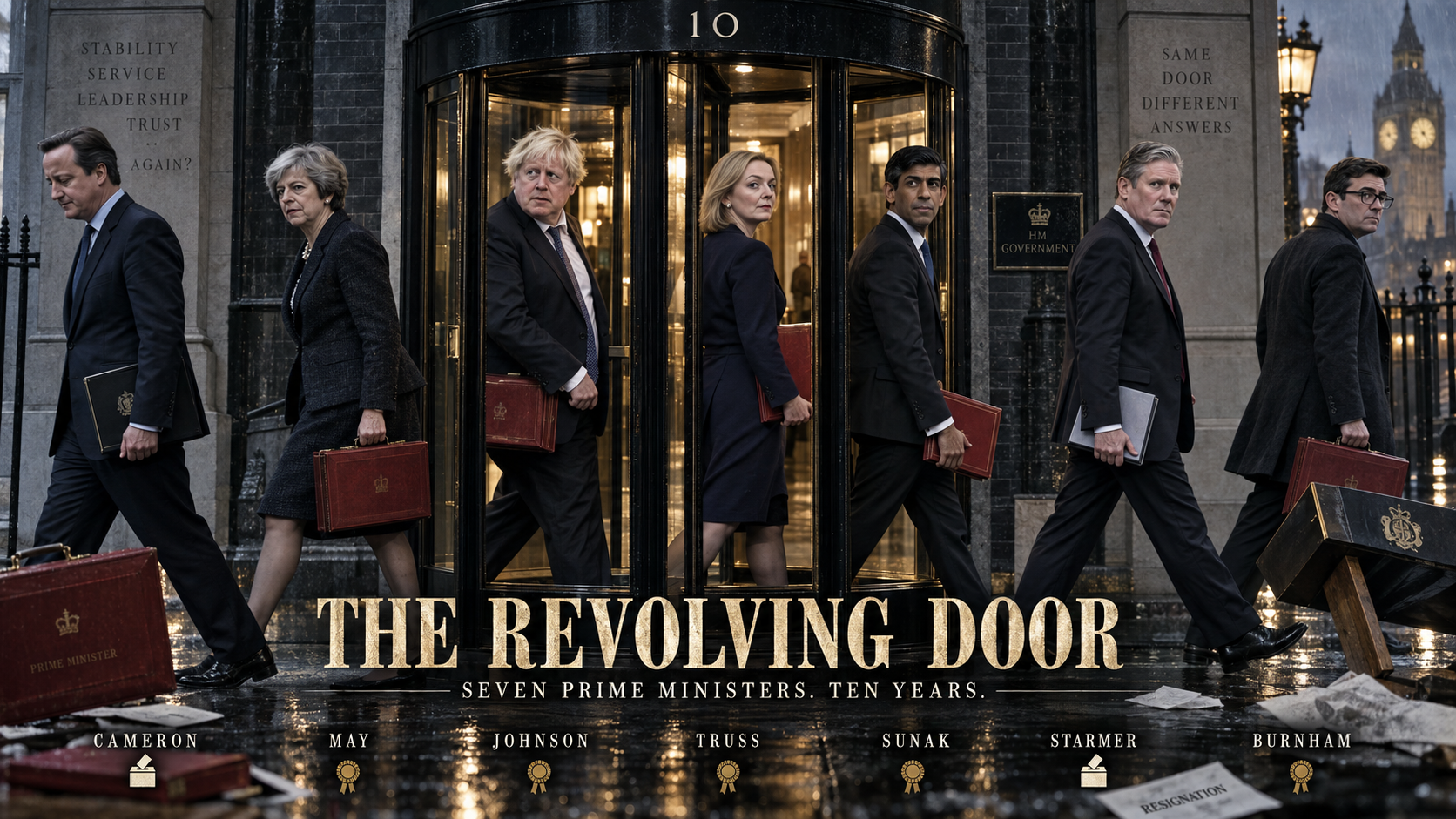
Labour attacked the Conservative transitions as evidence of chaos, exhaustion and democratic evasion. Keir Starmer then fronted Labour’s 2024 campaign and won 411 Commons seats. Two years later, his resignation placed Labour inside the same machinery it had criticised.
Labour’s 2026 rules required a leadership candidate to secure nominations from 20% of Labour MPs—81 MPs at the time—alongside the additional support required under party rules.
Andy Burnham secured 379 parliamentary nominations. No rival could qualify, so there was no ballot of Labour members or affiliated supporters. Burnham became Labour leader and was appointed prime minister by the King on 20 July 2026.
Burnham commands the confidence of a House elected in 2024. His government is constitutionally legitimate. He also inherited a Labour manifesto, a parliamentary majority and the authority of the state from an election he did not lead.
Those two statements can both be true.
The uncomfortable point is not that Burnham broke the rules. He followed them. The point is that Britain’s political culture encourages voters to treat the leader as the electoral offer, then insists that only the party mattered once that leader changes.
Who Actually Gets to Choose?
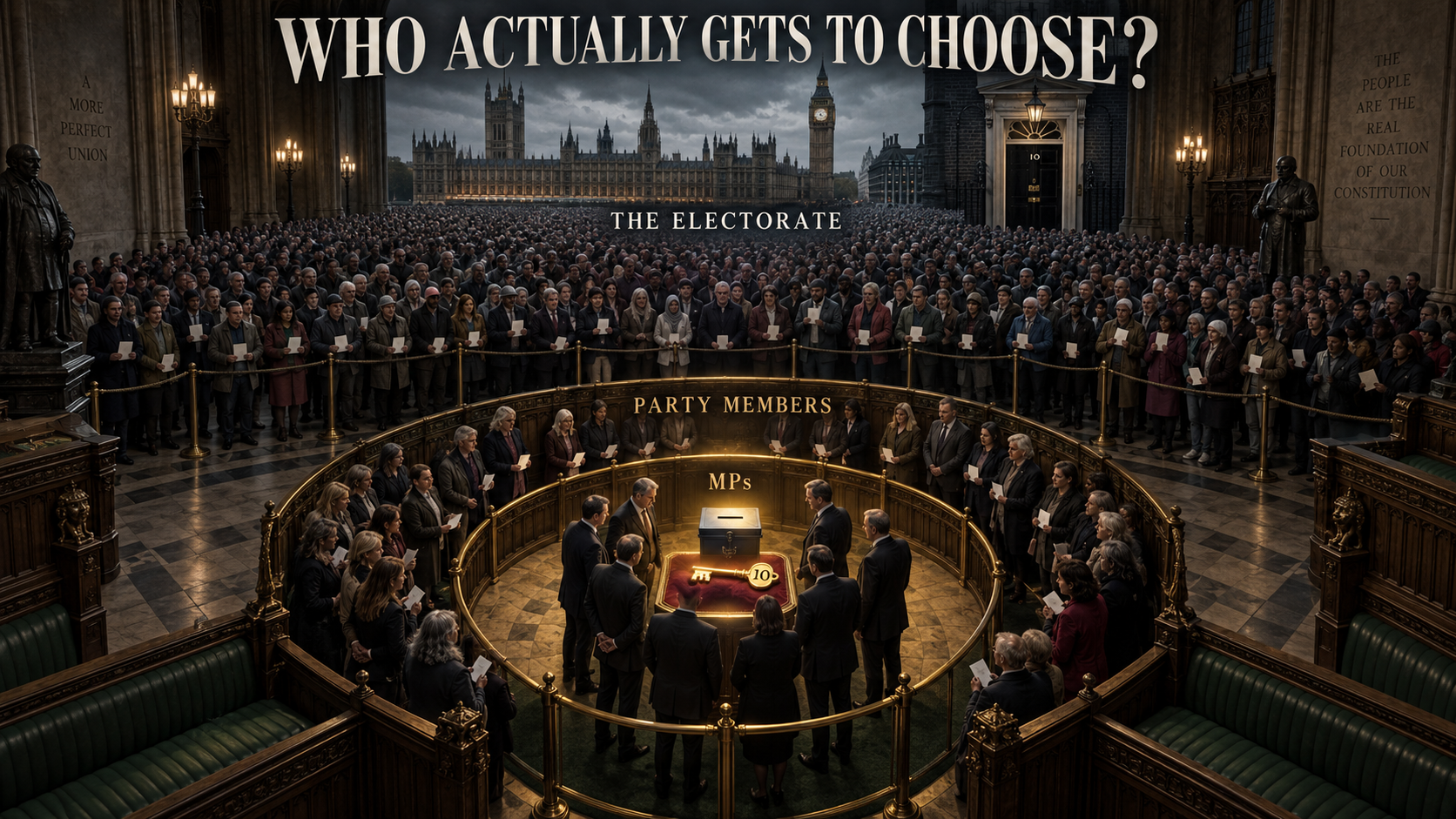
Replacement systems are often defended on the ground that party members provide democratic participation. Sometimes they do. But party membership is voluntary, self-selecting and tiny beside the national electorate.
Johnson entered Number 10 after 92,153 Conservative members voted for him. Truss reached it with 81,326 membership votes. May, Brown, Sunak and Burnham entered office without any final membership ballot at all.
The selectorate can shrink in stages. The national electorate chooses MPs. MPs decide which candidates may reach the party ballot. Party members choose between the approved finalists. If only one candidate clears the nomination threshold, even that final stage disappears.
A procedure designed to establish confidence inside a political party can therefore determine who controls the executive power of the state.
That power is not ceremonial. A prime minister appoints and dismisses ministers, shapes the Cabinet, directs the government’s programme, controls much of the machinery surrounding Number 10, advises the monarch and can request the dissolution of Parliament.
The office remains thinly defined in statute. Its practical authority is extensive.
Why an Automatic Election Is Not an Easy Answer
Requiring a general election whenever the prime minister changes would solve one legitimacy problem by creating others. Prime ministers leave through illness, death, scandal, parliamentary defeat, party revolt and national emergency.
An automatic election could reward internal sabotage, create instability at precisely the worst moment and move Britain towards a directly elected executive without openly redesigning the constitution.
The orthodox defence is straightforward: voters elect MPs rather than a prime minister; a successor is entitled to govern while commanding Commons confidence; and mandatory elections could create political and economic instability.
That defence has force. Parliament receives the electoral mandate, not the prime minister personally. A parliamentary system must remain capable of replacing a failed leader without automatically collapsing the legislature.
The mistake is pretending that this answers every democratic question.
A successor who preserves the existing manifesto and governs as a custodian can plausibly claim the party’s parliamentary mandate. A successor who introduces a radically different economic or constitutional programme tests that claim.
The greater the departure from the programme presented at the election, the weaker the claim that the original vote authorised it.
A More Honest Settlement
Britain does not need to pretend that every mid-term prime minister is illegitimate. It needs conventions that acknowledge the difference between inheriting Commons confidence and receiving a personal public mandate.
A replacement prime minister could be required to make a formal statement to the Commons explaining whether the government remains bound by the manifesto on which its majority was won.
Any substantial departure could require explicit parliamentary approval. The Commons could hold a recorded investiture vote, making confidence visible instead of merely assumed. Parties could also publish stable leadership rules that cannot be rewritten during a crisis to manufacture a single surviving candidate.
None of this would turn Britain into a presidential republic. It would clarify the parliamentary chain of authority and force political parties to own the power they exercise.
The Post-War Record
From Churchill’s wartime appointment in 1940 to Burnham’s succession in 2026, Britain repeatedly changed prime minister without a general election. Several successors later sought public endorsement; others never won a national election as leader.
| Prime minister | Initial route | Later election outcome |
|---|---|---|
| Winston Churchill, 1940 | Coalition negotiations | Returned after winning in 1951 |
| Clement Attlee, 1945 | General election | Won in 1950 |
| Anthony Eden, 1955 | Conservative succession | Won in May 1955 |
| Harold Macmillan, 1957 | Conservative soundings | Won in 1959 |
| Alec Douglas-Home, 1963 | Conservative consultation | Lost in 1964 |
| Harold Wilson, 1964 | General election | Won in 1966 and returned in 1974 |
| Edward Heath, 1970 | General election | Lost office in 1974 |
| James Callaghan, 1976 | Labour MPs | Lost in 1979 |
| Margaret Thatcher, 1979 | General election | Won in 1983 and 1987 |
| John Major, 1990 | Conservative MPs | Won in 1992 |
| Tony Blair, 1997 | General election | Won in 2001 and 2005 |
| Gordon Brown, 2007 | Unopposed Labour succession | Lost in 2010 |
| David Cameron, 2010 | Election and coalition | Won a majority in 2015 |
| Theresa May, 2016 | Unopposed Conservative succession | Lost her majority in 2017 |
| Boris Johnson, 2019 | Conservative members | Won in December 2019 |
| Liz Truss, 2022 | Conservative members | No general election |
| Rishi Sunak, 2022 | Unopposed after MP threshold | Lost in 2024 |
| Keir Starmer, 2024 | General election | Resigned in 2026 |
| Andy Burnham, 2026 | Unopposed after MP nominations | No general election yet |
THE MANDATE THAT MOVES WITHOUT YOU
The Joke Survives the Correction
Some prime ministers enter Downing Street after fronting a successful general-election campaign. Others are installed between elections through a process controlled by their party. All are formally appointed by the monarch. None is directly elected by the public.
The difference still matters. A general election gives voters an opportunity to assess the leader, the party and the programme together. A mid-term succession separates them. The parliamentary majority remains where it is while the person directing it changes.
Britain campaigns as if the leader is everything and governs as if the leader can be replaced without changing anything.
The system is presidential when it wants your vote, parliamentary when it changes the winner, and monarchical for the final appointment.
You elect an MP. The party chooses its leader. The King appoints the prime minister.
By the time the door of Number 10 opens, the public can be the only part of the system that was never asked.