Energy security · UK infrastructure
We Took Back Control. Who Holds the Oil?
Britain left the European Union to take back control. So let’s ask an awkwardly practical question: who owns the oil, the tanks and the pipelines that matter when supplies are disrupted?
The short answer is not “the Government owns nothing” and it is not “the Government owns the oil”. The UK relies chiefly on companies to hold legally required stocks. A major state pipeline network was sold in 2015. Yet ministers still set the stockholding rules and can direct an emergency release, while the Ministry of Defence retains a separate system of fuel depots. Those are different kinds of control, and mixing them together makes the argument harder to see.
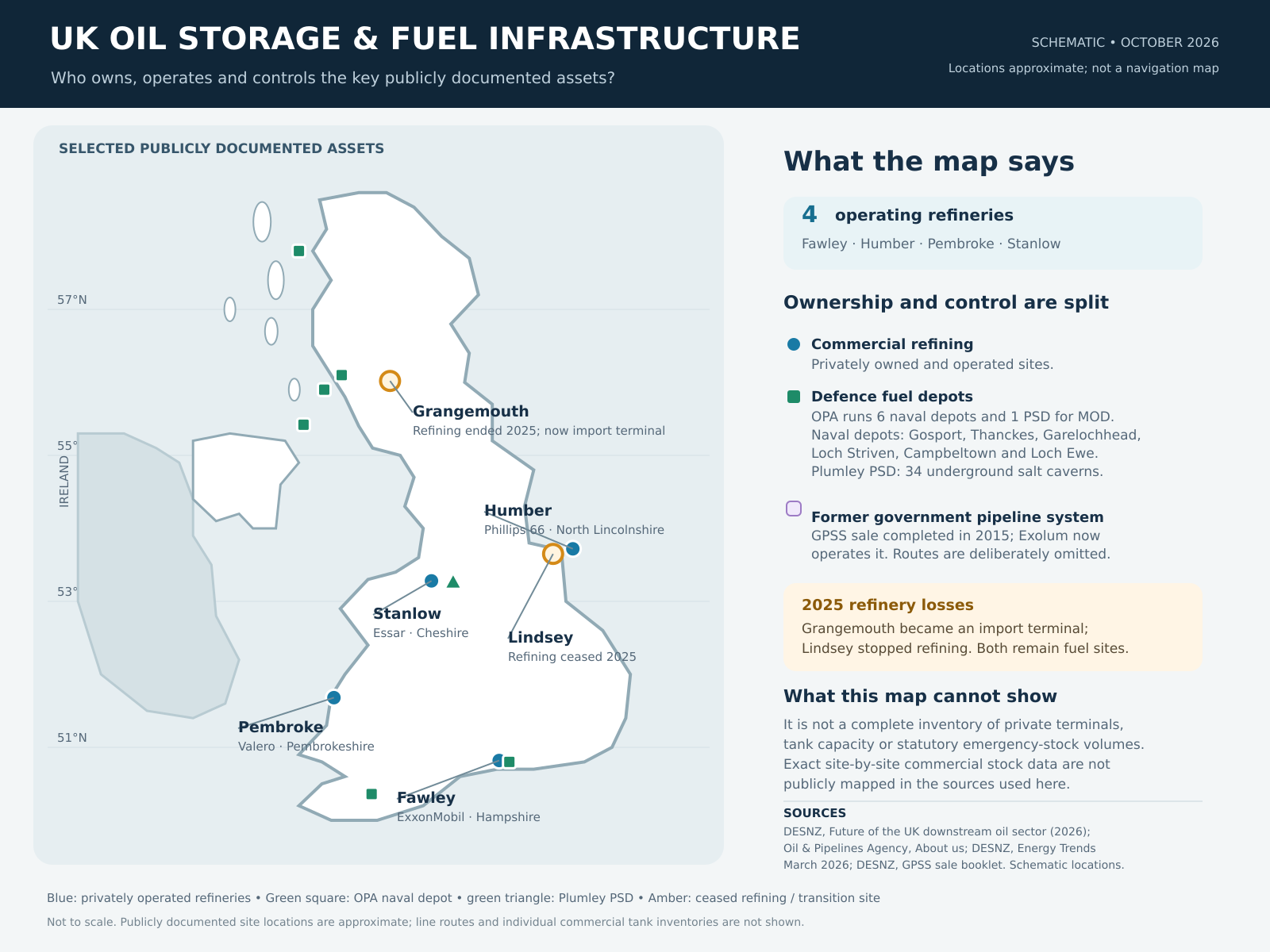
Four different meanings of “control”
When a crisis hits, “How much oil do we have?” can mean at least four things: who owns the molecules; where the stocks physically sit; who owns or operates the storage and pipelines; and who has legal authority to require stocks or release them. The UK divides those responsibilities between private companies and the state.
What Britain built—and what it sold
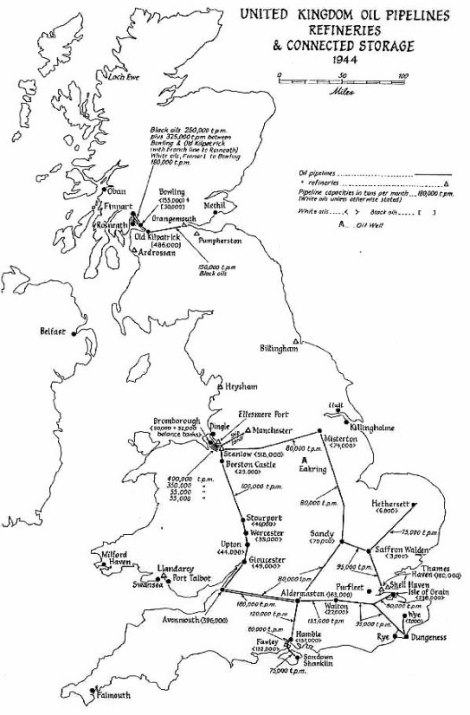
The Government Pipelines and Storage System (GPSS) was built to move fuel around the country, including to military sites and airports. The network extended for about 2,500 kilometres and included pipelines, pumping stations and storage depots. At the time of the Government’s sale material, it was estimated to distribute around 40% of aviation fuel used in the UK. That historical figure describes the network’s role then; it should not be read as its present-day market share.
In 2015, the Government sold the GPSS to Spanish company Compañía Logística de Hidrocarburos (CLH), now Exolum. The sale completed on 30 April 2015 for £82 million. The transfer covered the network and related assets included in the sale, but it did not mean that the state sold every oil stock, every refinery or all defence fuel infrastructure. Some sites were retained outside the transaction.
What remains under public control?
The Oil and Pipelines Agency (OPA) is a statutory public corporation sponsored by the Ministry of Defence. It operates, manages and maintains six Naval Oil Fuel Depots and one Petroleum Storage Depot for the Ministry of Defence. The Plumley depot stores petroleum in underground salt caverns. This is an important public capability, but it is a defence fuel system—not a state-owned, all-purpose civilian oil reserve for motorists, airlines and industry.
That distinction matters. The UK state retains specific assets and real emergency powers. But most commercial stocks are held by obligated companies, while much of the inherited GPSS infrastructure is now owned and operated by Exolum. Saying simply “we own it” or “we own none of it” obscures the split.
What has dwindled: refining capacity
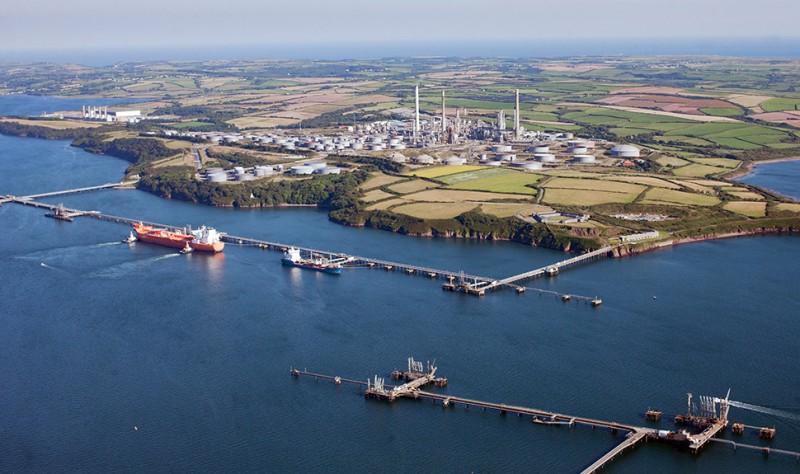
The clearest evidence of a thinner domestic oil system is not a simple count of tanks; comparable public data on usable storage capacity by site are not consistently available. It is the decline in refining. The UK had 18 refineries in the 1970s. Following the 2025 closures at Grangemouth and Lindsey, four operational refineries remain: Fawley, Pembroke, Stanlow and Humber.
Grangemouth stopped refining and transitioned to an import terminal in April 2025. The Lindsey refinery also ceased operations in 2025; Phillips 66 agreed to acquire its assets in 2026, but that transaction does not itself restore a standalone refinery. Across the sector, refinery production in 2025 was 18% below 2019. The UK became a net importer of petroleum products by 15.5 million tonnes in 2025, the largest net-import position since 2013.
That does not mean the UK has no oil or no resilience. It does mean that domestic capacity to turn crude into products has narrowed, and that a country can be a producer of crude while importing more of the fuels its transport and industry use. The product matters: the UK is broadly self-sufficient in petrol, while it relies on imports for jet fuel.
What the UK has now: stocks, rules and location
At the end of 2025, UK obligated oil stocks totalled 11.2 million tonnes. About 9.2 million tonnes—82% were physically in the UK. The remainder was held abroad under international arrangements, mainly in the Netherlands, Germany and Belgium. At the end of the second quarter of 2026, the total was 10.0 million tonnes, 2.4% lower than a year earlier. The Government reported that this still exceeded the UK’s International Energy Agency (IEA) requirement.
The IEA standard is often described as “90 days of oil”. More precisely, members must hold stocks equivalent to at least 90 days of net oil imports. It is not a promise that every fuel type needed by every region is sitting in a UK tank for three months. Some stocks can be held overseas under agreements; the mix of crude and products, where stocks are located, and how quickly they can reach users all matter.
The UK meets the obligation mainly by directing industry to hold stocks. In practical terms, the public authority sets the requirement and can coordinate a release, while companies hold the inventory. In March 2026, the Government participated in a coordinated IEA release in response to disruption from the US–Iran conflict. That was an exercise of public authority over a system whose stocks are largely commercial.
War is a trigger, not a complete explanation
Oil markets can be hit by war, sanctions, shipping disruption, infrastructure attacks and decisions by producing states. But war is not a substitute explanation for domestic policy choices about refining, storage, ownership or the design of emergency reserves.
UCDP, the Uppsala Conflict Data Program, recorded 65 state-based armed conflicts in 2025, the highest count in its series since 1946. Thirteen met its threshold for “war” at least 1,000 battle-related deaths in a calendar year and eight were interstate conflicts. These are not 65 equivalent threats to UK oil supply: many had no direct effect on global petroleum flows. The point is that armed conflict is widespread, while governments and markets pay particular attention when violence threatens major producing regions or shipping chokepoints.
The 2026 disruption around the Strait of Hormuz shows why routes matter as much as the location of a tank. In March, the IEA reported that crude and product exports through the Strait had fallen below 10% of their pre-conflict level. A reserve can buy time; it cannot make a blocked route, lost refinery or unsuitable fuel blend instantly replaceable.
How does the UK compare with Norway—and Germany?
Norway is a useful comparison because it is a major petroleum exporter. But that is exactly why it is not a like-for-like template for a net-importing UK. Norway is not subject to the IEA’s 90-day net-import stockholding obligation. Its law requires major importers and producers to hold stocks equivalent to 20 days of consumption. In 2026, a government-appointed commission recommended raising the requirement to 61 days; the Government had not yet decided and said it would return with proposals in the 2027 budget.
Germany offers a different comparison. Its public-law petroleum stockholding corporation, EBV, is legally responsible for a 90-day net-import reserve. EBV owns at least 90% of the stocks it holds, distributes them across regions, and releases them under federal direction. This is a more visibly public reserve model than Britain’s industry-held system.
| Country | Requirement / model | Who holds it? | What to take from it |
|---|---|---|---|
| United Kingdom | 90 days of net imports under the IEA framework; current reported stocks exceed the requirement. | Primarily obligated companies; some stocks may be held abroad under agreements. Government sets the obligation and can direct/coordinate releases. | Public authority, mostly commercial inventory. Not the same as a government-owned reserve. |
| Norway | 20 days of consumption under national rules; 61 days recommended in 2026, with a government decision pending. | Major oil importers and producers. | Exporter status changes the international obligation. The proposed increase is not yet adopted. |
| Germany | 90 days of net imports, held through a public-law stockholding corporation. | EBV owns at least 90% of its reserve stocks; federal authorities control release decisions. | A clearer centralized public reserve, funded and operated through a statutory body. |
Norway shows how a large exporter can choose a different baseline—and how that baseline may change when policymakers reassess risk. Germany shows that a state can create a dedicated public stockholder. The UK has chosen a third arrangement: impose a large stockholding duty on industry, keep defence fuel assets in public hands, and retain powers to coordinate emergency action.
So, who holds the oil?
Mostly companies hold the UK’s obligated commercial stocks. Much of the former GPSS is owned and operated by Exolum. Four refineries still process crude into products. The Ministry of Defence, through the OPA, retains a separate set of fuel depots. The Government does not own every barrel—but it does set the rules, monitor compliance and hold emergency powers.
That is a meaningful degree of control, but it is not the same thing as direct public ownership. The harder policy question is whether the current combination—private stocks, a smaller refining base, commercial infrastructure and targeted public defence assets—provides the resilience the country wants. Blaming the latest war cannot answer that. Nor can nostalgia for a system that has changed. The useful debate starts with the assets and powers Britain actually has now.