
Britain Is Not Special — Lessons from Argentina
Published
Part 6 of 7
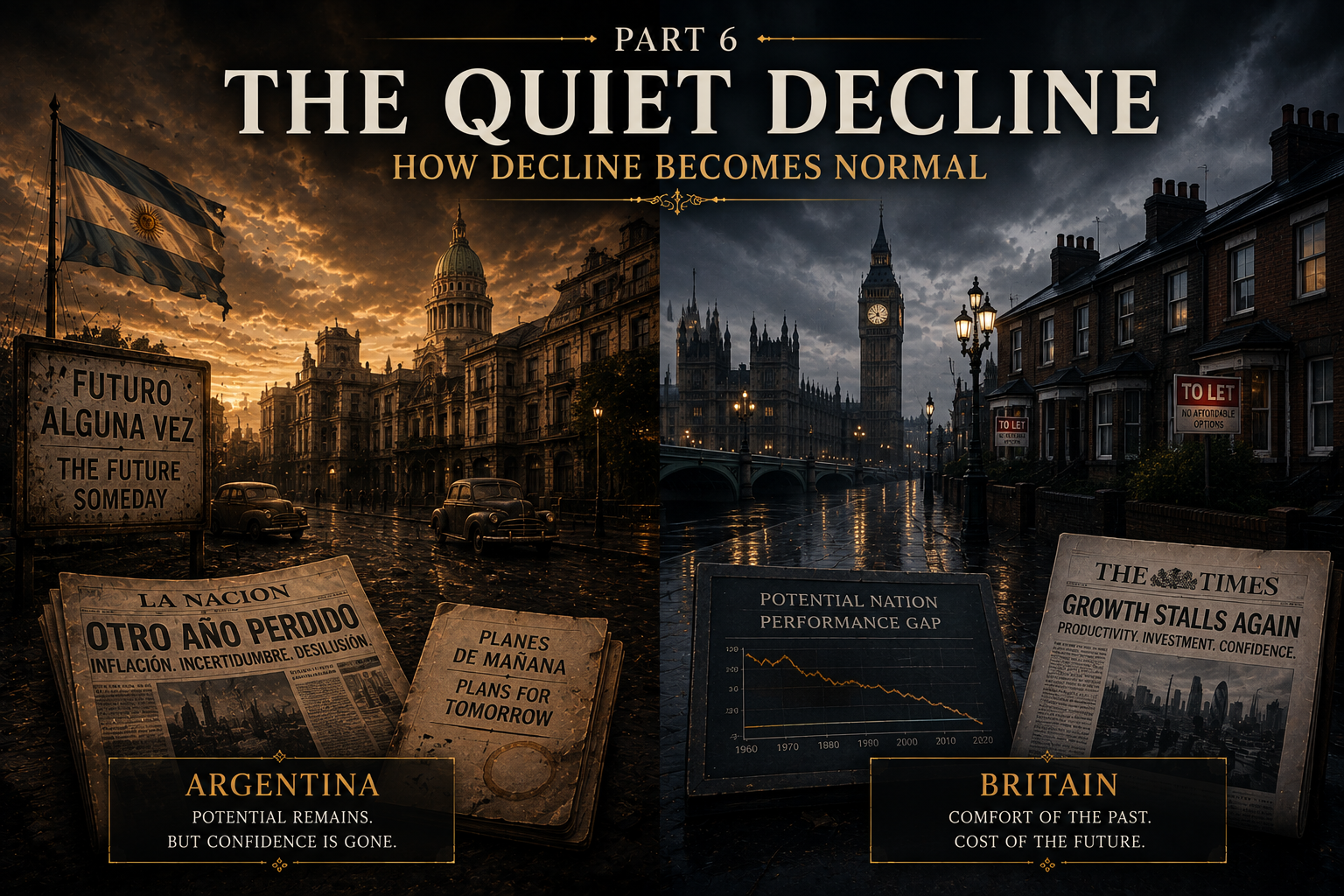
The Quiet Decline
Some countries collapse loudly. Others remain wealthy, stable and recognisable while their options slowly narrow around them.
The easiest form of decline to recognise is catastrophe.
A currency collapses.
Banks close.
Governments fall.
Inflation destroys savings.
People take to the streets.
At that point, nobody needs to ask whether something has gone wrong.
But there is another form of decline.
Slower.
Quieter.
Much easier to live through without recognising what is happening.
The most difficult decline to confront is the one that still looks like normal life.
Argentina Eventually Became Impossible to Ignore
Argentina’s decline was never one continuous collapse.
There were periods of growth.
Periods of stability.
Governments that appeared to have restored confidence.
Moments when the country seemed capable of finally escaping the cycle.
But the crises became increasingly difficult to dismiss as isolated events.
Political instability repeatedly interrupted economic development.
Military governments weakened democratic institutions.
Inflation repeatedly damaged confidence in the currency.
Debt accumulated.
Capital fled.
Eventually, decline became visible not merely in international comparisons but in ordinary life.
That is the point at which a national trajectory stops being an academic argument.
People can feel it.
The 2001 Crisis
Argentina’s economic crisis at the beginning of the 21st century became one of the clearest demonstrations of how far confidence could unravel.
The peso had been tied to the US dollar through the convertibility system introduced in the 1990s.
For a period, the arrangement helped control the inflation that had damaged Argentina for years.
But maintaining the peg became increasingly difficult.
Debt grew.
Competitiveness weakened.
Recession deepened.
Confidence disappeared.
As depositors attempted to withdraw money, the government imposed restrictions on access to bank accounts — the corralito.
Protests followed.
Political authority fractured.
Argentina defaulted on its sovereign debt.
The currency regime collapsed.
By 2001, Argentina was no longer debating whether its model contained weaknesses. The weaknesses had entered people’s bank accounts.
Decline Changes Expectations
But perhaps the deepest consequence of repeated instability is not any individual crisis.
It is adaptation.
People learn how to live inside the instability.
They hold savings differently.
They price risk differently.
They think differently about government promises.
They make different decisions about property, currency, employment and migration.
Behaviour that would appear extraordinary in a more stable system becomes rational.
The exceptional becomes familiar.
The temporary becomes permanent.
The unacceptable becomes manageable.
That is one of the most important characteristics of long-term decline.
People do not simply suffer it.
They learn to organise their lives around it.
Britain Has No Equivalent Collapse
This is where the comparison with Britain must remain disciplined.
Britain has not experienced Argentina’s modern economic history.
It has not suffered repeated military coups.
It has not experienced Argentine-style hyperinflation.
Sterling has not ceased to function as a credible major currency.
The British state has not defaulted on its modern sovereign obligations in anything resembling Argentina’s experience.
British institutions remain substantially stronger.
Britain remains a wealthy country.
That is precisely why the comparison is useful.
Because decline does not require Britain to become Argentina.
The question is not whether Britain will collapse like Argentina. It is whether Britain can decline without ever producing a moment that forces recognition.
What Quiet Decline Looks Like
Quiet decline does not look like a bank run.
It looks like waiting longer.
Paying more.
Travelling on older infrastructure.
Accepting smaller ambitions.
Watching projects take longer to build.
Watching public services become harder to access.
Watching wages struggle to create the life previous generations expected from comparable work.
Watching towns lose institutions one by one.
Watching industries disappear without replacement.
None of these things individually proves national decline.
Together, sustained over time, they can describe something more significant:
a country becoming accustomed to having less capacity.
Managing Decline
Governments rarely describe this process as decline.
They manage individual problems.
A railway requires another funding settlement.
A hospital requires another rescue package.
A council requires emergency support.
A water system requires another regulatory intervention.
An industry requires another strategy.
A housing shortage requires another target.
Each problem is treated separately.
That makes sense administratively.
But it can prevent the larger pattern from being recognised.
Managing decline often means solving each symptom without confronting the trajectory connecting them.
When Standards Adjust Downwards
Decline becomes particularly difficult to reverse when expectations change with it.
A delayed train becomes normal.
A long medical waiting list becomes normal.
Expensive housing becomes normal.
Young adults living with parents for longer becomes normal.
Infrastructure projects taking decades becomes normal.
Local services disappearing becomes normal.
Lower growth becomes normal.
None of these experiences is unique to Britain.
Many wealthy democracies face versions of the same pressures.
The issue is cumulative.
When enough deterioration becomes ordinary, the benchmark itself moves.
Yesterday’s failure becomes today’s baseline.
Today’s baseline becomes tomorrow’s expectation.
The Language of Exceptionalism
This is where Britain’s historical identity becomes important.
Britain does not merely remember being powerful.
Power remains embedded in the language through which the country describes itself.
- world-leading
- global
- sovereign
- exceptional
- punching above our weight
A country whose history supposedly guarantees continued relevance.
Some of this reflects genuine strengths.
Britain retains significant diplomatic, military, cultural, scientific and financial influence.
But language can become dangerous when it prevents accurate measurement of relative position.
The question is not whether Britain still matters.
Of course it does.
The question is whether the language of national power has adjusted as quickly as the distribution of global power itself.
We No Longer Rule the Waves
Britain’s historical mythology was built around control.
Control of trade routes.
Control of territory.
Control of finance.
Control of maritime power.
The modern country operates in a fundamentally different environment.
The United States is larger.
China is larger.
The European Union represents a market Britain chose to leave but cannot economically ignore.
Global supply chains constrain national autonomy.
Energy markets constrain national autonomy.
Financial markets constrain national autonomy.
Security relationships constrain national autonomy.
Britain has not become powerless.
But power increasingly means negotiation inside systems rather than commanding them from above.
Britain no longer rules the waves. Increasingly, it must navigate rules written alongside — and sometimes by — others.
The American Assumption
For much of the post-war era, Britain could adapt to reduced independent power partly because it sat inside a relationship with the United States that appeared unusually durable.
Security.
Intelligence.
Defence.
Diplomacy.
Nuclear cooperation.
The relationship helped Britain remain influential beyond what its economic size alone might otherwise have allowed.
But alliances are not laws of nature.
American priorities change.
Administrations change.
Strategic interests change.
Domestic politics changes.
A Britain that assumed American support would remain predictable now has to confront a much less comfortable reality:
dependency is still dependency, even when the relationship is friendly.
The point is not that the United States is abandoning Britain.
It is that Britain can no longer build national strategy around the assumption that another country will always absorb the risks Britain can no longer absorb alone.
Brexit Exposed the Difference Between Sovereignty and Power
Brexit was sold partly through the language of restored control.
Take back control.
Recover sovereignty.
Make our own rules.
The language was powerful because it connected directly to Britain’s historical memory.
But formal sovereignty and practical power are not the same thing.
Britain can write its own rules.
British businesses still need access to foreign markets.
Britain can set its own standards.
British exporters still have to meet the standards of the markets they want to sell into.
Britain can leave a regulatory system.
Geography does not leave with it.
Sovereignty tells you who is legally allowed to decide. Power tells you how many realistic choices remain once the decision is yours.
From Rule-Maker to Rule-Taker
This is where the phrase becomes uncomfortable.
Britain once possessed enough economic and imperial weight to help write large parts of the international system.
Today it frequently operates inside systems created by larger blocs, markets and alliances.
That does not mean Britain simply accepts whatever others decide.
It negotiates.
It influences.
It bargains.
It remains important.
But the balance has changed.
Britain once helped set many of the rules.
Today, increasingly, Britain must decide which rules it can afford to diverge from.
We do not rule the waves.
Increasingly, we wave the rules through.
Not because Britain has ceased to matter.
Because relative power has changed.
The Argentina Lesson
Argentina’s history does not provide a prophecy for Britain.
That has never been the argument.
Britain is not Argentina.
Britain has different institutions.
A different economy.
A different political history.
A different relationship with global capital.
A different currency.
Different alliances.
But Argentina destroys one particularly dangerous national myth:
There is no law saying that a wealthy, confident and globally important country must remain wealthy, confident and globally important forever.
Countries move.
Systems change.
Advantages expire.
Competitors emerge.
Institutions that once supported growth can become barriers to change.
And national identity can remain frozen long after national position has changed.
The Choice Is Recognition or Drift
Decline is not destiny.
That may be the most important distinction in this entire series.
A country can recognise structural weakness.
It can invest.
It can rebuild productive capacity.
It can modernise infrastructure.
It can widen opportunity.
It can strengthen education and technical capability.
It can choose institutions capable of adapting rather than simply preserving.
But recognition has to come before response.
And recognition becomes difficult when the national story insists that the country is still fundamentally where it used to be.
The danger is not that Britain wakes up one morning and discovers it has become Argentina.
The danger is that Britain spends decades becoming less capable while continuing to describe every loss as temporary.
When Decline Starts to Feel Normal
Argentina began this series as a warning.
Not because Britain is destined to repeat Argentina’s history.
But because Argentina demonstrates something national myths often make difficult to accept:
prosperity is conditional.
Power is conditional.
Stability is conditional.
Influence is conditional.
Every advantage depends on institutions, investment, productivity, adaptability and the world around it.
This is not the series conclusion. That comes next, with a look at Britain as it stands today.
For now, Part 6 ends with the quietest danger of all:
becoming accustomed to decline before deciding whether to reverse it.
The next question is not whether Britain can repeat Argentina’s past.
It is where Britain stands now — and what it chooses next.