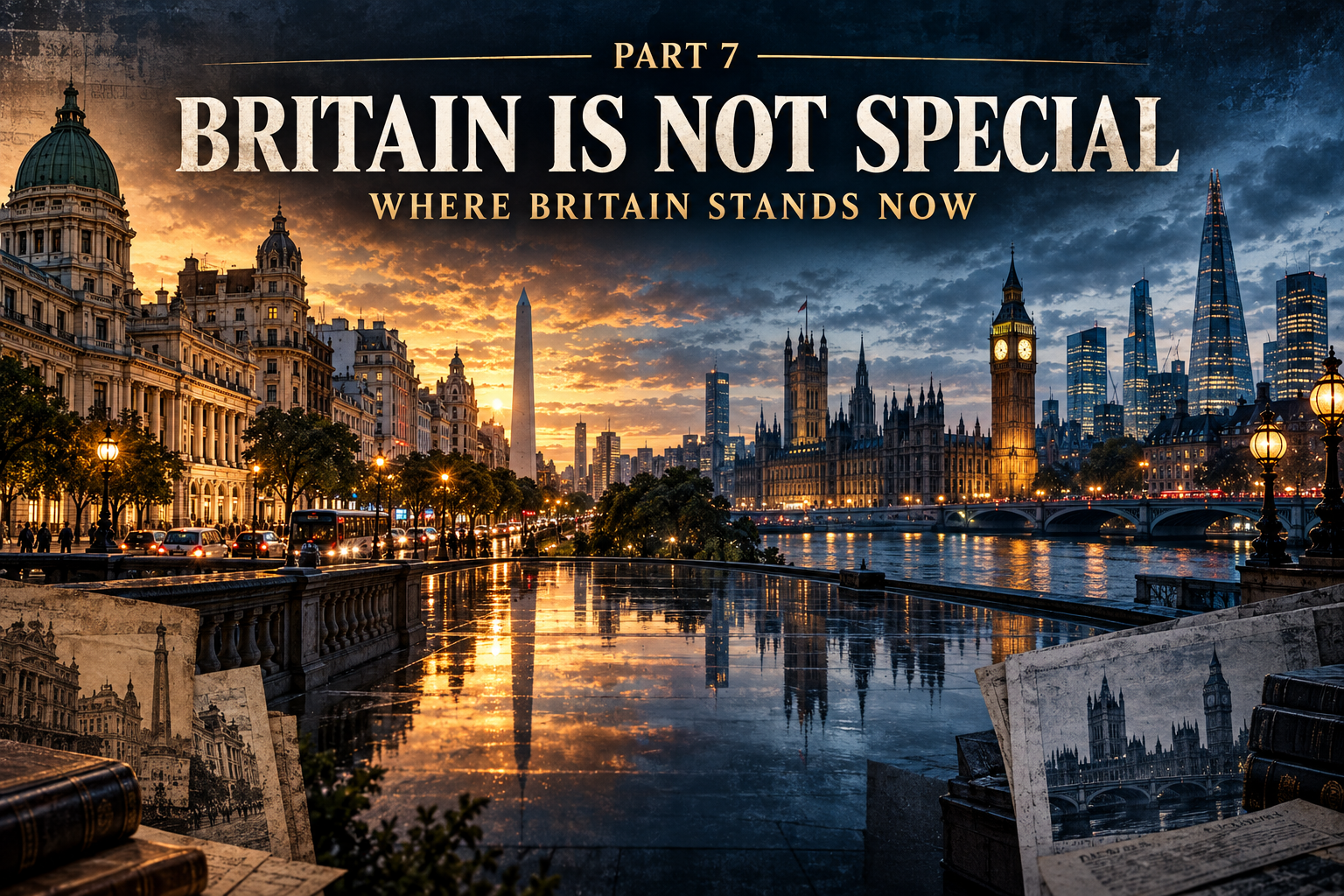

Britain Is Not Special — Lessons from Argentina
Published
Part 7 of 7 · Conclusion
Britain Is Not Special
Argentina is not Britain’s forecast. It is a reminder that prosperity, stability and influence have to be renewed. So where does Britain stand now — and what can still be changed?
This series began with a question about the stories countries tell themselves.
Argentina once looked destined for greatness. Britain still carries the confidence of a country that shaped the modern world. Those histories are not identical, and this series has never argued that Britain is about to become Argentina.
The comparison matters for a different reason. It shows how a country can mistake inherited advantages for permanent guarantees — and how the gap between national confidence and national capacity can widen without a single dramatic moment announcing it.
The comparison was never a prophecy
Argentina’s story is not a simple morality tale about a country that made bad choices and paid for them. Its history includes extraordinary wealth, political conflict, repeated economic shocks, changing global conditions and policies that often made recovery harder. The point is not to flatten that history into a warning label for Britain.
Nor is Britain starting from Argentina’s position. Britain has a different currency, institutions, economic structure, international relationships and room to respond. The differences are fundamental. Treating the countries as interchangeable would weaken the lesson rather than sharpen it.
Argentina is not a script Britain is destined to follow. It is a case study in how advantages can erode when a country stops adapting.
That is the thread running through all seven parts: early success can conceal weaknesses; people and capital respond to lost confidence; strong-looking structures can rest on narrow foundations; and headline wealth can disguise a failure to build the next source of prosperity.
Argentina is changing — but the repair is not painless
The present-day picture is more complicated than either a triumph story or a collapse story. Argentina’s monthly inflation rate was 1.9% in September 2026, a striking contrast with the runaway inflation that preceded the current stabilisation programme.1 But lower inflation does not mean the cost of stabilisation has disappeared from people’s lives.
INDEC reported that 32.3% of people in the 31 urban agglomerations it measures were living below the poverty line in the first half of 2026, up from 28.2% in the second half of 2025.2 The economy also contracted by 0.6% quarter on quarter in the second quarter of 2026, despite a positive year-on-year comparison.3
Those figures do not cancel out the progress on inflation or the case for reform. They do make the test more demanding: can stabilisation become broad, durable improvement in incomes, opportunity and productive capacity? A better headline is a beginning. It is not the same thing as a settled recovery.
Britain’s warning is quieter
Britain’s latest figures do not describe an economy in freefall. Real GDP grew by 0.1% in August 2026 and by 0.7% across the three months to August. The three-month figure was the eighth consecutive period of growth; services expanded while production and construction fell over that period.4
That is a mixed picture, not a catastrophe. But growth alone cannot tell us whether Britain is building enough capacity for the future. The ONS’s latest flash estimate put output per hour 0.7% higher than a year earlier in the second quarter, using its PAYE-based measure; its Labour Force Survey-based estimate showed a 0.2% fall over the same comparison. The ONS explains that these measures use different data sources, and that the PAYE estimate may be affected by a survey operational issue.5
The honest conclusion is not that one number proves Britain is failing. It is that productivity remains difficult to lift, and even the best current measure offers only modest annual growth. That matters because productivity is how a country can raise living standards over time without relying on ever more people working ever longer hours.
Britain remains wealthy, capable and institutionally resilient. Those are real strengths. But they are starting points, not substitutes for investment, skills, infrastructure, public services and a political system able to sustain decisions beyond the next announcement.
What the six parts have shown
Part 1 examined the illusion of being on top: how past status can linger in a country’s language long after its position has changed.
Part 2 looked at the curse of early success — the danger of believing that what worked before will keep working after the world around it has changed.
Part 3 followed the people who leave, and what their choices can reveal about opportunity and confidence.
Part 4 examined structures that look strong from a distance but depend on a narrow base.
Part 5 explored the economic mirage: how wealth, property and continued activity can make weakness harder to see.
Part 6 considered the quiet decline that begins when reduced capacity becomes normal — and when normality itself is mistaken for safety.
Together, these are not six predictions. They are six ways to notice risk before it becomes a crisis.
Where the choice still lies
A country does not reverse decline by declaring itself exceptional. It does so by being honest about what is no longer working, deciding what it wants to build, and staying with that work long enough for the results to reach beyond a few successful places and sectors.
That means treating productivity as a national project rather than a slogan. It means asking whether education equips people for changing work, whether transport and housing let them reach opportunity, whether public services are being repaired or merely kept going, and whether economic success is spreading beyond the places already best positioned to benefit.
It also means accepting that no government can make every choice painless. But the costs of change should be faced openly and fairly, not hidden until the people with the least room to absorb them are forced to carry the burden.
The point of looking at Argentina is not to ask whether Britain will become Argentina.
It is to ask what Britain is willing to learn while it still has choices.
Britain is not special.
That is not an insult. It is the most useful starting point we have.
Britain’s history gives it strengths. It does not guarantee the future. Argentina’s history offers no neat template, but it does show how quickly advantages can become memories when institutions, investment and confidence stop moving together.
Where Britain stands today is not fixed. The question is whether we can see the distance between the country we remember and the country we are building — and act before that distance feels irreversible.
Britain is not special.
That is not an insult.
It is an opportunity to stop pretending it is.
Sources and data notes
Figures checked on 18 October 2026. The UK productivity estimates use different data sources and should not be treated as directly interchangeable. Refresh the figures before publication on 15 November.
- INDEC, Consumer Price Index, September 2026.
- INDEC, Poverty and indigence in 31 urban agglomerations, first half of 2026.
- INDEC, National accounts, second quarter 2026.
- Office for National Statistics, GDP monthly estimate, August 2026.
- Office for National Statistics, Productivity flash estimate, April to June 2026.