Britain Was Never Made Fair
Farage’s millions did not corrupt a healthy democracy. They exposed a country built around inherited wealth, private power and institutions designed to process inequality—not prevent it.
Two billionaires. Two donations. Thirty-six million pounds each.
Within forty-eight hours, Ben Delo and Christopher Harborne handed Reform UK £72 million—more than either Labour or the Conservatives spent nationally during the 2024 general election.
Nigel Farage called it preparation for government. His donors called it a fair fight. Britain called it unprecedented.
But the money did not arrive from nowhere. Nor did it suddenly corrupt an otherwise healthy democracy.
It entered a political system that has spent decades making itself dependent on private wealth; a country that sold its public assets, weakened its unions, emptied its councils and reduced political participation to a transaction conducted every few years.
Farage’s millions are not an aberration. They are the logical conclusion.
The country Britain imagines
Britain maintains an unusually flattering idea of itself.
It is the country of fair play, moderation and common sense. The home of parliamentary democracy. A nation supposedly suspicious of extremism, unimpressed by wealth and instinctively resistant to anybody becoming too powerful.
There may be privilege, but not an establishment. Class, but not caste. Inequality, but always accompanied by opportunity.
Anyone can succeed. Anyone can rise. The institutions work. The rules apply. The referee is independent.
This mythology does not require Britain to be fair. It requires only that Britain continue believing itself fairer than somewhere else.
The United States has billionaires buying politics. Russia has oligarchs. Continental Europe has bureaucracy. Developing countries have corruption.
Britain has donors, benefactors, appointments, consultancies, honours and perfectly legal access.
The language changes. The power does not.
What 1945 actually built
The post-war settlement transformed Britain.
The NHS established healthcare as a social right. Councils built homes at scale. Major industries entered public ownership. Trade unions secured bargaining power. Education expanded. Progressive taxation constrained the accumulation of extreme income. The state accepted responsibility for employment, housing, infrastructure and economic security.
Britain became materially fairer.
Income inequality fell from its pre-war heights and remained comparatively restrained through the 1960s and 1970s. Millions of people gained healthcare, housing and educational opportunities their parents could never have expected.
But Britain did not dismantle its old order.
It retained the monarchy, the aristocracy, concentrated landownership, private schools, the House of Lords, the City of London and an extraordinarily centralised state. The commanding institutions remained disproportionately occupied by people drawn from the same narrow social world.
The post-war settlement placed a social-democratic structure over an older class system. It restrained inherited power without eliminating it.
Britain was not rebuilt on equal foundations. Its unequal foundations were temporarily prevented from determining quite so much of everybody’s life.
That distinction matters because restraints can be removed.
And from 1979 onward, they were.

The great reversal
Trade-union membership reached approximately 13.2 million in 1979. By 2025, despite a much larger population and workforce, it stood at around 6.57 million.
Margaret Thatcher’s first government reduced the highest rate of income tax on earned income from 83% to 60%. In 1988, it fell to 40%.
The state began selling industries, utilities and housing. Markets were introduced into public services. Finance was deregulated. Employment became less secure. Organised labour was weakened. Public ownership was recast as inefficiency; private ownership as freedom.
Allowing council tenants to buy their homes was presented as working-class emancipation. For many families, it was. But the homes were not replaced at anything approaching the rate at which they disappeared.
A council house once protected whichever family needed it next. Once sold, it protected the wealth of whichever family happened to acquire it first.
A collective asset became private equity. Security for future tenants became an inheritance for existing owners. Many former council properties eventually entered the private rental market, where councils could pay considerably more to house families in homes that had once belonged to the public.
This was not merely the sale of housing. It was the conversion of citizenship into ownership.
Those who acquired assets were invited into the new Britain. Those who came later were told to work harder.
The inheritance economy
Britain still talks about inequality primarily through wages.
It asks whether somebody earns £25,000, £50,000 or £100,000. It debates income-tax thresholds and marginal rates while treating accumulated wealth as a separate, almost private matter.
But two people earning the same salary can inhabit entirely different economies.
receives help with a deposit.
inherits a house.
can leave a bad employer.
can survive failure.
uses salary to build a life.
pays escalating rent.
funds parental care.
cannot miss a payslip.
cannot afford professional risk.
uses salary to service having no assets.
The latest ONS Wealth and Assets Survey estimated median household wealth in Great Britain at £293,700. The wealthiest tenth possessed at least £1.2 million per household, while the least wealthy tenth possessed less than £16,500.
The wealthiest 10% held around half of all recorded household wealth.
These figures are estimates, and the survey has subsequently faced serious questions about data quality. But no credible reading of the evidence produces a remotely equal Britain.
Resolution Foundation research found that the average wealth gap between the middle and the wealthiest tenth increased from approximately £1 million in 2006–08 to £1.3 million in 2020–22. That gap was equivalent to roughly 52 years of average income.
Britain continues to tell people to work harder in an economy where decades of work cannot reproduce the advantage conferred by choosing the correct parents.
As housing and other assets rise faster than earnings, inheritance becomes more important. Family wealth increasingly determines who can buy, where they can live, which opportunities they can accept and how safely they can fail.
Britain has replaced parts of the welfare state with private family welfare.
The fortunate receive deposits, property, connections and security. Everyone else receives advice about budgeting.

The private production line
Only a small minority of British children attend private schools. Their former pupils nevertheless remain dramatically overrepresented across the institutions governing and interpreting the country.
Sutton Trust research published in 2025 found that privately educated people occupied approximately a quarter of seats in the House of Commons, around half of the House of Lords and close to half of leading political-commentary positions. More than two-thirds of FTSE 100 chairs had attended private schools.
The point is not simply that money purchases smaller classes or better facilities.
It purchases networks, confidence, cultural fluency and proximity. It teaches pupils how the country’s commanding institutions speak because many of those institutions were built for people like them.
The same people then dominate politics, business, law, journalism and public administration while insisting that each institution selected them independently on merit.
Britain’s elite does not merely possess more money. It operates a private production line for the people permitted to describe the country to itself.
Unequal people, unequal places
Britain has also organised inequality geographically.
Productivity, wealth, health, infrastructure and opportunity are distributed with enormous regional disparities. Parliamentary evidence and OECD analysis have repeatedly identified the unusually wide gap between London and large parts of the rest of the country.
This is not simply because London is successful.
It is because Britain remains one of the most centralised major democracies in the developed world. Political authority, finance, media, culture and infrastructure decisions accumulate in one place. Local government carries responsibility without equivalent fiscal power.
Councils are instructed to regenerate economies they do not control, repair infrastructure they cannot afford and maintain services while competing against one another for temporary pots of money distributed by Westminster.
Then, when places decline, Britain treats their deterioration as a local cultural failure.
The North lacked ambition. The Midlands failed to modernise. Seaside towns became dependent. Councils mismanaged themselves.
Britain does not merely contain unequal places. It constructs them—and then blames them for failing to compete.
The empire did not entirely disappear
The Cayman Islands are not an exotic footnote to this story.
Neither are the British Virgin Islands, Bermuda, Jersey, Guernsey or the Isle of Man.
Britain’s formal empire receded, but parts of its geography were repurposed as infrastructure for international finance. The constitutional relationships differ: Crown Dependencies are not the same as Overseas Territories, and Westminster does not directly administer every company or transaction.
But together they form a British-linked financial ecosystem connected to the City of London.
Formal empire receded. A British-linked financial network remained.
The Tax Justice Network ranks British-linked jurisdictions—including the British Virgin Islands, Cayman and Bermuda—among the world’s most consequential corporate tax havens. Transparency campaigners have repeatedly identified Britain and its territories as central to the global architecture through which wealth can be owned, transferred and concealed.
As late as 2026, Parliament was still documenting incomplete progress towards fully public registers showing who ultimately owns companies across these jurisdictions.
Britain did not simply lose an empire. It converted part of its imperial geography into financial infrastructure.
At home, the country lectures ordinary people about responsibility, affordability and living within its means. Offshore, its wider network helps global wealth move between legal entities, tax systems and secrecy jurisdictions.
Britain presents these as separate worlds.
They are the same economy viewed from opposite ends.
Democracy enters the marketplace
Political parties require money. Campaigns require staff, offices, data, research, legal advice, advertising and organisation.
The question is not whether politics should cost anything.
It is who becomes politically indispensable because they can afford to pay.
came from only
19 donorsNineteen people supplied most of the private money entering an entire national party system.
That is not mass participation. It is concentrated financial power wearing a democratic name badge.
Reform’s dependence on billionaires is not unique in principle. The scale is new; the system is not.
The Conservatives have long depended heavily on wealthy individuals and companies. Labour has historically drawn more support from trade unions and membership income, but it has also cultivated rich private donors and accepted multimillion-pound contributions.
Both established parties may condemn the size of Reform’s donations. Neither can convincingly condemn the underlying principle.
If a legally permissible donor offered Labour or the Conservatives £36 million tomorrow, would either refuse?
The scandal is not that Nigel Farage discovered how to corrupt a healthy system. The scandal is that Britain’s established parties constructed a system in which his donors are doing nothing exceptional except adding another zero.
Money talks louder in an empty room
Britain’s hollowing-out changed the relationship between public and private power.
The state sold assets. Councils lost capacity. Public services were outsourced. Trade unions weakened. Local journalism collapsed. Political parties became smaller, more professionalised and more detached from mass membership.
Into the vacuum came consultants, contractors, financiers, lobbyists, think tanks and donors.
Money did not simply become more plentiful at the top. The institutions capable of answering it became weaker.
A multimillion-pound donation can purchase:
- Permanent organisers between elections
- Research and policy departments
- Polling and voter-data infrastructure
- Legal and communications teams
- Candidate recruitment and training
- National digital campaigning
Election-period spending may be regulated, but political capacity can be constructed years before an official campaign begins.
Two billionaires can therefore give one party an infrastructure that millions of ordinary voters could never collectively access through the ballot box alone.
Money always talks. But it speaks loudest when everything around it has been silenced.
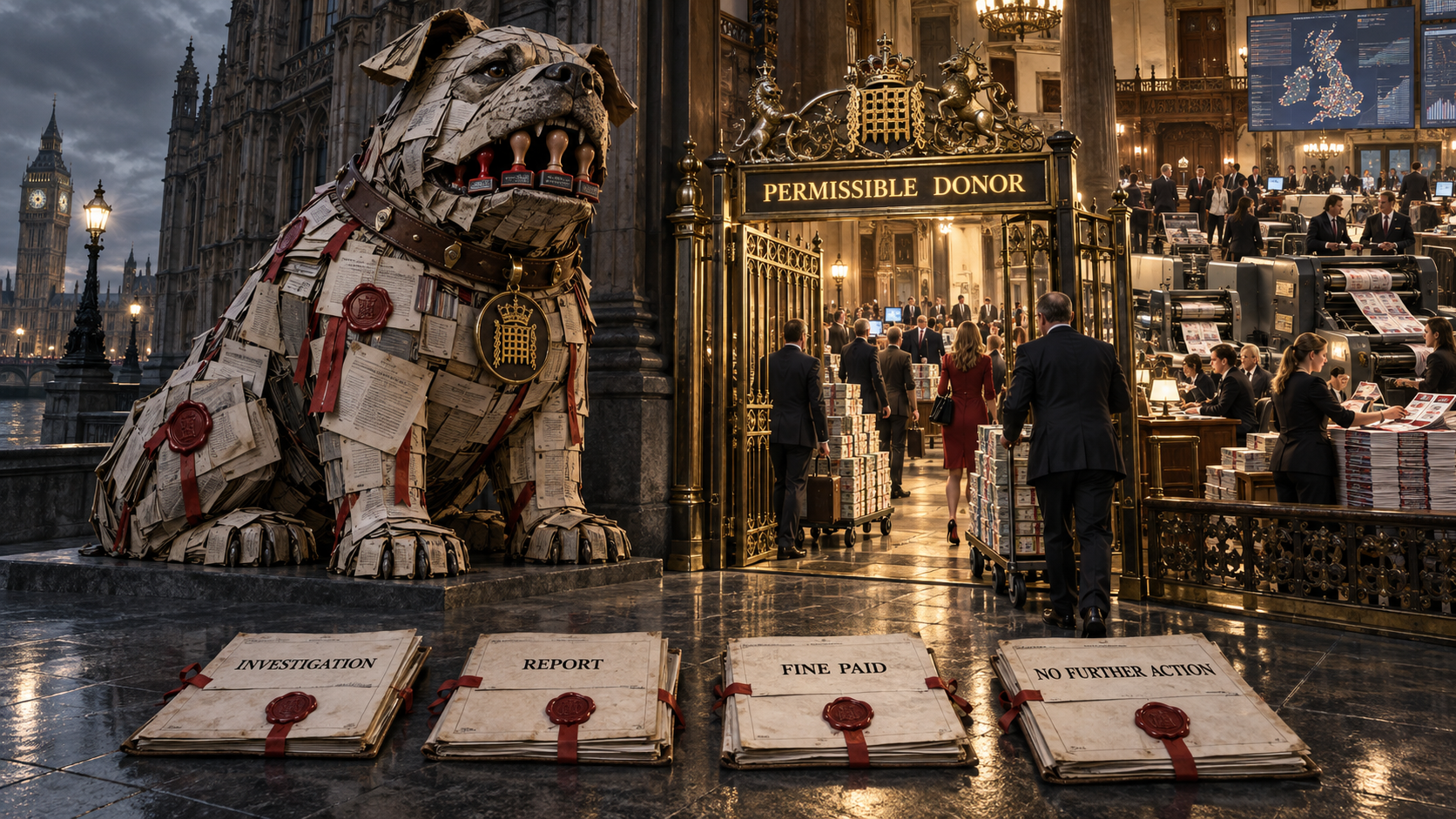
Rules without consequences
Britain does have an Electoral Commission.
Created in 2000, it registers parties, publishes donations and accounts, monitors political spending, investigates suspected breaches and imposes civil penalties.
It can determine whether a donor is legally permissible. It can check whether a contribution has been declared. It can publish the amount.
What it cannot do is decide that £36 million gives one person too much democratic power.
If the donor is permissible and the paperwork is correct, the Commission cannot refuse the transaction because it is politically obscene. Britain has no general ceiling preventing a domestic permissible donor from giving a party an enormous sum.
The watchdog patrols a marketplace whose most dangerous practices Parliament has chosen to keep legal.
Even where rules are broken, meaningful consequences are uncertain.
In 2018, the Electoral Commission concluded that Vote Leave and BeLeave had operated under a common plan during the EU referendum. It found that £675,000 channelled through BeLeave should have counted against Vote Leave’s spending and that Vote Leave had exceeded its £7 million limit by approximately £449,000.
Vote Leave was fined £61,000 and referred to the police.
It withdrew its appeal and paid the fine.
Nobody from Vote Leave was prosecuted. The referendum result remained untouched. Brexit proceeded. Its leading figures entered government.
There were legal complications. Darren Grimes successfully appealed his separate fine, and the Electoral Commission had previously supplied advice that a court found to be legally incorrect. The police concluded that the evidence did not justify criminal prosecution.
Every institution could therefore claim it had completed its narrow task.
The Commission investigated. The campaign paid. The police considered the evidence. The courts heard appeals. Parliament retained the law. The government implemented the result.
The system processed the breach without ever confronting what it meant.
Britain possesses rules, regulators, committees, reports and procedures. What it repeatedly lacks is consequence.
If unlawful spending helps secure an irreversible political victory while the eventual punishment is a manageable fine imposed years later, that fine ceases to be a deterrent. It becomes a cost of doing politics.
The organisation is toothless because the political class designed the teeth, limited their size and placed the jaw in somebody else’sלית handsExecutor.
The Norway question
Another model is possible.
Norwegian political parties also accept private donations, and Norway has experienced its own controversies over wealthy contributors. It is not politically pure.
But public subsidy provides the foundation of its party system.
Approximately NOK 635 million came from government subsidy.
Norwegian parties are therefore less dependent upon finding a billionaire willing to finance their infrastructure. A wealthy donor can still exert influence, but is less capable of becoming the institution’s financial life-support system.
Germany also combines private contributions with substantial public party funding, linked to electoral support and money raised independently. Its system is imperfect and has experienced donation scandals, but parties are explicitly treated as constitutional democratic institutions requiring publicly regulated support.
Britain largely expects political parties to raise their own money and then acts astonished when the richest citizens become the most valuable participants.
It regulates transparency while refusing to regulate power.
The machine protects itself
Economic inequality does not remain confined to bank accounts.
It becomes political inequality.
Public institutions are weakened. Private wealth becomes more powerful. Political parties become more dependent on private wealth. Wealth gains greater access to decision-makers. Governments become more reluctant to tax accumulated assets or regulate donors. Public institutions weaken further.
The cycle protects itself.
Britain proposes donation transparency without donation limits. Social mobility without confronting inheritance. Regional equality without surrendering Westminster’s authority. Clean finance without dismantling its offshore network. Affordable housing without challenging the value of existing property.
It wants the appearance of fairness without disturbing any of the structures that make fairness impossible.
Britain’s genius is not preventing power from being purchased. It is maintaining enough ceremony around the transaction that purchasing power still looks respectable.
Britain was never made fair
Farage’s £72 million may accelerate the Americanisation of British politics. It may allow Reform to employ hundreds of staff, develop policy, recruit candidates and maintain a permanent national campaign.
But America did not create Britain’s vulnerability.
It merely demonstrated how easily it could be exploited.
Britain entered the post-war period with an unequal distribution of wealth, land and institutional power. The settlement built after 1945 compressed some of that inequality and created a wider realm of public security.
Then Britain dismantled much of that protection while leaving the old machinery intact.
The result is not Victorian Britain restored exactly. It is something more modern and more deceptive: inherited privilege operating through markets, contracts, property, professional networks, offshore structures and legally permissible political finance.
A country may hold elections and still distribute political power unequally.
A country may publish every donation and still allow its democracy to be purchased.
A country may possess watchdogs and still design them never to bite hard enough to matter.
The question is no longer how Britain can make an unfair system slightly fairer.
It is whether Britain—as presently constituted—can tolerate fairness at all.