CRY ME A RIVER
Forty Years of Being Told Who Wants Your Cookie
Britain has spent decades arguing about the crumbs. From Thatcherism and Murdoch to “wealth creators”, “benefit scroungers” and the algorithmic outrage machine, the same question keeps disappearing: while we’re being told to watch the person with half a cookie, who owns the fucking bakery?
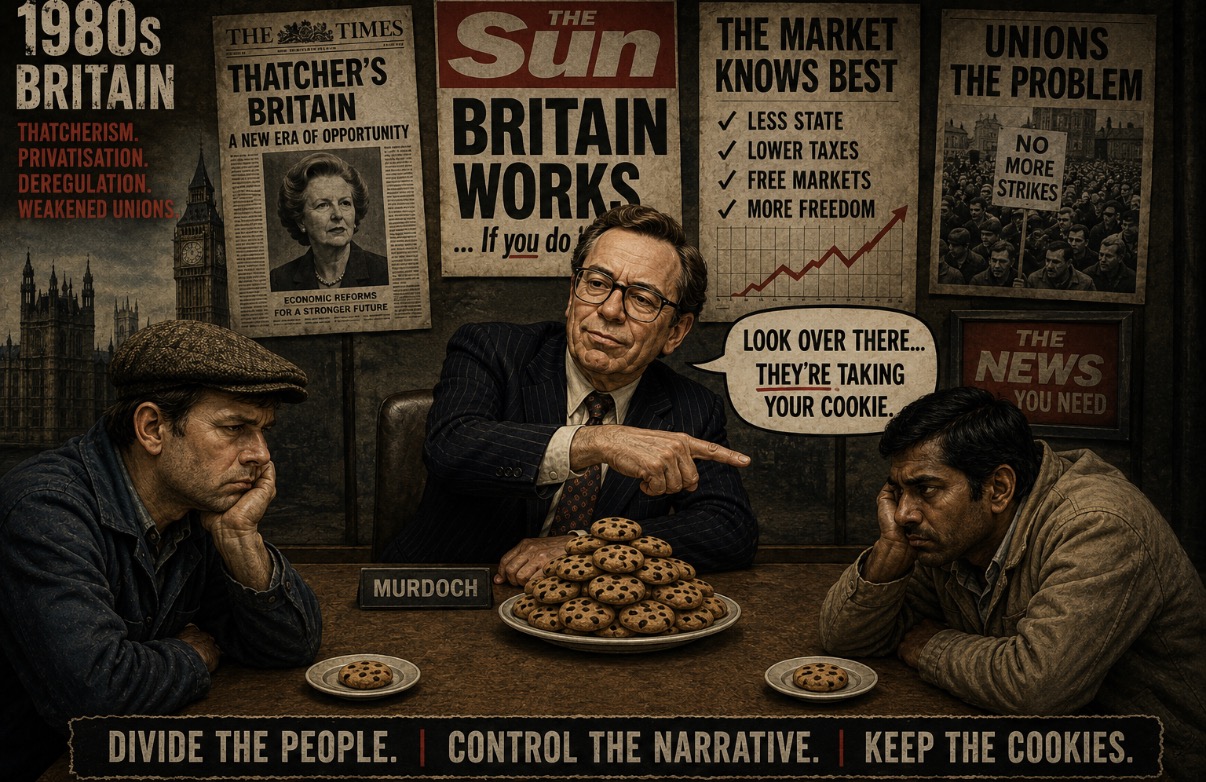
There is a political cartoon that explains an uncomfortable amount about modern Britain.
Three people sit at a table.
One has a mountain of cookies.
One has a cookie.
The other has almost nothing.
The person with the mountain turns to the person with one cookie, points across the table and says:
“Careful. That bloke wants your cookie.
That’s the trick.
And once you see it, you start seeing it everywhere.
Britain in 2026 is remarkably good at arguing about the crumbs.
We scrutinise benefits. Migrants. Public-sector pensions. Striking workers. Trade unions. Employment rights. People on low incomes receiving support. Somebody somewhere getting something we’re told they haven’t earned.
Then VAT is applied to private-school fees and suddenly Britain discovers the struggling wealthy.
Talk about taxing substantial inheritances and newspapers discover ordinary families merely trying to pass something on.
Increase employment costs and businesses warn about redundancies, recruitment freezes and higher prices.
Regulate landlords and we’re warned they’ll flee the market.
Question another enormous executive remuneration package and somebody explains the international market for talent.
Everybody, apparently, is struggling.
Everybody is being squeezed.
Everybody is being punished.
Except the person with one cookie.
They need to work harder.
AN OLD TRICK WITH NEW MACHINERY.
Before Rupert Murdoch enters the story, something needs saying.
He didn’t invent this.
Margaret Thatcher didn’t invent it.
Ronald Reagan didn’t invent it.
Facebook didn’t invent it.
Elon Musk didn’t invent it.
History repeatedly shows societies taking genuine economic anxiety and attaching it to a convenient human target.
The target changes with the century.
Sometimes the grievance is legitimate.
Sometimes the institution being criticised genuinely does possess power. Sometimes governments really have failed. Sometimes migration, taxation, welfare, regulation or labour markets genuinely require difficult debate.
That’s precisely why the trick works.
It doesn’t always invent a problem from nothing.
It takes something enormously complicated and gives it one emotionally satisfying explanation.
It is considerably easier than explaining housing policy, productivity, taxation, deindustrialisation, demographics, labour markets, financialisation, globalisation and forty years of political choices.
And considerably more useful to anyone who would rather you didn’t look upwards.
The mechanism is old.
What changed around the 1980s was the economic environment in which it operated.
THE SETTLEMENT CHANGED.
By the end of the 1970s, the post-war economic settlement was under enormous strain.
Britain had experienced inflation, industrial conflict and repeated economic crises.
Then came Thatcher.
Across the Atlantic came Reagan.
Thatcherism and Reaganism weren’t identical, and pretending everything before them worked beautifully would make for a very convenient history.
It would also be nonsense.
But together they represented part of a broader ideological transformation.
There were reasons this appealed.
Millions bought homes. People acquired shares. Businesses were created. Parts of an exhausted economic model were challenged.
But underneath the language of freedom and ownership, something else was happening.
From institutions towards individuals.
From employers towards employees.
From the state towards households.
And that change matters enormously.
YOUR PENSION. YOUR RISK.
Look at pensions.
The American 401(k) became one of the clearest symbols of this wider shift, although Britain’s pension system developed differently.
Under a traditional defined-benefit occupational pension, an employer promises an outcome according to the rules of the scheme.
Work here. Meet the conditions. Reach retirement. Receive an income related to salary and service.
The institution carries much of the investment and longevity risk.
Defined-contribution provision changes that relationship.
Increasingly: your risk.
Britain experienced its own long-term movement away from defined-benefit pensions across much of the private sector towards defined-contribution provision.
But pensions weren’t alone.
Housing increasingly became an asset.
Education increasingly became an individual investment.
Employment became more flexible.
Utilities became markets.
Public assets became private businesses.
The citizen increasingly became a consumer expected to navigate a portfolio of personal risks.
Personal responsibility is not inherently a bad thing.
But it works rather differently depending on how many cookies you started with.

THEN CAME THE STORY.
Economic systems don’t sustain themselves through spreadsheets.
They need stories.
They need language.
They need heroes and villains.
They need explanations for success and failure.
And this is where Rupert Murdoch becomes impossible to ignore.
Murdoch didn’t invent Thatcherism.
He didn’t single-handedly create modern Britain.
Nor did everybody who bought one of his newspapers obediently absorb its politics.
That’s a cartoon version of media influence.
The reality is subtler.
Over decades Murdoch built an extraordinary international media empire spanning Australia, Britain and the United States.
In Britain, his newspaper interests came to include The Sun, The Times, The Sunday Times and News of the World before its closure.
These papers weren’t merely passive observers of politics.
Politicians courted proprietors and editors. Governments cared about endorsements. Front pages could transform complicated subjects into national controversies.
And across the wider political culture a particular vocabulary became extremely familiar.
“Eventually you stop hearing the argument contained inside the language. It simply sounds like reality.
WHO DESERVES YOUR SYMPATHY?
Listen to how Britain describes money depending upon who wants it.
None of those descriptions is automatically false.
That’s what makes this interesting.
The question is why one set of interests so often acquired sympathetic economic language while another acquired moral language.
One side encounters market conditions.
The other makes bad choices.
One experiences headwinds.
The other should have worked harder.
THE CONVERSATION THAT NEVER QUITE DIES.
I’ve written about another version of this before.
Britain has an extraordinary ability to recycle political tropes long after the circumstances that produced them have changed.
These terms come from different periods and political traditions, but they can perform a remarkably similar function.
They give enormous, complicated systems a villain.
Again, nuance matters.
George Soros funds political causes. The BBC is a powerful institution and deserves scrutiny. Judges exercise power. Universities have institutional cultures. Civil servants influence how governments function.
There is nothing conspiratorial about investigating power.
The problem comes when investigation becomes mythology.
When Soros stops being a wealthy political donor and becomes a universal explanation for unrelated political events.
When one objectionable BBC decision becomes evidence of a secret ideological project.
When an inconvenient judicial ruling proves that democracy itself has supposedly been captured.
And history matters here.
Some conspiratorial portrayals of Soros overlap with much older antisemitic myths about hidden Jewish financiers manipulating governments and nations.
That doesn’t mean criticism of Soros is inherently antisemitic.
It means understanding the history of a trope matters before casually recycling it.
“SOCIALIST LABOUR.”
Few phrases demonstrate the power of framing better.
Britain can reach a point where relatively conventional arguments about taxation, employment rights and public provision inside an overwhelmingly capitalist economy quickly acquire the word socialist.
Yet governments intervene elsewhere constantly.
They subsidise industries. Guarantee contracts. Protect banks during systemic crises. Underwrite infrastructure. Protect intellectual property. Enforce property rights. Offer investment incentives.
Those interventions aren’t automatically wrong either.
The revealing part is that we have different words for intervention depending upon who receives it.
“Money moving downwards can become dependency. Money moving upwards can become growth.
Protection for workers becomes inflexibility.
Protection for capital becomes confidence.
That’s not simply economics.
That’s storytelling.
CRY ME A RIVER.
Which brings us neatly to private schools.
There are parents who make substantial sacrifices to pay school fees.
Some children have particular educational needs. Some independent schools operate on narrow margins. Policy changes have consequences.
All true.
Now zoom out.
Most British children attend state schools.
Britain has spent years discussing teacher shortages, SEND provision, deteriorating buildings, overstretched councils and funding pressures.
Apply VAT to private-school fees and substantial political attention suddenly focuses on hardship experienced by households purchasing an educational option unavailable to most families.
Those families are perfectly entitled to dislike paying more.
That’s not the interesting question.
Cry me a river.
THEN THERE ARE THE COMPANIES.
Businesses have genuine costs.
A small hospitality business and a multinational corporation obviously don’t have identical economics.
Some businesses genuinely cannot absorb another increase in costs.
But listen to the language when large organisations announce cuts.
Then look at where the difficult decision lands.
Sometimes those measures are unavoidable.
Sometimes they occur alongside healthy profits, dividends, share buybacks or substantial executive remuneration.
That doesn’t automatically prove the cuts were unnecessary.
It raises a different question.
“When everybody supposedly has to sacrifice, why does sacrifice have such an extraordinary ability to find the people with the fewest cookies?
That’s where the next article goes deeper.
National Insurance. Wages. Productivity. Corporate margins. Housing costs. Cheap labour. Investment. The actual mechanism underneath the rhetoric.
This article is about the story.
The next one is about what happens when the numbers stop working.
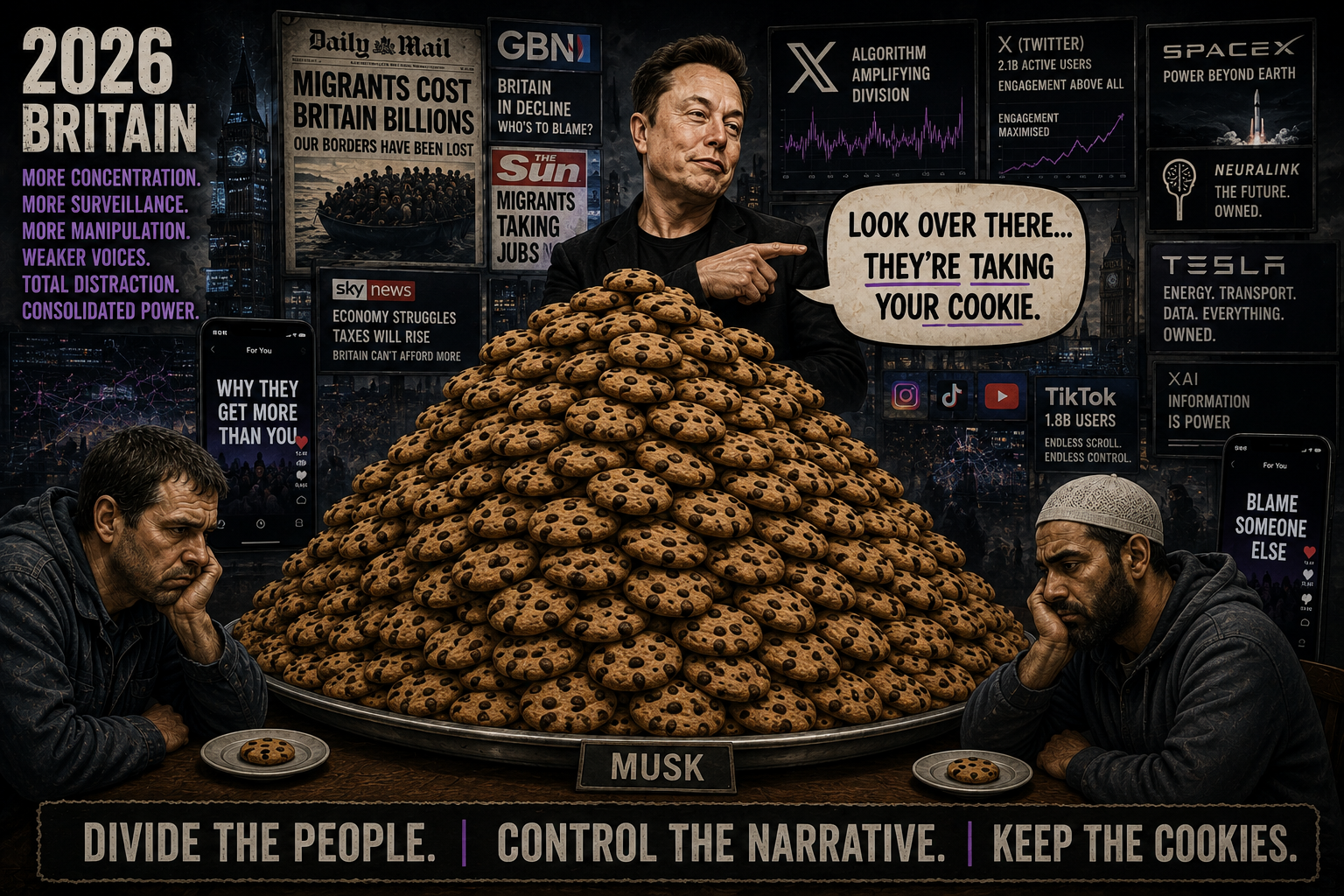
FROM MURDOCH TO THE ALGORITHM.
Then the machinery changed again.
The internet arrived.
Newspaper circulation declined.
Facebook arrived.
Twitter arrived.
YouTube arrived.
TikTok arrived.
Elon Musk bought Twitter and renamed it X.
The gatekeepers changed.
But the cookie trick didn’t disappear.
In some ways, technology perfected it.
THE FRONT PAGE. One message to millions.
THE FEED. A different message for each of us.
A newspaper editor could help decide what millions of readers might be angry about tomorrow morning.
A recommendation system can learn what makes you stop scrolling and offer another version of it seconds later.
That’s a different kind of power.
And somewhere in this transition Britain became simultaneously more informed, more connected and, in a strange sense, more docile.
Not docile because people stopped being angry.
Quite the opposite.
Angry at a stranger on X.
Angry at a TikTok clip.
Angry about a migrant.
Angry about a cyclist.
Angry about a landlord.
Angry about a renter.
Angry about Brexit.
Angry about Remain.
Angry about woke.
Angry about anti-woke.
Furious. Constantly.
And yet an apparently rebellious population can become remarkably politically docile if its anger is permanently fragmented into thousands of tiny lateral battles.
We scroll.
We react.
We post.
We argue.
We feel politically engaged because we’re permanently politically stimulated.
But stimulation isn’t agency.
Reaction isn’t power.
A public can be furious and still remarkably easy to govern.
Especially when everybody is furious with the person sitting beside them.
“The newspaper said: look over there. The algorithm learns exactly where you like looking.
FORTY YEARS OF LOOKING SIDEWAYS.
After Thatcher.
After Reagan.
After Blair.
After the financial crisis.
After austerity.
After Brexit.
After the pandemic.
After decades of rising property wealth for some and deteriorating affordability for others.
After social media turned political argument into a permanent background condition.
Still arguing about cookies.
Pick a tribe.
Find an enemy.
Point across the table.
The tragedy isn’t that these groups have no legitimate disagreements.
Of course they do.
The tragedy is how rarely the argument proceeds to the next question.
THIS ISN’T AN ARGUMENT AGAINST SUCCESS.
This isn’t an argument against becoming wealthy.
It isn’t an argument against business.
It isn’t an argument against landlords.
It isn’t an argument against private education.
It isn’t an argument that immigration, welfare, taxation, unions or public-sector spending should somehow escape scrutiny.
Quite the opposite.
Just apply the same standard upwards.
If improperly claimed benefits deserve investigation, so does questionable corporate expenditure.
If a worker’s pay rise must be justified by productivity, ask what justified the executive’s.
If government support creates dependency when given to households, ask what repeated support creates when given to industries.
If workers must accept market discipline when times are bad, shareholders cannot simultaneously expect insulation from every adverse market condition.
And if capitalism means accepting risk, risk cannot permanently belong to everybody except capital.
COUNT THE COOKIES.
Maybe Britain doesn’t need another ideology.
Maybe it needs a very simple habit.
Whenever somebody tells you who is responsible for your economic problems, count the cookies first.
History teaches us that the mechanism isn’t new.
Thatcherism didn’t invent it.
Reaganism didn’t invent it.
Murdoch didn’t invent it.
Social media didn’t invent it.
They’re chapters in a much older story about wealth, fear, power and attention.
The genius of the cookie trick is that the person with one cookie can become absolutely furious with the person who has half.
And for as long as those two are fighting, neither asks why somebody else owns the bakery.
Then decide who really deserves your sympathy.
CRY ME A RIVER. 🍪