SYSTEMS / ENERGY
ENERGY
Where it comes from. Who controls it. What happens to it. Who ultimately pays.
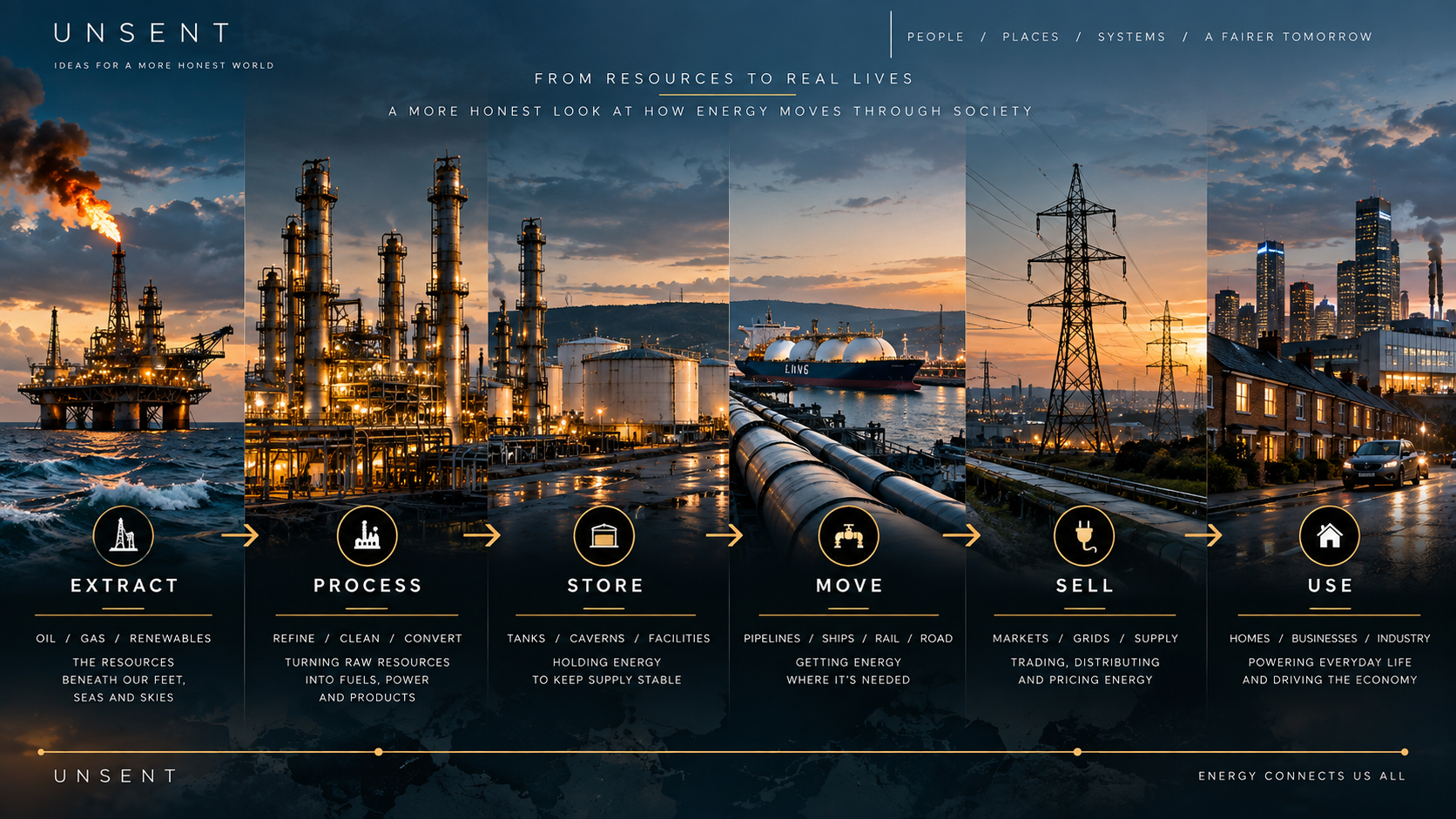
Energy is usually discussed as a commodity: oil, gas, electricity, wind, nuclear. But the resource is only the beginning. Before it reaches a home, factory or vehicle, it passes through infrastructure, ownership, markets and physical systems.
The resource matters.
The system around it determines the outcome.OWNERSHIP / CONTROL / REVENUE
The Money
Possession is only the start. Ownership, taxation, state participation and long-term investment decide where the value finally settles.
PHYSICAL INFRASTRUCTURE
The Machinery
Refineries, terminals, tanks, pipelines, ports, cables and substations turn resources into something a country can actually use.
Avonmouth
Infrastructure we stopped seeing.
Britain’s Refineries
What remains between extraction and use.
Storage & Terminals
Who holds the oil, and where.
Pipelines
The hidden routes beneath supply.
Ports & Energy
The coastline as national infrastructure.
CAPABILITY / DEPENDENCY / TRANSITION
The System
A national energy system is what a country can generate, import, refine, store, transport and deliver—and how those connections behave under pressure.
North Sea Oil & Gas
Britain’s Refining Capacity
Electricity & the Grid
Nuclear
Renewables
Imports & Energy Security
SAME PLANET / DIFFERENT SYSTEMS
The World
Countries do not simply possess different resources. They make different choices about ownership, taxation, infrastructure, investment and what happens to the proceeds.
China
Scale, processing and strategic control.
UAE
Energy converted into diversification.
Qatar
Gas, scale and state wealth.
Australia
An export giant with a different capture model.
Iran
Resources operating under constraint.
Nigeria
Production, wealth and leakage.
Canada
Abundance inside a federal market economy.
Brazil
Offshore wealth and state participation.
A country can have energy without controlling it.
It can produce energy without processing it.
It can export energy without retaining the wealth.