SYSTEMS / POWER
They Fixed
the Schools.
So Why Are They
Falling Apart?
England’s pupils performed well. But stability is being rewritten as transformation—and international rankings are being used to manufacture the myth that Michael Gove fixed British education.
A group of 15-year-olds completes an international assessment. England performs well. Other countries fall backwards. Within hours, an entire political philosophy has apparently been vindicated.
Michael Gove was right.
Traditional education won. Progressive education failed. The Conservatives fixed England’s schools.
That, at least, is the story now being assembled around the latest Programme for International Student Assessment results.
The Times declared that results in mathematics, science and reading showed that “Gove’s reforms worked”. Its accompanying argument went further: England had conclusively demonstrated the superiority of a traditional, knowledge-heavy education over the more progressive approaches pursued in Scotland and Wales.
It is a wonderfully clean conclusion.
It is also a conclusion the results cannot prove.
England performed well. But “performed well” is already being rewritten as “Michael Gove transformed education.”
England’s performance deserves recognition. Its pupils achieved scores above the OECD average in all three subjects and performed significantly better than pupils in the other UK nations.
But England’s mathematics score did not rise between 2022 and 2025. Its reading score did not significantly improve. Science recovered from its 2022 result, but did not reach a level statistically distinguishable from that recorded a decade earlier.
England moved upwards primarily because it remained comparatively stable while much of the developed world deteriorated.
That is resilience. It is not proof that one politician fixed an entire education system.
Rank Is Not the Same as Improvement
Source: PISA 2025 National Report for England. Statistical stability does not mean the result is unimportant. It means the ranking and the underlying performance answer different questions.
We Have Heard This Before
During the 2024 general election, Rishi Sunak and other Conservative politicians repeatedly claimed that England’s primary-school children were the “best readers in the Western world”.
Mark Harper went further and described them as the best readers in the world.
The claim came from the 2021 Progress in International Reading Literacy Study, known as PIRLS. It assessed Year 5 pupils—children aged approximately nine or ten—across participating education systems.
England finished fourth in the principal international table, behind Singapore, Hong Kong and Russia. It had moved from joint eighth place in 2016.
It sounded like a dramatic national improvement.
England’s actual score had moved from 559 to 558.
It had fallen by one point.
England climbed because its performance remained comparatively resilient while many other countries experienced larger declines during the pandemic.
The comparison was further complicated because some previous high-performing systems were absent from the principal ranking. Pandemic disruption meant they assessed children at a different point in the school year and their results were therefore treated separately.
Ireland and Northern Ireland, both of which had previously performed above England, were among those excluded from the main table.
Researchers from Oxford University who worked on England’s national report explicitly warned against overinterpreting the ranking. They explained that England’s position reflected declines elsewhere and the exclusion of certain systems—not a straightforward rise in English performance.
They also stated that the assessment could not link England’s result to any specific government initiative.
The qualification was careful, accurate and essential.
It was also completely useless as a political slogan.
How an Abstract Figure Becomes an Achievement
Rankings are perfect political material because they feel definitive.
But a ranking conceals the movement underneath it.
A runner can move from eighth to fourth without running any faster if four competitors slow down. A school system can rise through an international table without its pupils learning significantly more than before.
That does not make international comparisons worthless. It makes their meaning narrower than the political claims built around them.
PISA can help answer:
How did England perform compared with the education systems participating in this particular assessment?
It cannot independently answer:
Did Michael Gove’s reforms cause England’s performance?
It certainly cannot answer:
Did fourteen years of Conservative government fix English education?
Yet that is the journey the statistic is being made to take.
From Statistical Result to Political Monument
What Did Gove Actually Fix?
“The Gove reforms” were never one intervention.
The phrase now absorbs curriculum reform, academisation, free schools, phonics screening, new GCSEs, the English Baccalaureate, changes to teacher training, tighter accountability, behaviour policies and a renewed emphasis on factual and subject knowledge.
These policies began at different times. They operated through different mechanisms. Schools implemented them differently. Some affected the children tested in 2025 more directly than others.
Some may genuinely have helped.
Systematic phonics has credible evidence behind it, particularly for teaching children the mechanics of early reading. England’s work on mathematics mastery and Maths Hubs may also have strengthened teaching practice. A stable national curriculum may have helped schools embed knowledge more consistently.
But systematic phonics did not originate with Michael Gove. It had already been placed at the centre of government policy following the Rose Review commissioned under Labour in 2005 and published in 2006.
Academies began under Labour. National testing, league tables, Ofsted and England’s intense accountability culture all predated 2010.
Gove inherited a system that had already undergone decades of reform. His policies changed it further, but the subsequent performance of millions of children cannot be separated neatly into before Gove and after Gove.
A favourable national average cannot tell us which reform worked, how much it contributed or what would have happened without it.
PISA is an observational international assessment. Countries are not randomly assigned different education policies. England did not change one variable while Scotland and Wales remained identical control groups.
The results may support further investigation of particular English practices. They do not supply a causal estimate for the political brand called “the Gove reforms”.
The Girls Who Became a Success by Going Backwards
The earlier reading results contained a smaller example of the same problem.
Conservatives celebrated the narrowing of England’s reading gap between girls and boys. Presented abstractly, a smaller gender gap sounds inherently positive.
The gap narrowed partly because girls’ performance declined.
That does not erase the improvement among boys. It changes the meaning of the headline.
The same assessment found that only 29 per cent of English pupils said they liked reading very much, compared with 42 per cent internationally. Reading confidence had fallen, while approximately 35 per cent of participating children reported experiencing bullying monthly.
None of that survived the journey to “best readers in the Western world”.
The method is simple: select the favourable measure, remove its internal movement and ignore whatever the same assessment discovered that complicates the desired conclusion.
If the Schools Were Fixed
If the Conservatives fixed England’s schools, what precisely did they fix—and why do so many parts of the system now look broken?
Total school spending per pupil aged five to eighteen fell by approximately 10 per cent in real terms between 2010–11 and 2019–20, according to the Institute for Fiscal Studies.
The most disadvantaged secondary schools experienced larger spending reductions than the least disadvantaged. The funding advantage once directed towards the poorest schools was eroded.
England continues to face teacher recruitment and retention problems, persistent absence, a strained special educational needs system, deteriorating buildings, reduced creative provision and large gaps between disadvantaged pupils and their wealthier classmates.
Teachers leaving
Children missing school
SEND support delayed
Arts provision reduced
Buildings deteriorating
Disadvantage persisting
A healthy education system cannot be measured solely by whether a sample of children correctly answered an international test.
A school can produce strong examination results while its roof leaks.
A teacher can raise attainment while planning to leave the profession.
A child can pass a reading assessment while learning to dislike reading.
A disadvantaged pupil can beat the OECD average while remaining substantially behind a wealthier child living only a few miles away.
What exactly has been fixed?
The Achievement May Belong to the People Who Survived the Policy
England’s results remain encouraging.
Pupils performed well. Teachers preserved learning through austerity, Brexit-era instability, a pandemic and severe pressure on public services. School leaders continued to deliver education while managing problems that stretched far beyond the classroom.
But that allows another interpretation of England’s resilience.
Perhaps the results demonstrate the strength of England’s teachers and schools—not the wisdom of every policy imposed upon them.
The Conservatives want credit for everything the system achieved while separating themselves from everything the system endured.
Ministers restored rigour.
The profession has a recruitment problem.
Parents must take responsibility.
Demand has unexpectedly increased.
Schools must manage their estates.
Children need higher expectations.
Achievement travels upwards to the government.
Failure travels downwards to the institution, teacher, parent or child.
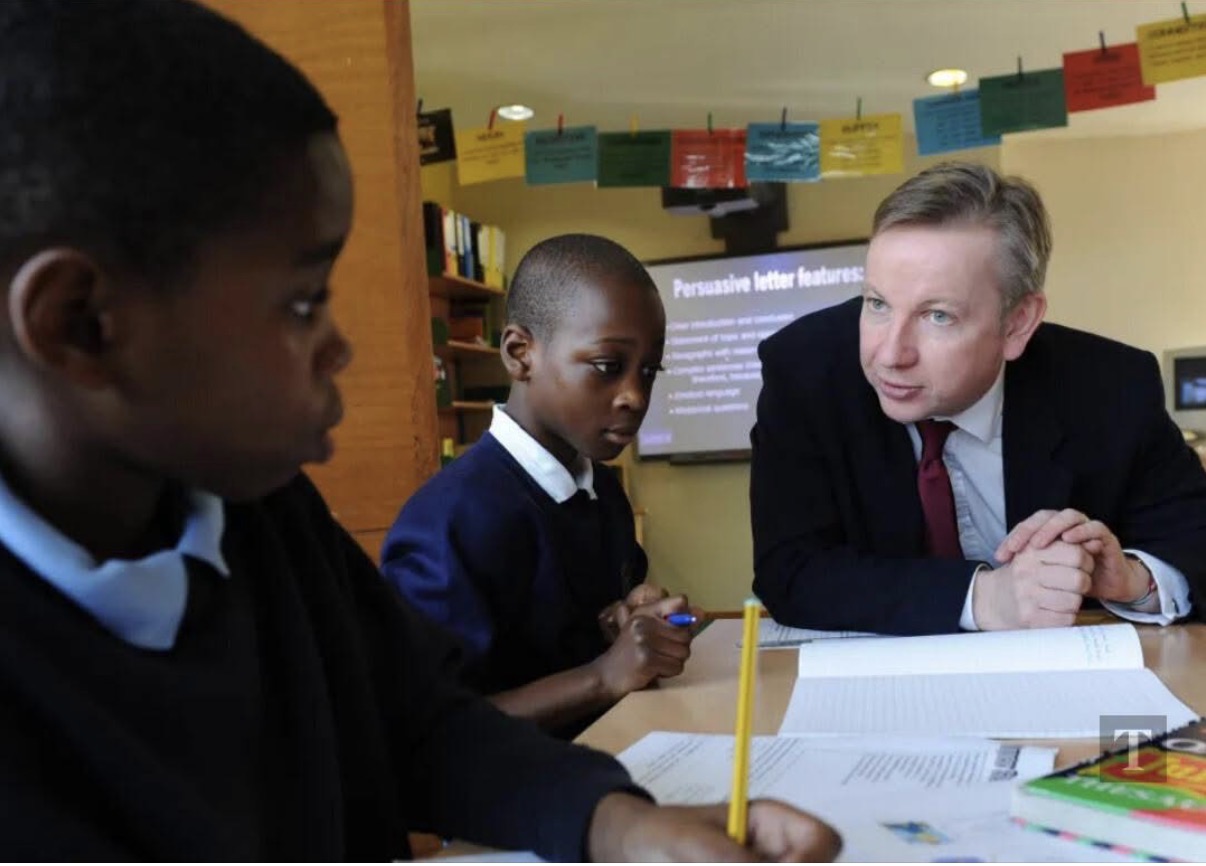
The Children in the Photograph
The photograph chosen to illustrate the latest argument is not generic classroom stock.
It shows Michael Gove with Black pupils at Durand Academy Primary School in Stockwell, south London, on 24 November 2010.
It was taken during the launch of the coalition government’s education White Paper, when hundreds of schools faced being classified as underperforming and potentially subjected to intervention.
Its reuse sixteen years later performs a specific political function.
The Black inner-city child becomes the visual representation of the “soft bigotry of low expectations”. Gove becomes the adult bringing knowledge, discipline and opportunity.
The image establishes the rescue narrative before the reader encounters any evidence.
Yet the argument does not tell us how the children in that classroom subsequently performed. It does not present results for Black African, Black Caribbean, mixed-heritage or disadvantaged pupils as distinct groups.
It does not examine what happened to Durand Academy itself.
The children function symbolically. Their presence gives moral legitimacy to a reform programme designed and narrated by powerful adults.
Meanwhile, the material conditions shaping children’s education disappear from the frame: poverty, insecure housing, local-authority cuts, food insecurity, overcrowding, reduced youth services and insufficient SEND support.
Black children are visible enough to illustrate Conservative success, but not visible enough for their complete circumstances to be included in the measurement.
One photograph cannot prove a deliberate media-wide racial strategy. But its editorial meaning can still be examined.
These children have been selected as the face of a success story whose central causal claim is not established by the accompanying data.
England Was Not a Controlled Experiment
The Times describes the United Kingdom as a “fascinating petri dish”, as though devolution produced a clean educational experiment.
England performs well. Scotland and Wales decline. Traditional education therefore wins.
But these are not identical systems with one educational variable changed.
They have different demographic profiles, funding arrangements, qualification systems, accountability structures, school organisation, teacher workforces and policy histories.
Scotland’s Curriculum for Excellence has experienced serious and extensively documented implementation problems. Those problems deserve scrutiny.
Wales’s new curriculum, however, only began its statutory rollout in 2022. Most of the 15-year-olds assessed by PISA in 2025 spent the vast majority of their education under the curriculum it replaced.
Using their performance as a conclusive verdict on the new curriculum is chronologically dubious.
None of this excuses weak results in Scotland or Wales. It simply prevents comparison from being misrepresented as causation.
The four nations can generate useful questions. They cannot turn Michael Gove’s England into the treatment group of an experiment that never occurred.
From Political Record to Political Mythology
The process resembles the construction of Margaret Thatcher’s legacy.
First, the disruption is described as necessary.
Then its social costs disappear from the historical account.
Anything that remains standing becomes evidence that the disruption worked.
Eventually, the politician is remembered not through the complete record but through a simplified national lesson.
THATCHER MODERNISED BRITAIN.
GOVE RESTORED STANDARDS.
THE CONSERVATIVES FIXED THE SCHOOLS.
Complicated history becomes personal mythology.
This becomes particularly important after a government loses power. Fourteen years of Conservative rule produced austerity, Brexit, ministerial instability, deteriorating public services and collapsing trust in government.
That period now requires a usable legacy.
Education provides one because international rankings carry the appearance of scientific neutrality. They look separate from politics. They arrive with decimal points, comparative tables and official logos.
A stable score enters at one end.
A political monument emerges from the other.
THE VERDICT
England’s Schools
Survived.
England’s international results are encouraging. They suggest that its schools retained considerable strength through an extraordinarily difficult period.
Some reforms may have contributed to that resilience. Those reforms should be examined honestly and protected where the evidence supports them.
But children are not evidence for a politician’s mythology.
Standing still while other countries deteriorate is not the same as transforming a system.
A high international ranking does not repair a school roof, recruit a specialist teacher, provide an assessment for a child with additional needs, restore a music department or close the divide between rich and poor pupils.
The Conservatives may have introduced policies that contributed to England’s results.
They did not fix the schools.
And if the system’s greatest achievement was continuing to function through everything imposed upon it, perhaps the people who deserve the monument are the teachers, pupils and families who held it together—not the politicians now returning to claim that its survival proves they were right.