
Efficiency becomes the objective.
WHEN EFFICIENCY BEGINS TO REPLACE INTENTION.
Optimisation is what happens when systems begin refining themselves.
They adjust, improve and streamline — often without questioning their original purpose.
Over time, efficiency becomes the priority.
What works is reinforced, regardless of what it costs.
THE SYSTEM LEARNS WHAT TO KEEP.
Each cycle removes friction, variation and delay. The process becomes cleaner — but also narrower.
-
Processes becoming faster but less human
-
Decisions driven by metrics rather than judgement
-
Systems prioritising output over experience
-
Automation replacing nuance
-
Efficiency improving while outcomes feel worse
Optimisation can detach systems from reality.
What is efficient is not always what is effective.
Over time, systems can become highly optimised — and fundamentally misaligned.
Systems rarely stop to ask why they are optimising.
They continue refining based on existing rules.
The further they optimise, the harder it becomes to reverse direction.
IN PRACTICE
Examples of optimisation in motion.
-
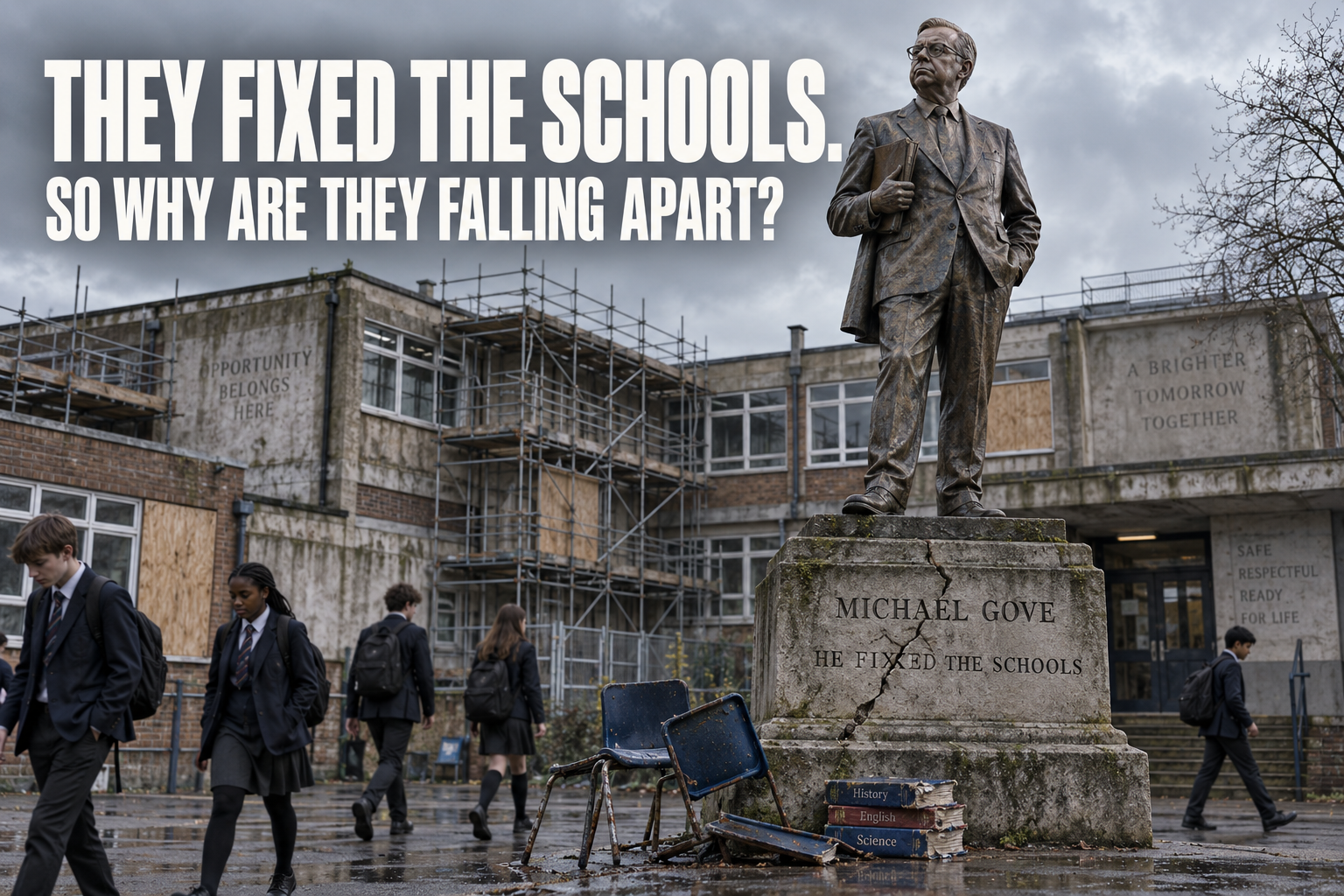
They Fixed the Schools Schools. So Why Are They Falling Apart?
📚 England’s pupils performed well—but stability has been rewritten as transformation. How international rankings are being used to manufacture the myth that Michael Gove fixed Britain’s schools.
-
COBRA, Barbecues and the British Disease
🔥 Heat. Drought. Wildfires. COBRA. Then a request to retailers. Britain can respond to emergencies, but it struggles to build the resilience that stops predictable pressures becoming emergencies in the first place. 🇬🇧
-
Britain’s Substitute Workforce
🇬🇧 Britain still needs its doctors, teachers, nurses and skilled workers. But permanent roles are increasingly supplemented by agency staff and contractors. Flexibility was easy to introduce. Rebuilding the workforce is much harder. 🔄
-
The Poor Man at His Gate
🏦 The poor man doesn’t stand at the gate anymore. He checks his phone. From Victorian casual labour to zero-hours contracts, the language has changed — but insecurity, ownership and power remain remarkably familiar. 🇬🇧



Refinement has a limit.
Optimised systems don’t always improve.
Sometimes, they begin to erode.
A SYSTEM CAN BEOUTPUT / MISALIGNMENT
PERFECTLY OPTIMISED
AND STILL BE WRONG.
EFFICIENCY REMOVES FRICTION.
THEN REDUNDANCY.
THEN, SOMETIMES, RESILIENCE.