WRITING · SEXUALITY · BLACK MASCULINITY
I Said I Was Gay (I’m Bi). You Thought About Sex.
I told you my sexuality. You imagined my sex life. Then somehow you decided I fancied you.
There is a particular conversation I have had more times than I can remember. I say something about being gay. Or bisexual. Or liking men. And before I have said anything remotely sexual, somebody else has already taken the conversation into the bedroom.
What makes it even stranger is that I grew up around men who were perfectly comfortable making heterosexuality visible. Loudly visible. Sometimes theatrically visible.
Nobody seemed worried about sexuality then.
Apparently sexuality only becomes “too much” when it stops being heterosexual.
Nearly Breaking Your Neck to Prove You Like Women
Growing up, I knew guys who could practically dislocate something when a woman walked past.
She did not have to be Beyoncé. She did not have to be dressed provocatively. Sometimes she was simply an ordinary woman walking down an ordinary street, minding her own business.
But inside the group the whole performance could begin.
Head turns. Body twists. Somebody looks back through the rear window. Somebody announces what he has seen. Somebody else joins in. Everybody needs everybody else to know that they noticed her.
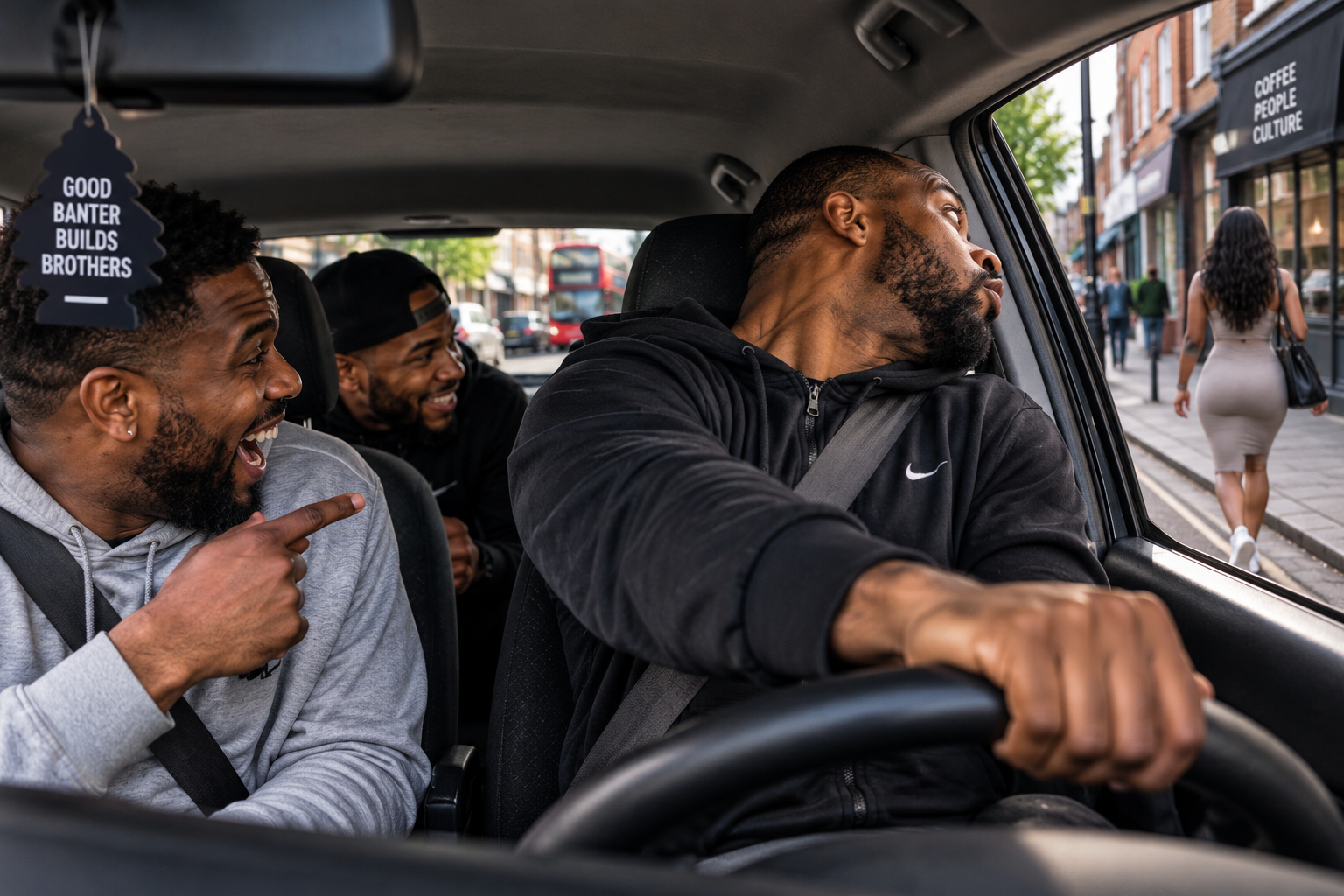
Of course some of it was attraction. Some of it was lads having a laugh. I’m not suggesting every bloke who has ever looked at a woman is secretly acting out a sociological theory.
But there was also something else going on.
Heterosexuality was not merely allowed to exist. Sometimes it seemed to need announcing.
Nobody said: “Stop shoving your heterosexuality in my face.”
Men could discuss women’s bodies. Who they fancied. Who they had slept with. Who they wanted to sleep with. They could make comments, tell stories and perform desire in front of each other.
Nobody suddenly became concerned about what happened in somebody else’s bedroom.
That was just men talking.
Then tell some of those same men that you like men.
Suddenly everybody becomes a prude.
I Was Never Particularly Confused About Attraction
Before we go any further, I should clear something up.
I am bisexual.
I use the word gay in this piece because I have used it conversationally, people have used it about me, and frankly it does not frighten me. Call me gay. Call me bi. The word does not remove anything from me.
But bisexual is what I am.
I knew what I liked. Women could attract me. Men could attract me. And, like everybody else on Earth with a functioning sense of attraction, some people did absolutely nothing for me.
Attraction has never worked like a census category.
Male is not a sufficient qualification.
I have a type. I have tastes. I have preferences. There are bodies I notice and bodies I do not. There are men I have wanted and men I would never think about twice.
Which is why one particular heterosexual reaction has always amused me.
I Said “Gay.” You Heard a Description of Intercourse.
I have had versions of this response throughout my life:
“That’s your business.”
“I don’t want to know what you lot get up to.”
“Keep that stuff away from me.”
“I don’t need to hear about what you do in bed.”
And my question has increasingly become:
What exactly did I tell you I do?
Because saying that I am gay or bisexual is not describing a sexual act.
I have not told you what happens in my bedroom. I have not described anybody’s genitals. I have not told you how I have sex, where I have sex, how often I have sex or who I last had sex with.
You supplied all of that yourself.
Now, there is an important complication here.
Gay liberation really was about sex.
Of course it was.
When the state has historically criminalised sex between men, when the law determines which consenting adults are allowed sexual privacy, when police, courts, employers and families can punish people because of the sex they have, then sex becomes political whether gay people want it to or not.
The 1967 Sexual Offences Act was a landmark, but it was not instant equality. It permitted sexual acts between two consenting men over 21 in private in England and Wales under restrictions that did not apply equally to heterosexual couples.
Britain’s Gay Liberation Front went further in the early 1970s. Liberation was not simply about politely requesting tolerance. It challenged the social structures determining what gay people were permitted to be, say and do.
Gay people did not invent the politics surrounding gay sex. Society made their sex political by regulating it.
So I am not interested in sanitising gay history until homosexuality becomes respectable enough for everybody else.
Sex is part of it.
But there is a considerable distance between recognising sexual liberation and hearing the words I am gay as though somebody has just given you an unsolicited account of anal sex.
The Confidence Is Almost Admirable
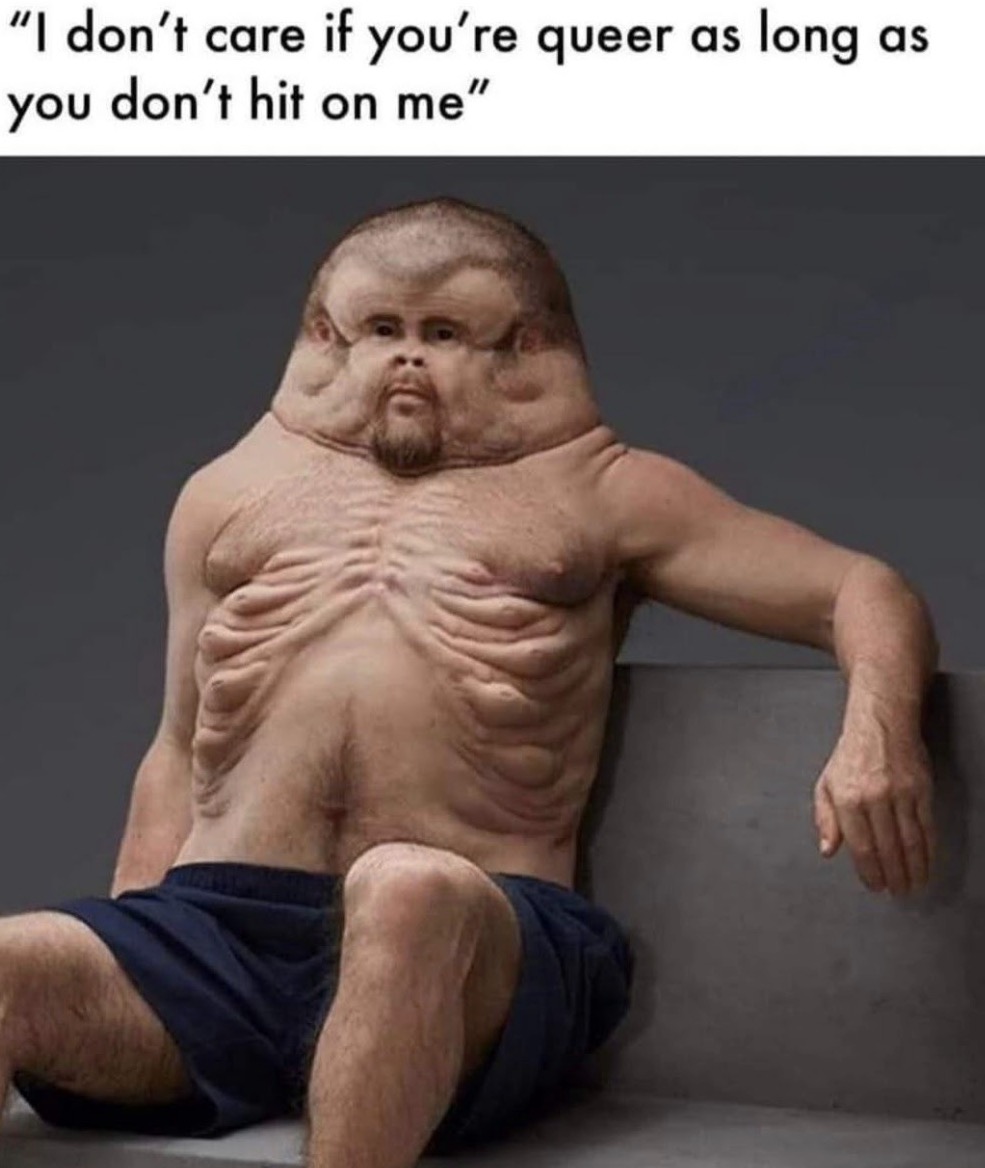
This one has always fascinated me.
You tell a man you are gay and somehow, in his head, the journey goes:
There is something wonderfully confident about inserting yourself into somebody else’s sex life before they have even expressed an opinion about you.
Mate. Who said you were my type?
Straight men understand selectivity perfectly well when it applies to them. They are not attracted to every woman.
They can describe preferences with forensic precision. Hair. Height. Shape. Face. Age. Personality. Style.
Nobody says heterosexuality means a man wants every woman he meets.
Yet homosexuality can suddenly be imagined as desire without standards.
Apparently the qualification is simply:
Sometimes the most flattering thing a man has imagined about himself is apparently what he thinks a gay man must be thinking about him.
But beneath the comedy is a serious question.
Why does another man’s possible attraction make some heterosexual men feel that their own heterosexuality suddenly needs defending?
For Me, This Has Had a Particular Black Dimension
I need to be precise here.
I am not saying all Black people are homophobic. I am not saying white British culture has eradicated homophobia. It plainly has not.
I am saying something much simpler.
In my own life, I have encountered this particular reaction far more often in Black spaces than I have in ordinary white British ones.
That is my experience.
And I’m not going to rewrite my own experience because discussing homophobia inside your own community is uncomfortable.
There have been rooms where heterosexual masculinity appears almost compulsory. Everybody likes women. Everybody talks as though everybody else likes women. Everybody seems remarkably confident about everybody else’s sexuality.
Unless somebody appears obviously gay.
And even that phrase reveals the problem.
People Think They Know What Gay Looks Like
If a man is feminine, flamboyant, camp, expressive or fits whatever collection of mannerisms somebody has learned to associate with homosexuality, people may register him as gay immediately.
Everybody else?
Straight until further notice.
Except sexuality does not work like that.
A masculine man is not necessarily heterosexual. A feminine man is not necessarily gay. A married man is not necessarily straight. A man with children is not necessarily straight. A camp man is not necessarily homosexual. And a bisexual man does not acquire a particular face when he wakes up.
The stereotype does not reveal gay people. It reveals the gay people you have been taught to recognise.
There is even research pointing towards something deeper here. A 2026 study in the British Journal of Social Psychology examined stereotypes of gay men and Black men across five studies involving 1,226 participants. The researchers found evidence that stereotypical ideas of “gay men” and “Black men” can be perceived as psychologically incompatible, affecting how people categorise gay Black men.
In plain English: society can carry one stereotype of what a Black man is supposed to be and another stereotype of what a gay man is supposed to be, and struggle when the same person occupies both identities.
That resonates with something I have felt for years.
Sometimes it feels as though Black people are allowed to be almost anything except openly gay.
Yet Black gay people have never existed outside the Black community.
We came from it.
Somebody’s son is gay. Somebody’s daughter is lesbian. Somebody’s brother is bisexual. Somebody’s uncle never told anybody.
Online, Black Gay Men Are Everywhere. Then You Enter the Room.
This is another thing I have always found fascinating.
Go online and finding Black gay or bisexual men is hardly difficult.
They’re there.
Social media. Dating apps. Forums. LGBT spaces. Porn. Communities built specifically around Black queer identity.
Then you step back into ordinary life and sometimes it feels like somebody switched everybody off.
I have lost count of the rooms I have been in where sexuality comes up and I appear to be the odd one out.
Everybody else is straight.
Maybe they are.
I cannot look inside somebody else’s head and I am certainly not interested in announcing that heterosexual men are secretly gay because they happen to make me suspicious.
But I do know something simpler:
Unless somebody tells you, you don’t actually know.
And that raises another possibility.
Perhaps what has sometimes made me the odd one out is not merely being different.
Perhaps it is being willing to be seen being different.
If heterosexuality is assumed, homosexuality can disappear without anybody actually leaving the room.
Some Sexual Behaviour Gets Condemned. Some Sexuality Gets Condemned.
This is where the conversation becomes uncomfortable.
Communities can contain enormous amounts of heterosexual dysfunction.
Infidelity. Misogyny. Men maintaining several relationships at once. Domestic abuse. Sexual violence. Absent parenting. Exploitation.
Those things may be condemned individually, as they should be.
But nobody usually looks at a heterosexual man behaving appallingly and concludes:
“This proves heterosexuality is destroying the community.”
His behaviour is the problem.
Yet homosexuality can sometimes be treated differently.
Two consenting adult men do not even have to behave badly. Their sexuality itself can become the objection.
Which creates an uncomfortable hierarchy.
Why can harmful heterosexual behaviour be understood as bad behaviour, while consensual homosexuality is sometimes treated as bad identity?
That is not a minor distinction.
Black Culture, Christianity and a History More Complicated Than the Slogans
It is tempting to flatten this history into something simple.
One side says homosexuality is foreign to African or Caribbean culture. Another side replies that Europeans invented Black homophobia.
Neither slogan is enough.
Different societies had different sexual norms long before European colonialism. There was never one single African or Caribbean attitude towards sexuality.
What is historically clear, however, is that Britain did not merely arrive overseas with its own sexual morality tucked quietly into a suitcase.
British colonial administrations codified criminal prohibitions on same-sex sexual activity across substantial parts of the empire.
In the Caribbean, laws criminalising consensual same-sex conduct were imposed through British colonial rule. Across other territories, variants of the British imperial legal model spread through penal codes, sometimes surviving independence long after Britain itself began dismantling similar restrictions at home.
History therefore gives us an awkward question.
When homosexuality is described as some alien Western contamination of Black culture, which parts of the morality being defended were themselves shaped, reinforced or legally institutionalised through British empire and Christian colonial rule?
That does not mean colonialism explains every modern attitude.
It means the history is far messier than the claim that there was always one timeless, natural, culturally pure Black heterosexual morality.
Eventually the Performance Follows You Home
Go back to the men in the car.
The exaggerated head turn. The commentary. The laughter. The need for the other men to know what you noticed.
At first it is funny.
But masculinity can become exhausting when it has to be constantly demonstrated.
Don’t look weak. Don’t cry. Don’t appear feminine. Don’t let another man think you might be gay. Don’t discuss intimate things. Don’t admit uncertainty. Don’t let anybody see fear.
Eventually the other men do not even have to be in the room.
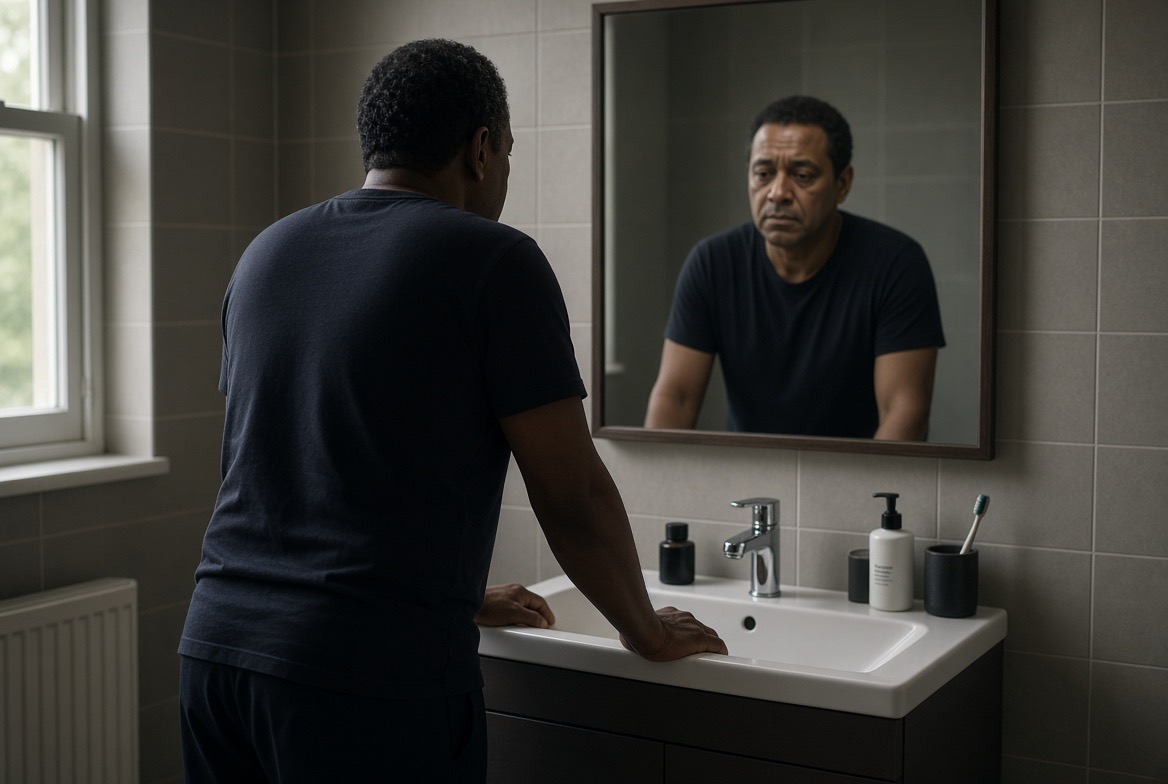
That is when the conversation stops being only about homosexuality.
Because if masculinity requires silence around vulnerability, bodies and fear, eventually that silence can follow men into places where talking matters.
Sometimes Men Actually Need to Talk About Their Bodies
Black men in the UK face a particularly high risk of prostate cancer.
Current Prostate Cancer UK figures estimate that around 1 in 4 Black men will be diagnosed with prostate cancer during their lifetime.
That is not evidence that homophobia causes prostate cancer. It does not.
Nor am I suggesting every Black man avoiding a health conversation is secretly worried about appearing gay.
The evidence is more interesting than that.
UK research involving Black men and healthcare professionals has identified barriers including fear, stigma, limited culturally sensitive information, mistrust and experiences of racism.
It has also identified something directly relevant to this essay: ideas about masculinity can affect open discussion about prostate cancer and men’s healthcare preferences.
Other research has found stigma and masculinity concerns affecting attitudes towards intimate examinations, sexual side effects and discussing prostate cancer with other people.
That does not prove one neat causal chain.
It does suggest that the rules men learn about what they are permitted to discuss can have consequences long after the banter ends.
If you spend your life learning that certain conversations about your body threaten your masculinity, what happens when talking about your body becomes medically important?
Suddenly “we don’t talk about that” is no longer merely an attitude towards gay people.
It becomes a much wider question about what men have been taught not to say.
Let’s Go Back to the Beginning
I told you I was gay.
I’m bisexual, but we’ve covered that.
I did not tell you what I did in bed.
I did not tell you what I do with men.
I did not tell you what I do with women.
I did not describe anybody’s body.
I did not ask about your sex life.
And I certainly did not tell you I fancied you.
You supplied all of that.
Maybe that is why these conversations have stayed with me.
They start with somebody warning gay people not to make everything about sex.
Yet within seconds that same person has imagined my bedroom, my body, another man’s body and, somehow, himself standing somewhere in the middle of it.
Which leaves me with one question.