SYSTEMS · STRUCTURES · MEDIA
LBC Doesn’t Sell the Truth. It Sells the Argument.
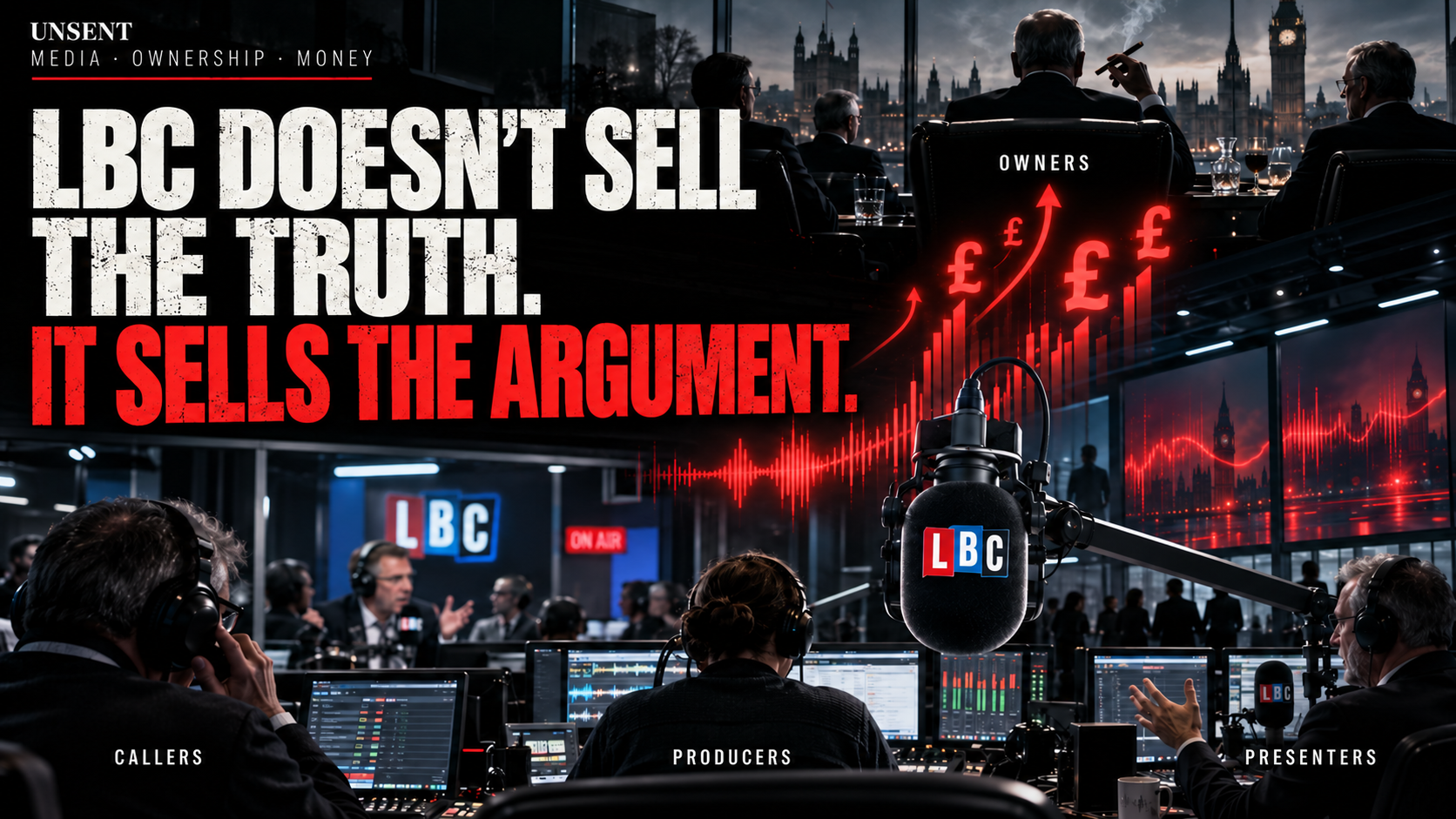
Callers provide the conflict. Producers construct the programme. Presenters become the product. The value travels upwards.
I knew it was coming. The only question was when.
On 23 September 2026, LBC launched Catch Up Plus: a subscription service offering eligible catch-up programmes without the standard advertising breaks, alongside an exclusive newsletter and weekly competition entries.
The price is £4.99 a month or £49.99 a year after a free trial. The subscription does not remove advertising from live LBC, and even the supposedly ad-free catch-up can retain sponsorship messages, presenter-read commercial references, promotional segments and promotions for other Global content.
To be clear, ordinary catch-up has not simply disappeared behind a paywall. Listeners can still use Global Player without subscribing. What LBC is selling is an upgraded version: eligible catch-up without conventional advert breaks, plus a newsletter and competition entries.
But the significance is larger than whether a listener can still press play for free.
LBC has found another way to monetise a conversation that its audience already helps to create.
The callers provide the stories, anger, disagreement, emotion and occasional moments of genuine insight. Producers research and construct the programmes. Presenters turn that material into a recognisable show. Advertising monetises the original broadcast.
Now the experience of hearing it back without the interruptions is being monetised too.
The conversation has become a subscription product.
The one programme still worth finding
Nick Abbot is the reason the change caught my attention.
His Sunday-night programme is now the only LBC show I make a particular effort to hear. Three hours of LBC in an entire week is probably enough for me now-and sometimes even that is too much—but Abbot remains different.
He sounds less sanitised.
His programme is not free from production, commercial breaks or the institutional limits of the station. No nationally broadcast programme is. But he retains a looseness and scepticism that much of LBC’s weekday output has lost.
He is funny without pretending the country is functioning normally. He can recognise the absurdity of politics without immediately turning every subject into another manufactured left-versus-right contest. The programme can wander, breathe and occasionally sound like a real person thinking rather than a branded presenter delivering an approved format.
That is increasingly rare.
Nick Ferrari is polished political breakfast radio. James O’Brien is a skilled and often formidable argumentative broadcaster. Shelagh Fogarty can handle difficult human stories with intelligence and compassion. I do not dislike these people.
But weekday LBC often feels heavily processed.
Everything must become a debate. Every subject needs two opposing camps. Every hour requires conflict, telephone numbers, clips and advertising breaks. The presenter’s personality may change, but the machinery remains.
Nick Abbot occasionally seems to slip through the machinery.
That is why promoting paid listening through programmes with unusually loyal audiences makes commercial sense. The station does not need every listener to subscribe. It needs the people attached to a particular presenter to decide that £4.99 is a reasonable price for convenience, fewer conventional adverts and a sense of additional access.
Global has also offered The Whole Show Plus, a separate Nick Abbot subscription at the same monthly or annual price, promising ad-free listening, subscriber-only episodes and an exclusive newsletter.
The presenter creates loyalty. Loyalty creates habit. Habit becomes recurring revenue.
That is not a conspiracy. It is a business model.
Who owns Britain’s conversation?
LBC is not a public service owned by its listeners. It is part of Global Media & Entertainment, the privately controlled group that also operates Capital, Heart, Classic FM, Smooth, Radio X and Gold, alongside a large outdoor-advertising business.
Ashley Tabor-King founded Global and remains its executive president. Companies House records identify his father, Michael Tabor, as the person with significant control of Global Media & Entertainment Limited. Global’s rise was financed by the Tabor family’s wealth and a series of major acquisitions.
In 2007, Global purchased Chrysalis Radio, which included LBC, Heart and Galaxy, for approximately £170 million. It later acquired GCap Media and GMG Radio, helping turn the company into the dominant force in British commercial radio. Contemporary reporting described a series of deals collectively worth more than £600 million.
The ownership should be described accurately.
It is tempting to call LBC “billionaire-owned,” particularly because Global’s early financial story involved several extraordinarily wealthy investors and people associated with billionaire fortunes. But the 2025 Sunday Times Rich List reportedly estimated the wealth of Michael Tabor and his family at £524 million.
That is not technically a billion pounds.
It is still a level of private wealth almost beyond ordinary comprehension.
So the defensible description is this: LBC is controlled through a privately held, extremely wealthy, family-backed media empire that was built with access to hundreds of millions of pounds.
Britain may provide the conversation, but Britain does not own the platform.
Follow the money
Global is not simply a radio operator.
Its business combines audio, digital services, podcasts and one of Britain’s largest outdoor-advertising estates. The same corporate group that places voices in people’s cars, kitchens and headphones also sells advertising space across roads, airports, buses and the London Underground.
Global says its radio brands reach more than 29 million listeners each week.
Global’s accounts for the year ending March 2024 recorded revenue of approximately £858.2 million and an operating profit of £87.5 million. But finance expenses of £213.4 million contributed to a pre-tax loss of £120.4 million. The following year, reported revenue rose to about £898 million while finance costs increased further.
Those figures require a note.
When most ordinary people hear that a company made a £120 million pre-tax loss, they imagine a business that sold its product for less than it cost to provide it.
That is not what these accounts show.
Global generated an operating profit of approximately £87.5 million. The reported loss appeared after more than £213 million in finance expenses and other items were applied.
In other words, the broadcasting and advertising operation produced a substantial operating profit, but the financial structure surrounding that operation produced a pre-tax loss.
And remember the class of people involved here.
Global is controlled by an extraordinarily wealthy family and was built with financial backing unavailable to almost any ordinary business. People operating at that level do not experience money simply as a wage arriving in one bank account. Wealth can sit across companies, loans, assets, investments and different jurisdictions. Money moves through interest, debt repayments and corporate structures before the final taxable result appears on a set of accounts.
That does not by itself prove wrongdoing.
Finance expenses can be entirely legitimate. Debt genuinely costs money, and a corporate group can report a real accounting loss while remaining commercially active and cash-generative. Global also recorded an income-tax charge for the year, despite reporting a pre-tax loss.
But the distinction matters.
An operating profit tells us that the underlying business generated money before financing and other costs. A pre-tax loss tells us what remained after the company’s wider financial arrangements were taken into account. Those are not the same statement.
So when a large privately controlled company reports hundreds of millions in revenue, tens of millions in operating profit and a substantial pre-tax loss, the public should not simply translate that into: “The owners lost £120 million.”
That is not necessarily what happened.
The operation generated value. The question is where that value travelled after it was generated—through interest, lenders, investment, debt and the wider corporate structure—and who ultimately benefited from those movements.
There is also a public consequence. A company’s taxable position is shaped by what can legitimately be deducted before taxable profit is calculated. When substantial operating earnings are absorbed by financing costs, less profit may remain available for corporation tax than the headline revenue or operating performance might lead the public to expect.
That does not automatically make the arrangement unlawful or artificial. It does show why “the company made a loss” is an inadequate conclusion.
For the deeper question of how wealthy individuals and corporate groups can arrange income, debt, ownership and taxation across complex structures, that belongs in my separate tax investigation and tax hub.
The relevant point here is simpler: LBC sits inside a business that generated hundreds of millions of pounds in revenue and a sizeable operating profit. Whatever the final pre-tax result, this is not a struggling community radio station passing a collection tin around the studio.
It is a major commercial media operation with wealthy private backing, significant assets and a financial structure ordinary listeners are unlikely ever to possess.
Balance as a commercial format
LBC promotes itself as a platform for informed opinion and debate.
But debate is also its commercial format.
The station does not require agreement. It requires engagement. Anger can be as valuable as admiration because both keep people listening, calling, sharing clips and returning to hear what happens next.
A presenter on the right attracts supporters and opponents. A presenter broadly associated with the liberal left does the same. Place them across the schedule and the station can market itself as politically diverse while monetising the conflict generated by both.
This is where the language of balance becomes convenient.
Balance sounds like a democratic principle. Commercially, however, it also means constructing a schedule capable of attracting multiple audiences without committing the institution itself to a coherent view of the truth.
One presenter can dismantle a political claim in the morning. Another can help restore the same claim to respectability later.
Both programmes generate content. Both attract attention. Both sell advertising.
The station wins whichever argument the audience believes has taken place.
The Brexit contradiction
James O’Brien deserves genuine credit for his broadcasting during the Brexit years.
While much of the media repeated vague promises about sovereignty, trade deals and “taking back control,” O’Brien repeatedly asked callers and politicians to explain what Brexit would achieve in practical terms.
What law would change? What problem would leaving solve? What economic mechanism would produce the promised benefit?
Many of the arguments collapsed because the slogans had never been required to survive detailed questioning.
O’Brien became one of broadcasting’s most recognisable critics of Brexit. He challenged false claims when parts of the political media were still treating demonstrable misinformation as merely one respectable side of a debate.
In that sense, he was a Brexit champion—not a champion of Brexit, but a champion of exposing it.
That contribution matters.
But it existed within the same station that employed Nigel Farage as a presenter.
Farage did not merely appear occasionally as a guest to have his claims scrutinised. He received his own recurring LBC programme and, with it, the legitimacy and reach provided by a national broadcaster.
This is the LBC contradiction in its clearest form.
The station could promote O’Brien challenging Brexit misinformation while simultaneously benefiting from the audience, controversy and political influence generated by one of Brexit’s principal architects.
One presenter interrogated the project. Another helped sell it.
LBC monetised both.
O’Brien versus Farage was not merely a political contradiction. It was a content strategy.
The boundaries do not need daily instructions
This does not require imagining Ashley Tabor-King telephoning presenters before every programme and instructing them what to say.
Media ownership usually operates more subtly than that.
Owners and senior executives appoint leadership. Leadership determines budgets, formats and priorities. The organisation chooses presenters, allocates time slots, promotes particular clips and decides which personalities receive long-term investment.
Commercial pressures do the rest.
Presenters learn which subjects generate calls. Producers learn which confrontations create shareable clips. Executives see which personalities attract audiences and advertisers. Nobody needs to issue a written order requiring more outrage.
The system teaches itself.
The boundaries are established through recruitment, programme design, risk management and commercial incentives. A presenter may possess considerable freedom inside those boundaries while having little power to redraw them.
That is why ownership matters even when direct editorial interference cannot be proven.
The owner does not have to write every sentence.
Owning the stage is enough.
“Spare a thought for the producers”
LBC presenters regularly mention their producers.
The term sounds powerful. In television and film, “producer” can suggest somebody controlling budgets, commissioning work and making major creative decisions. On live radio, the role is essential—but the title does not necessarily bring comparable status or money.
The producer may research the programme, identify stories, prepare briefing notes, contact guests, screen callers, manage timings, monitor legal risks, communicate with the presenter and help create digital material from the broadcast.
When something goes well, the presenter receives the public recognition.
When something goes wrong, the production team must help contain it.
And yet listeners are rarely told what these workers earn.
Global’s advertisements commonly describe benefits and workplace culture, while some roles either omit a salary or use language such as “competitive.” That phrase does not tell an applicant whether the wage is sufficient to live independently in London. It tells them that the employer would prefer the number not to shape the public discussion.
We should be careful not to invent a salary where Global has not published one. Not every producer is paid the same, and senior production staff may earn considerably more than junior employees.
But the lack of transparency is itself relevant.
They are not decorative assistants laughing behind a glass screen. They are skilled workers making the product possible.
They screen the caller before the presenter speaks to them. They locate the guest. They check the story. They keep one eye on the clock and another on potential legal disaster. They absorb the pressure of live broadcasting while the public-facing personality accumulates the recognition.
LBC reflects a wider British economic model: prestige and reward concentrated around the visible figure while the supporting labour is treated as replaceable.
We should not describe that work as low-skilled.
The problem is that Britain repeatedly pays skilled people as though it were.
The audience works for free
There is another workforce LBC does not pay at all.
The callers.
A caller supplies an experience, confession, disagreement or piece of personal history. That contribution fills airtime. It gives the presenter material to react to. It may be clipped, promoted and circulated across social media.
The caller receives no fee.
Sometimes the exchange provides something valuable in return: the chance to speak, to challenge a public figure or to place an ignored experience before a large audience.
But the commercial value travels in one direction.
The audience supplies the raw material. Producers filter and arrange it. Presenters perform around it. Global owns the resulting content and sells access to the audience surrounding it.
Now it can also sell a version of the replay with fewer conventional advertisements.
LBC calls this participation.
Economically, it is user-generated content attached to a commercial broadcasting operation.
From conversation to product
None of this means LBC has never produced valuable journalism.
It has.
James O’Brien’s Brexit broadcasting mattered. Shelagh Fogarty has conducted thoughtful discussions. Nick Abbot still provides something increasingly difficult to find in commercial radio: a programme that can sound human, sceptical and not entirely assembled by algorithm.
The station has broken stories, challenged politicians and created space for callers who might otherwise never be heard nationally.
But useful journalism does not cancel the need to examine the institution producing it.
LBC is neither a public square nor a neutral national listening post. It is a commercial product owned by a wealthy private group.
Its political range is real, but commercially useful. Its arguments are unscripted, but structurally controlled. Its callers are members of the public, but also unpaid suppliers of content. Its producers are highly important, but mostly invisible.
Its presenters can challenge power, but they do so from a platform that is itself an exercise of private power.
And its catch-up service remains available without payment—but the cleaner, more convenient version is now another recurring subscription.
Who profits from the argument?
The class structure behind the microphone belongs to a related question: Who Chose the Conversation?
That investigation asks why so many of the people authorised to explain Britain emerge from a narrow educational and professional pipeline.
This one asks what happens once those people have been selected.
Who owns their platform? Who chooses the format? Who supplies the labour? Who contributes the stories? Who carries the status? Who receives the money?
LBC’s presenters provide the recognisable voices. Its producers construct the broadcasts. Its callers provide conflict, testimony and emotion. Its listeners provide attention and data. Advertisers pay to reach them, and subscribers can now pay to escape some of those advertisers when listening back.
The value rises through the system.
The ownership remains at the top.
So yes, Britain is having a conversation.
But it is taking place inside somebody else’s business.
LBC does not need to establish the truth. It only needs to keep the argument going.