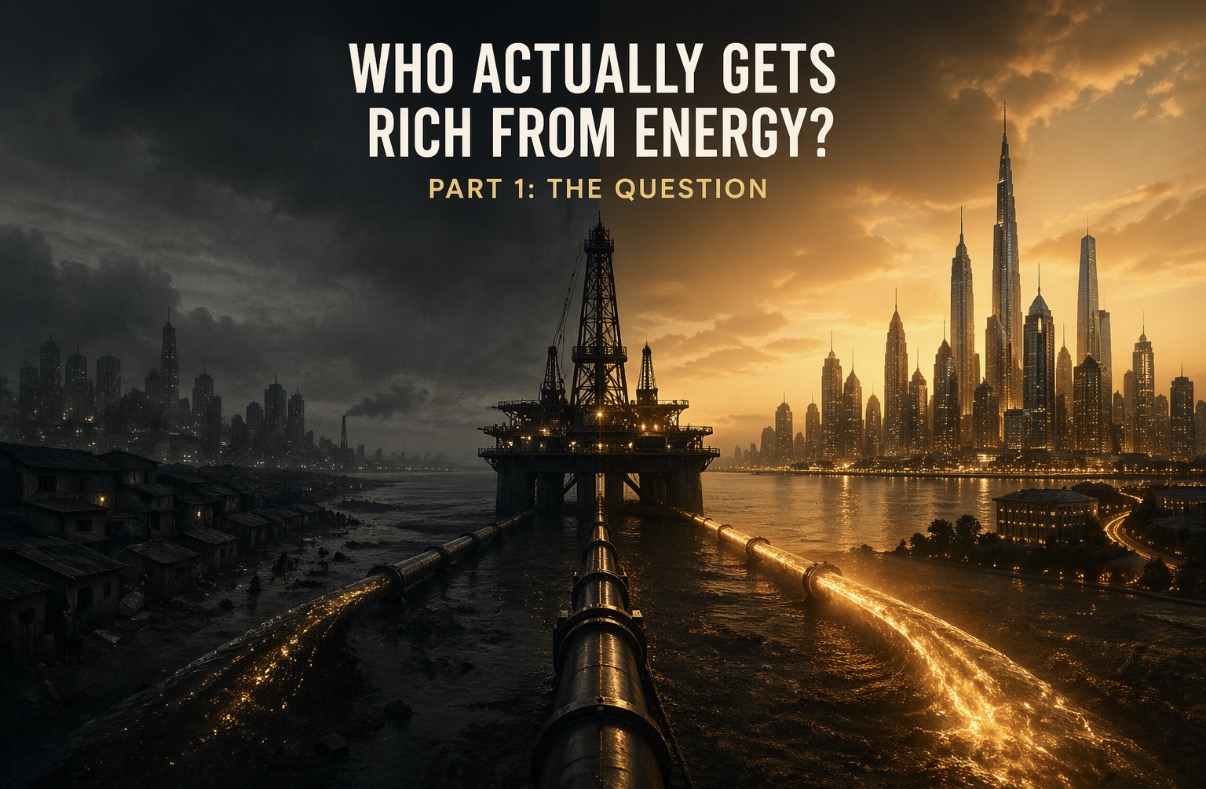
WHO ACTUALLY GETS RICH FROM ENERGY?
PART 01 / 07
THE QUESTION
Same oil.
Same gas.
Completely different outcomes.
When energy prices rise, somebody gets richer.
The question is who.
For millions of households, the energy crisis meant something very simple:
HIGHER BILLS.
In Britain, Ofgem’s typical default-tariff price cap stood at £1,277 a year in October 2021.
By April 2022 it had reached £1,971.
By January 2023, the underlying Ofgem cap would have reached £4,279 for a typical household had the government not intervened through the Energy Price Guarantee.
The government effectively stepped between the wholesale market and households.
But the cost had not disappeared.
It had simply moved.
THE OTHER SIDE OF THE CRISIS
Somewhere Else, The Numbers Were Moving In The Opposite Direction.
While households were being protected from enormous increases in energy costs, enormous amounts of money were being generated elsewhere in the same system.
Saudi Aramco net income in 2022 — its highest annual profit since listing.
Oil revenue recorded by the Saudi government during 2022.
Norwegian state net petroleum cash flow in 2022.
2021 — NOK 287.5BN
Same global energy shock.
Very different national consequences.
FOLLOW THE VALUE
So Where Did The Money Go?
We usually discuss energy as a question of price.
But price only tells us what the resource is worth.
It doesn’t tell us who captures that value.
And that distinction changes everything.
Imagine two countries sitting above valuable oil and gas reserves.
Both extract them.
Both sell them into international markets.
Both experience exactly the same increase in global prices.
MORE VALUABLE OIL = RICHER COUNTRY
It would be tempting to assume that equation works.
But it is incomplete.
Because between the resource underground and wealth appearing on a country’s balance sheet sits an entire system.
THE SYSTEM
Three Questions Change Everything.
WHO OWNS IT?
Who owns the companies, licences and infrastructure extracting the resource?
WHO CONTROLS IT?
Who decides how quickly it is extracted, where it is sold and how the industry develops?
WHO CAPTURES THE REVENUE?
Where do the profits, taxes, dividends and investment returns ultimately go?
Those questions determine whether an energy boom becomes:
And there is another question after that.
Perhaps the most important one.
AFTER EXTRACTION
What Happens To The Money Afterwards?
Capturing revenue isn’t enough.
A government can receive billions from natural resources and spend it immediately.
Or it can invest some of it.
- Build infrastructure
- Reduce debt
- Finance public services
- Create sovereign investment funds
- Acquire assets elsewhere in the world
A finite resource underground can therefore be converted into financial assets capable of generating income long after the original oil or gas has been extracted.
Norway did precisely that.
Value at the end of 2025.
Investments across roughly 7,200 companies worldwide.Oil extracted decades ago has therefore become something else.
AND THEN THERE IS BRITAIN
Britain Has Oil Too.
Britain is not simply an energy consumer.
For half a century it has also been a significant oil and gas producer.
North Sea production transformed Britain’s energy position during the 1970s and 1980s.
Equivalent to approximately 3.1% of GDP.
Boosted by higher energy prices and the Energy Profits Levy.
That is substantial money.
But compare the architecture.
Norway built a mechanism specifically designed to convert petroleum income into permanent national financial wealth.
Britain largely did not.
THAT DIFFERENCE CANNOT BE EXPLAINED BY GEOLOGY.
The oil fields sit beneath the same sea.
THE METHOD
Follow The Money.
This isn’t really a series about oil.
It is about what happens between a country’s resources and its citizens.
THE ENERGY LEDGER
Every country in this series will be tested against the same questions.
COMING NEXT
Three Countries. Three Models.
SAUDI ARABIA
CONTROLA system in which the state remains overwhelmingly dominant in the country’s principal oil producer.
NORWAY
SYSTEMA system designed to capture petroleum revenue and convert part of it into long-term national wealth.
UNITED KINGDOM
THE PATTERNThe same sea. A different ownership, taxation and investment model.
Resources alone don’t create national wealth.
Ownership matters.
Control matters.
Taxation matters.
Investment matters.
Once you understand that, the question isn’t:
WHO HAS THE OIL?
WHO ACTUALLY
GETS RICH
FROM IT?
Saudi Arabia
CONTROL
When prices rise, the country gets richer.
ENTER PART 02 →