SYSTEMS / PATTERNS / LANGUAGE
Woke:
Just Tell Me
What You Mean
A word born as a warning to stay alert became a way of avoiding the argument altogether.
What do you actually mean?
Somewhere along the way, woke stopped being a word with a meaning and became a noise people made when something irritated them.
A television programme is woke. A university is woke. A company is woke. The BBC is woke. A Black actor is woke. A gay character is woke. A diversity programme is woke. Something involving trans people is woke. An environmental policy is woke. A museum talking about empire is woke.
Eventually you have to ask a fairly obvious question.
Because if one word can describe all of those things, it may no longer be describing any of them particularly well.
I KNEW THE SCORE
Every Other Word Was Woke
I remember working with someone from Essex a few years ago, around the Brexit period, and every other word seemed to be woke.
This was woke. That was woke. The BBC was woke. Something somebody had said was woke. Race came up: woke. Sexuality: woke. Immigration: woke. Some social change he didn’t particularly like: woke.
I didn’t really engage with it that much. Because, rightly or wrongly, after hearing it enough times I thought I already knew the score.
Was I stereotyping him? Absolutely.
But let’s not pretend these things exist in completely separate universes either. The stereotype didn’t materialise from nowhere, and anyone who lived through the Brexit years will recognise the collection of arguments I’m talking about.
The interesting thing is that woke did a remarkable amount of work within it.
You didn’t necessarily have to say what you thought about immigration. Or race. Or gay people. Or trans people. Or multiculturalism. Or feminism. Or whatever social change happened to be irritating you that afternoon.
I certainly thought I did.
And that’s what eventually interested me. Because perhaps I shouldn’t have filled in the blanks for him either.
Perhaps the better response would have been:
What do you actually mean?
Because once somebody has to replace woke with a complete sentence, the conversation becomes much more interesting.
And much more revealing.
BEFORE THE CULTURE WAR
Woke Didn’t Start Where You Think It Did
Woke wasn’t invented by a university diversity department. It wasn’t invented by Labour. It wasn’t invented by Stonewall, the BBC, millennials, trans activists or somebody on Twitter.
Its roots are in African American English and the much older idea of being awake to what was happening around you — particularly racial danger and injustice.
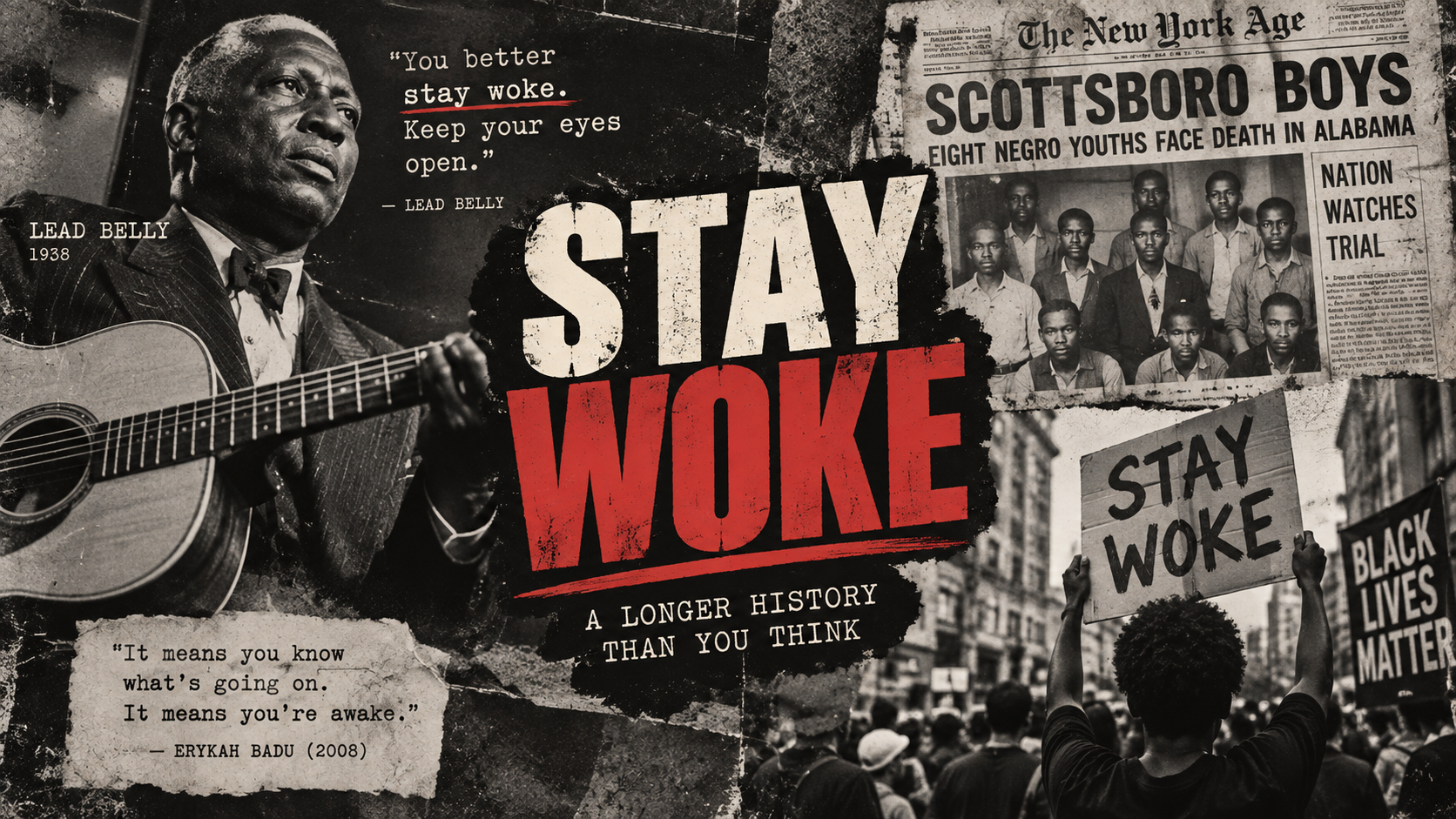
Stay awake.
Black American usage connected being “woke” with awareness, vigilance and understanding the world around you.
Lead Belly and Scottsboro.
Blues musician Lead Belly used “stay woke” while discussing the Scottsboro Boys case and the danger Black people faced travelling through Alabama.
Back into popular culture.
Erykah Badu’s Master Teacher helped return “I stay woke” to wider cultural circulation.
Ferguson and Black Lives Matter.
“Stay woke” became internationally associated with awareness of racism, policing and social injustice.
Strip away everything that happened afterwards and the original proposition isn’t particularly complicated:
ADD THREE LETTERS
Then Woke Became “Wokeism”
This is where things become more interesting.
Wokeism sounds like a formal ideology. Add -ism and suddenly it sounds as though there must be a doctrine, a manifesto and a membership card.
But there is no universally agreed political programme called Wokeism.
Instead, the label is commonly used by critics to bundle together a collection of sometimes related, sometimes very different ideas:
Some of those things overlap. Some don’t. Some contain perfectly legitimate ideas. Some policies implemented under those banners can be clumsy, contradictory or deserving of criticism.
But calling the entire collection wokeism doesn’t settle any of those arguments.
It avoids having them.
THE TEST
So, Is This Woke?
Let’s try the word against actual situations.
A child says an adult sexually abused them. We listen, investigate and put safeguarding procedures around them.
WOKE?A woman says her boss is sexually harassing her and expects the law to protect her.
WOKE?A disabled employee needs reasonable adjustments to access their workplace.
WOKE?A Black applicant shouldn’t be rejected because of the colour of his skin.
WOKE?Two men want their marriage recognised by the state on the same legal basis as everybody else’s.
WOKE?Once you strip the label away, these become questions about rights, evidence, fairness, safeguarding and where society draws boundaries.
Which is precisely what political discussion should have been about in the first place.
WHEN WOKE TAKES THE CREDIT AWAY
The Black Professor Problem
There is another use of the word that bothers me more.
A Black person reaches a position traditionally dominated by white people and somebody immediately reaches for an explanation:
Take Professor Jason Arday at Cambridge.
If somebody claims that a Black academic only obtained his position because of “wokeism”, that isn’t evidence. It’s a claim requiring evidence.
Was the position reserved for a Black applicant?
Were academic standards lowered?
Was a more qualified candidate rejected because of race?
Was positive action actually used in the appointment?
What evidence do you have?
Because otherwise something revealing has happened.
And that is where an accusation supposedly directed against racism can reproduce a very old racial assumption:
You couldn’t possibly have got there on merit.
BRITAIN ISN’T AMERICA
Affirmative Action? Not Quite.
British culture-war arguments routinely import American terminology. “Affirmative action” is one example.
In Great Britain, the Equality Act provides for positive action in particular circumstances. Employers can take proportionate measures to address disadvantage or underrepresentation.
There is also a limited recruitment provision that can allow a protected characteristic to be considered where candidates are as qualified as one another and the statutory conditions are met.
If you believe that happened in a particular appointment, demonstrate it.
Otherwise you’re not exposing a diversity appointment.
You’re assuming one.
AND THE LEFT DOESN’T GET A FREE PASS
Forget Woke. Is It True?
None of this means every position described as progressive is automatically correct.
That would simply replace one ideological shortcut with another.
The transgender debate demonstrates the problem particularly well. There are genuine disputes involving biological sex, gender identity, language, medicine, sport, prisons, safeguarding and single-sex spaces.
Those questions aren’t resolved by shouting woke. Nor are they resolved by declaring every disagreement transphobic.
“Men can have babies.”
A trans man who retains the reproductive anatomy required for pregnancy may be capable of becoming pregnant.
Whether society should routinely describe that biological reality using the phrase “men can have babies” is a question about definitions, identity and language.
Likewise, recognising transgender people doesn’t require pretending biological sex is irrelevant in every context.
You can support protections for transgender people while still believing that biological sex matters in particular circumstances.
You can agree with some of J.K. Rowling’s arguments about sex and disagree with others. You can support trans rights and still question a particular policy. None of those positions becomes true merely because somebody attaches the correct political label to it.
What is the claim? What is the evidence? What happens in practice? Which rights are actually competing? Where is the boundary being drawn?
Those questions are harder than shouting woke.
They are also considerably more useful.
THE SHORTCUT
When the Word Becomes the Argument
This is ultimately what bothers me about the modern use of woke.
It can become a substitute for completing the sentence.
Maybe the criticism survives those questions.
Sometimes it will.
A diversity programme can be badly designed. An institution can overcorrect. Language can become ridiculous. Policies designed with good intentions can produce bad outcomes. Competing rights can genuinely collide.
Fine.
Then criticise that.
Tell me which policy doesn’t work. Tell me which statistic is wrong. Tell me which right you think should take precedence. Tell me which institution has behaved unfairly.
Give me something that can actually be examined.
FACTS BEFORE TEAMS
I Don’t Need to Join Your Side
Maybe this is where I sit with all of it.
I don’t need every progressive idea to be correct because I support equality.
I don’t need every conservative criticism to be wrong because I disagree with much of the politics surrounding it.
And I don’t need to decide whether something is woke before deciding whether it makes sense.
Tell me what happened.
Tell me what was said.
Tell me what the policy actually does.
Tell me who gains.
Tell me who loses.
Tell me what the evidence says.
Then we can have an argument.
And if the evidence changes, the conclusion should be allowed to change with it.
THE IRONY
Perhaps We Should Have Stayed Woke
There is something almost perfect about what happened to this word.
A phrase associated with staying alert — with noticing what was happening around you — travelled through decades of Black American culture and eventually became an insult used in arguments where nobody seems particularly interested in defining what they’re talking about.
The original instruction was essentially:
Pay attention.
The modern insult can sometimes function as the opposite:
Don’t bother explaining it. It’s woke.
And perhaps that’s why the bloke from Essex stayed in my head.
Not because he used the word.
Because eventually the word seemed to be doing all the talking for him.