A Folder Full of Potential, a Country Short of Jobs
EMPLOYMENT SERIES PART 01
The National Record of Achievement asked young people to document what they could offer. But the country around them was losing industrial jobs and dismantling parts of its shared training system.
The folder did not cause those changes. Its story is revealing because it shows how much responsibility was being placed on individuals to make themselves employable, while the structures around training and work were changing.
01 THE FOLDER
A record of what you could offer
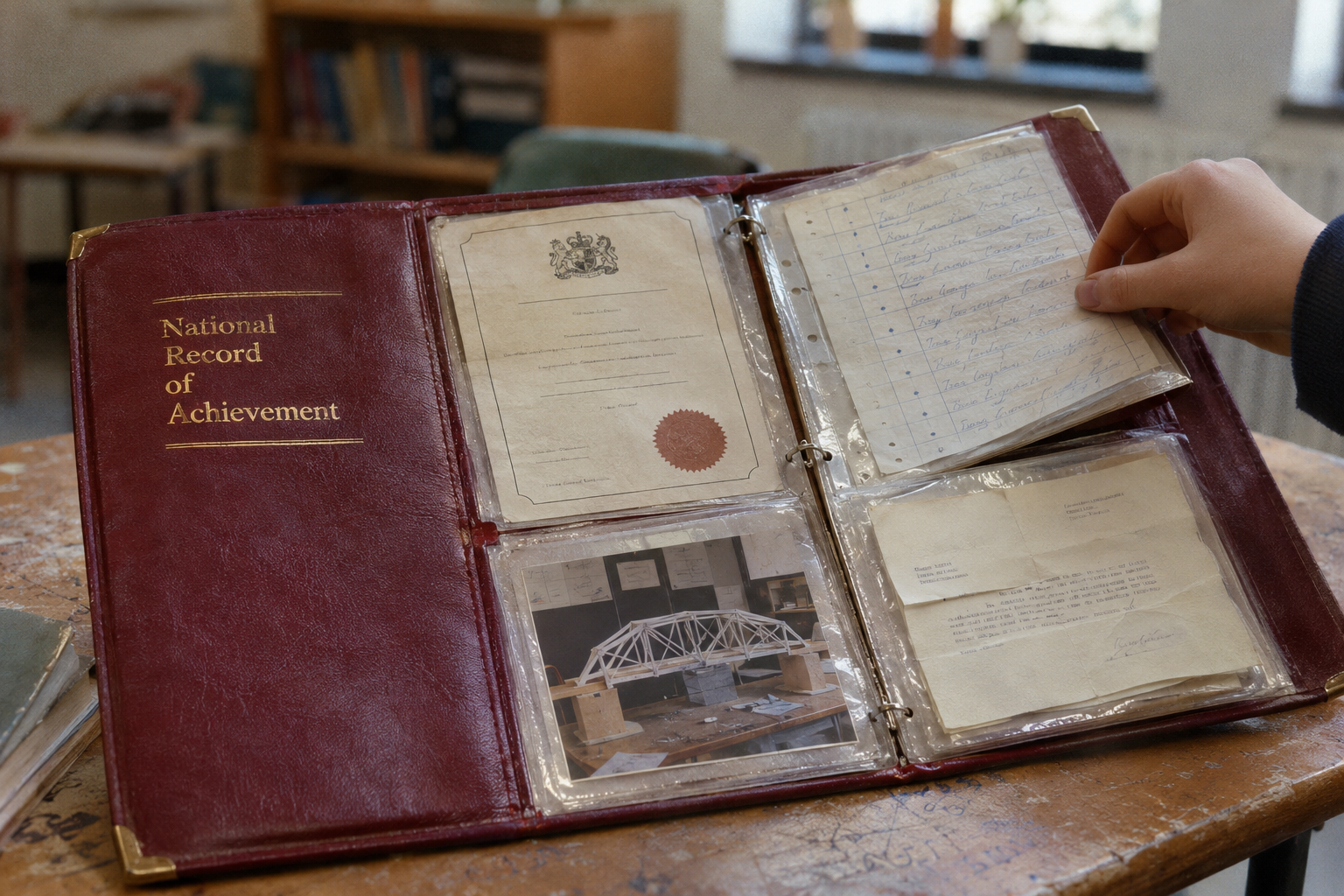
The National Record of Achievement arrived in a burgundy folder, usually with gold lettering and plastic wallets for certificates, reports and examples of work. Pupils were encouraged to record not only qualifications, but work experience, voluntary activity, personal qualities and ambitions.
The idea was appealing: give young people a way to show what they could do, including things that exams might miss. The folder was meant to travel with them into adult life, helping them explain their abilities to colleges, training providers and employers.
But its promise sits awkwardly beside the Britain in which it was introduced. Young people were being asked to document their potential at a time when the country was losing manufacturing jobs and reducing the reach of its industry-wide training institutions.
The folder did not cause those changes. Its story is revealing because it shows how much responsibility was being placed on individuals to make themselves employable, while the structures around training and work were changing.
02 WHO CAME UP WITH IT?
A Tory policy, with roots beyond one politician
The answer is more complicated than one politician simply inventing the folder. Records of achievement had been developed in schools and colleges before the national scheme. Their use was often local, including as a way to recognise work that conventional exams did not capture.
But the Conservative government made the idea national policy. In November 1983, Sir Keith Joseph, the Conservative Education Secretary, announced centrally supported pilot schemes. He said records should include academic and non-academic achievement and help pupils show qualities employers might value.
The political tension was already visible in that Commons debate. Labour MP Dennis Skinner challenged the emphasis on records while young people were worried about whether they would find jobs. Joseph’s response was that a record could help young people present their character and abilities to employers.
That exchange does not prove the scheme was designed to replace job creation. It does show two different ways of looking at the problem: one focused on whether enough work existed; the other on how young people could better present themselves for it.
In 1984, Joseph and the Welsh Secretary set out a policy for developing records of achievement across schools in England and Wales. Their stated aim was a national framework with room for local variation. The national folder itself was launched in February 1991 by the government.
THE POLICY CONTEXT
A short timeline
- The government announces that the number of Industrial Training Boards will fall from 23 to seven.
- Keith Joseph proposes centrally supported pilot schemes for records of achievement.
- A policy statement sets out plans for a national framework, with room for local variation.
- Parliament records a net fall of about 1.8 million manufacturing employees in Great Britain since 1979.
- The National Record of Achievement launches; by June, more than 1.3 million copies have been ordered.
- Reviews and employer research examine how well the record works beyond school.
03 THE CONTRADICTION
A folder full of potential, a country short of jobs
The NRA was launched as a record of what an individual had achieved and a tool for continuing their learning. That was a sensible aim. A young person might have useful skills, experience or commitments that did not show up in exam results.
The contradiction was in the scale of the promise. The folder could help someone describe their abilities. It could not create a vacancy, provide a training place or guarantee that an employer would recognise what was inside it.
At the same time, the government was reducing the coverage of the Industrial Training Boards. These bodies had helped organise and fund training across particular industries. In 1981, the government said their number would fall from 23 to seven, and that some sectors would rely on voluntary arrangements instead. That was a choice to move more responsibility for training towards employers and the arrangements they chose to make.
Then came the steep loss of manufacturing employment. Parliament’s figures show a net fall of about 1.8 million manufacturing employees in Great Britain between 1979 and 1985. The losses were spread across regions, including the West Midlands, Yorkshire and Humberside, the North West and the North.
Those changes should not be collapsed into one simple claim. The NRA was not a scheme to compensate for the loss of factories, and it was not the cause of the decline in industrial training. But they formed part of the same political period. One set of policies weakened or narrowed collective training arrangements; another asked individuals to keep a record of their own achievements and present them to the labour market.
That is where the folder starts to look less like a solution and more like a symbol. It placed faith in the young person’s ability to explain and improve themselves, even as the supply of jobs and the institutions that built skills were being reshaped around them.
04 EMPLOYERS AND THE FOLDER
Did employers use it?
I’m 43. I remember putting my National Record of Achievement together at school. And then, as far as work was concerned, I left it there.
I can’t remember ever bringing it to an employer. No one asked to see it. Not one employer.
That is my experience, not proof that nobody ever used theirs. But it sits alongside the findings of a 1997 Institute for Employment Studies survey of 487 employers. The researchers found that relatively few employers used the NRA, mainly those who regularly recruited young people. It could help as a discussion tool in an interview, but it generally had a limited role in selection and was rarely used to manage training and development. The report described it as peripheral to employers’ systems, rather than central to them.
So the folder could have been useful to an individual pupil. But for many of us, the promise that employers would want to see it never became part of working life. It stayed where it began: at school.
05 WHAT A RECORD CAN’T DO
A record can describe opportunity. It cannot supply it.
The National Record of Achievement was built around a decent idea: that young people have abilities and experiences worth recognising, and that not all achievement fits neatly onto an exam certificate.
The problem was asking a folder to do work that only employers, training institutions and government could do. It could record work experience, but not create a route into skilled employment. It could list certificates, but not replace a system that offered people sustained training. It could help a young person present themselves, but it could not make the labour market offer them a fair chance.
That was the deeper contradiction. The country issued young people a record of their potential while industrial employment was collapsing and shared training arrangements were being cut back. They were told to take responsibility for documenting their value. The question of who was responsible for building the opportunities around that value was harder to answer.
References and further reading
- House of Commons Hansard — Records of Achievement, 22 November 1983
- House of Commons Hansard — Policy statement on records of achievement, 17 July 1984
- House of Commons Hansard — Industrial Training Board reforms, 16 November 1981
- House of Commons Hansard — Manufacturing employment figures, 10 February 1988
- House of Commons Hansard — National Record of Achievement launch and orders, 11 June 1991
- Education and Training for the 21st Century — White Paper, 1991
- Dearing Review — The National Record of Achievement, 1996
- Institute for Employment Studies — Employers’ Use of the National Record of Achievement, 1997