Norway built a
system to keep it.
Oil created the opportunity. Rules, ownership and restraint turned it into durable national wealth.
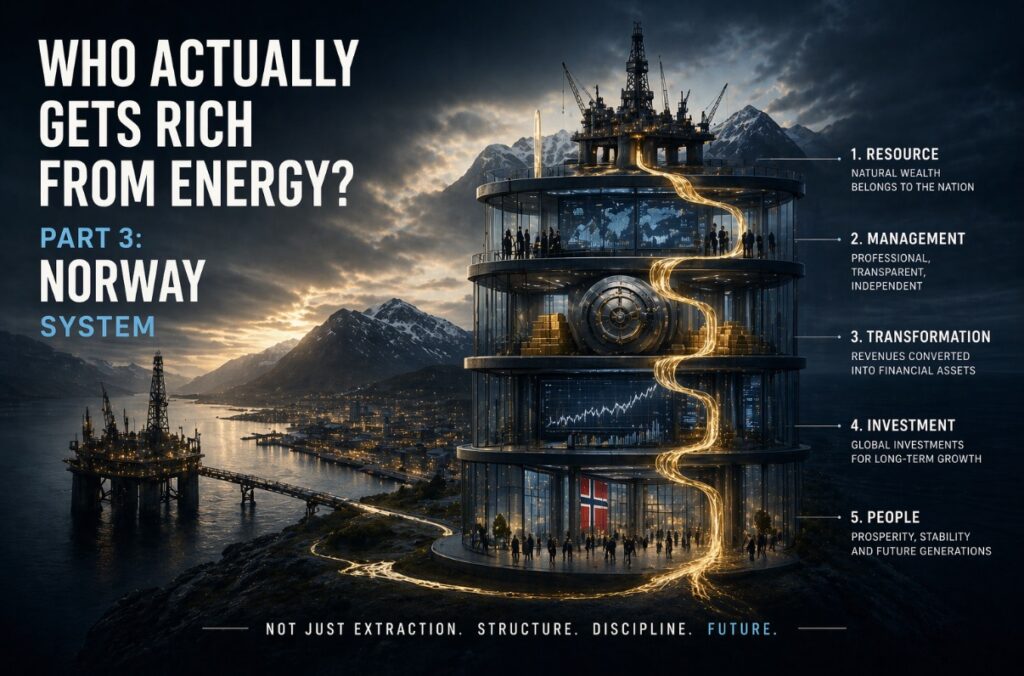
The resource was the same.
The architecture was not.
Saudi Arabia shows what happens when a state controls the system. Norway shows something else: what happens when a country deliberately builds one.
Norway discovered the giant Ekofisk field in 1969. It faced the same opportunity—and the same danger—as every country suddenly made resource-rich.
It could extract, sell and spend. It could also let a temporary boom distort the economy, concentrate power and create dependence on a single sector.
Norway did not avoid the resource curse by accident.
It designed around it.
Public capture.
Mixed operation.
Norway kept the state inside the value chain without making the state the only actor. Private firms and international expertise remained part of the sector—but on terms set by a public framework.
EQUINOR
The Norwegian state’s current shareholding.
DIRECT INTEREST
The state owns stakes in fields, pipelines and onshore facilities.
MARGINAL TAX
The combined marginal rate applied to petroleum profits.
EXPERTISE
Private and international operators still participate.
Current ownership and tax structure. Figures checked October 2026.
The strength is not one company.
It is the arrangement.
Commercial operation, regulation, ownership and political authority are connected—but not collapsed into one another. The state writes the rules, taxes exceptional returns, owns direct interests and receives dividends.
That separation matters. It makes the system less dependent on one minister, one company or one year’s oil price.
Do not spend the barrel.
Convert it.
Parliament created the legal foundation for the fund in 1990. The first transfer arrived in 1996. The principle was bigger than saving cash: turn a finite underground asset into a diversified financial asset held for current and future generations.
Spend the expected real return—not the capital.
Over time, transfers to the budget should follow the fund’s estimated real return. The present benchmark is around three per cent.
Temporary extraction.
Permanent capital.
By 30 June 2026, the Government Pension Fund Global was worth NOK 22.683 trillion. More than half of that value had come from investment returns—not direct government deposits.
Fund figures: Norges Bank Investment Management, as at 30 June 2026.
The country gets richer.
But the budget does not chase the price.
Higher petroleum prices can raise taxes, direct state income and dividends. The decisive step is what happens next: the net government cash flow is transferred to the fund, while budget use remains governed by Parliament and the fiscal rule.
For 2026, official estimates put net government cash flow from petroleum activities at roughly NOK 671 billion. The number can move. The architecture is designed not to move with it.
The hardest technology
is restraint.
Norway could have spent more, faster. Instead, it built a political convention around limits: save the principal, smooth withdrawals, invest abroad and keep operational investment decisions at arm’s length from day-to-day politics.
A resilient system
is not a perfect one.
Norway remains a major oil and gas exporter. Petroleum still shapes state revenue, exports and investment. The fund is exposed to global markets, currencies and political arguments over ethics, climate and risk.
The model does not remove contradiction. It changes who absorbs the value, how quickly it enters the economy and how long it can last.
Both capture wealth.
They capture it differently.
SAUDI ARABIA
- Concentrated ownership
- Direct state control
- Revenue funds transformation now
NORWAY
- Mixed operating system
- Layered public capture
- Revenue becomes capital over time
Energy wealth does not depend only on what a country owns—or how much it produces.