Ownership.
Control. Revenue.
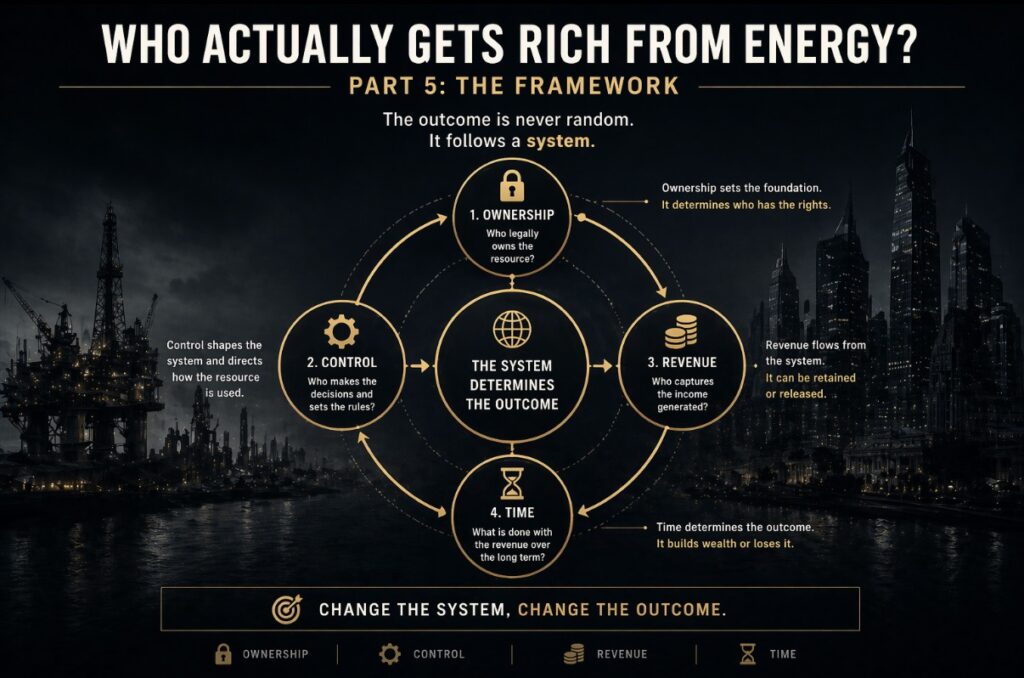
Four questions that show who benefits from energy—and what lasts after the resource is sold.
The cases were different.
The questions were the same.
Saudi Arabia shows concentrated state ownership and control. Norway shows how public participation, regulation and revenue management can work together. The United Kingdom shows a different pattern: Crown-owned resource rights, commercial operators and public revenue that flows into wider public finances.
Each system produces a different outcome. Those outcomes are not random. They follow a structure.
The resource creates value.
The system decides what becomes of it.
Three elements.
One system.
Ownership, control and revenue are the core variables. A fourth question follows: what happens to the money over time?
OWNERSHIP
Who owns the resource rights, the companies and the infrastructure?
CONTROL
Who sets the rules, makes the decisions and directs the operation?
REVENUE
Who receives the value, and how much reaches the public finances?
After revenue is captured, is it spent now, invested, distributed or preserved?
→Start with what
is actually owned.
Ownership is not one simple thing. A country can own the rights to oil and gas beneath its territory while commercial companies hold licences to explore and produce. The state may also own shares in a producer or hold direct interests in fields and infrastructure.
Separate the resource rights, the operating companies and the assets built around production. They can belong to different people and institutions.
Ownership does not
answer who decides.
Control determines how the system operates. Who awards licences? Who sets the conditions? Who regulates production? Who decides how the industry develops?
Control can be divided between governments, regulators, state-owned companies and private operators. A state can set the rules and capture value without running every operation itself.
The sale price is not
the public’s share.
Money generated by production is divided across costs, company profits, taxes, royalties, dividends, suppliers and shareholders. The government’s share depends on the fiscal rules and ownership arrangements, as well as prices, production and costs.
So distinguish the total value of energy sold from the revenue the state actually receives. Then ask what happens after that money reaches the public finances.
What happens
after the money arrives?
Captured revenue can support today’s spending, fund public investment, reduce debt or be saved in a dedicated fund. These choices shape whether resource income mainly supports current priorities or is also converted into assets for the future.
Norway’s Government Pension Fund Global was worth about NOK 21.3 trillion at the end of 2025. That value is not simply oil revenue put aside: it reflects petroleum contributions, investment returns and currency movements. The fund’s value makes the role of time visible.
Norwegian fund market value at 31 December 2025. Its value includes investment returns and foreign-exchange movements.
Three countries.
Three arrangements.
These are not simple rankings. Each case shows a different way ownership, control, revenue and time fit together.
Saudi Arabia
A state with a direct majority stake in its principal oil producer.
- OWNERSHIP
- The government held an 81.48% direct shareholding in Aramco in its 2025 annual report.
- CONTROL
- State ownership is central to the country’s oil system.
- REVENUE
- Public income includes the state’s shareholding returns and petroleum-related government receipts.
- TIME
- Revenue use and investment choices determine what lasts beyond production.
Norway
Public participation and commercial operation within a long-term framework.
- OWNERSHIP
- Direct state interests, including SDFI stakes, alongside a 67% shareholding in Equinor.
- CONTROL
- The state sets the framework; commercial companies carry out operations.
- REVENUE
- Taxes, SDFI cash flow and dividends provide multiple routes for public capture.
- TIME
- Petroleum revenues flow to the Government Pension Fund Global under a fiscal rule.
United Kingdom
Crown-owned petroleum rights, licensed commercial operators and tax revenue in the wider public finances.
- OWNERSHIP
- Petroleum rights are vested in the Crown; companies hold licences to explore and produce.
- CONTROL
- Public authorities license and regulate activity while firms operate fields.
- REVENUE
- Net oil and gas tax receipts were £4.5bn in 2024–25, down from £9.0bn in 2022–23.
- TIME
- Receipts flow into wider public finances rather than a dedicated UK petroleum fund.
UK oil and gas tax receipts are HMRC net cash receipts. They are not the total value of production or the full economic contribution of the sector.
A framework for
following value.
These questions can also help us examine mining, infrastructure, utilities and financial systems: who owns the assets, who sets the terms, who receives the income and what is preserved over time?
The details change from one sector to another. The questions help make the structure visible.
Energy creates value.
The system decides
who benefits—and what lasts.
Energy prices, household bills and who benefits when costs rise.
COMING NEXT →