Britain found the oil.
It did not build the fund.
North Sea wealth entered the Treasury, the market and the wider economy. What it did not become was a permanent national asset.
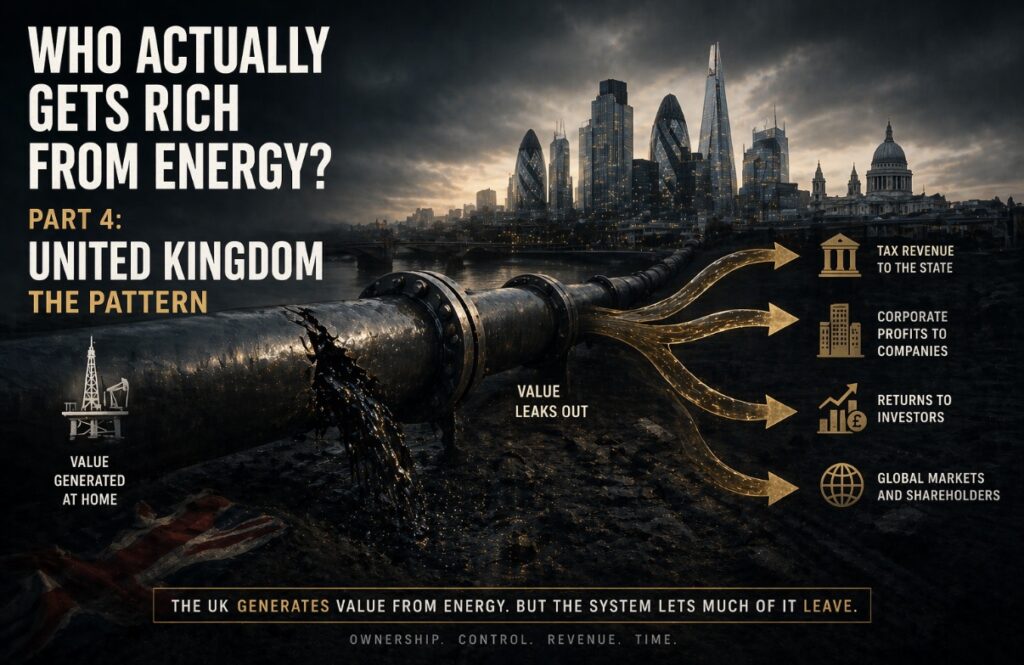
Same sea.
Different settlement.
Saudi Arabia shows control. Norway shows design. The United Kingdom shows what happens when a country captures income without building a durable system to hold the wealth.
Large North Sea discoveries arrived from the late 1960s into the 1970s. Britain had capital, engineering capability, stable institutions and a developed tax system. It did benefit—through jobs, investment, exports and public revenue.
The missed opportunity is not that Britain received nothing. It is that a finite national asset was never consistently converted into a permanent national balance sheet.
The oil was temporary.
The spending became ordinary.
Britain did build a state stake.
Then it dismantled it.
The story is more revealing than a simple claim that Britain always left oil to private companies. The 1975 Petroleum and Submarine Pipe-lines Act created the British National Oil Corporation—BNOC—to give the state a direct position in North Sea development.
That route did not last. The Oil and Gas (Enterprise) Act 1982 separated BNOC’s production business into Britoil. Britoil was then privatised in stages during the 1980s.
The British model therefore became a choice: the state would primarily license, regulate and tax extraction rather than remain a major long-term commercial owner.
Not no control.
A different kind of control.
The UK owns the resource in law and decides who may extract it. It sets licence terms, safety and environmental rules, and a ring-fenced tax regime for petroleum profits. Private operators make commercial production and investment decisions inside that framework.
That distinction matters. The state can collect a large share of profit without owning the operating company—but it receives less direct influence over commercial strategy, supply chains and the destination of corporate returns.
Britain taxed the boom.
It did not preserve the principal.
North Sea production has generated substantial public revenue through corporation tax, the supplementary charge, petroleum revenue tax in earlier periods, licence payments and—more recently—the Energy Profits Levy.
But those receipts were generally treated as current government income. They entered the public finances alongside other taxes and helped support the economy of the moment. Britain did not establish a Norway-style mechanism that automatically converted petroleum cash flow into a diversified national fund.
That does not mean every pound was wasted. It means the country never created a visible, protected asset showing what remained after the barrel had gone.
Official production and revenue series. Figures checked 17 October 2026.
The Treasury can gain.
The household can still lose.
Higher oil and gas prices can lift company profits and tax receipts. They can also raise energy costs across the economy. Those movements are not opposites: they are two outputs of the same internationally priced market.
Most UK-produced crude is traded into global markets. Domestic production therefore does not automatically create a protected domestic price. More extraction can affect supply, tax revenue and energy security; it does not create a simple route to cheaper bills.
The fund was never built.
Now the basin is smaller.
UK crude oil and natural-gas-liquids production fell to 30.4 million tonnes in 2024—far below the 1999 peak. Official projections expect continued decline as mature fields deplete.
Direct extraction employment also fell from around 38,000 in 2015 to 28,000 in 2024. The question is no longer only how to divide current petroleum income. It is whether skills, ports, engineering capacity and infrastructure can be carried into the next energy system.
Brexit did not cause the missed fund.
It reveals the same tension.
The decisive North Sea ownership and savings choices were made decades before the 2016 referendum. Brexit did not create Britain’s petroleum model, and it would be dishonest to write the history backwards.
It does, however, expose a related question: what is sovereignty worth without the structures that turn it into leverage? The UK left the EU’s internal energy arrangements and now manages electricity trading, interconnectors, carbon-market questions and security cooperation through a more negotiated relationship.
The Trade and Cooperation Agreement preserved energy cooperation. The 2025 UK–EU reset opened discussion about closer electricity-market participation. The issue is not whether Britain may set its own policy. It is whether autonomy, coordination and market access have been arranged to produce a better material outcome.
Sell the asset.
Tax the activity. Spend the flow.
This is the British pattern at its clearest: trust private capital to operate, use markets to allocate, and capture part of the value through taxation. It can mobilise investment and expertise quickly. It can also leave public wealth dependent on a volatile stream rather than a durable stock.
Commercial assets sit largely outside the state.
Licences, regulation and taxation shape private activity.
Receipts move with prices, profits and production.
No dedicated petroleum fund preserves the principal.
Same commodity.
Three architectures.
SAUDI ARABIA
- Concentrated ownership
- Direct state control
- Revenue funds transformation now
NORWAY
- Mixed operating system
- Layered public capture
- Revenue becomes capital
UNITED KINGDOM
- Private operation
- Capture through tax
- Revenue enters current spending
Britain did not fail to make money from the North Sea. It failed to make the money permanent.